<?xml version="1.0" encoding="utf-8"?><feed xmlns="http://www.w3.org/2005/Atom" ><generator uri="https://jekyllrb.com/" version="4.4.1">Jekyll</generator><link href="/feed.xml" rel="self" type="application/atom+xml" /><link href="/" rel="alternate" type="text/html" /><updated>2026-01-19T11:14:59+00:00</updated><id>/feed.xml</id><title type="html">ヘデラ</title><subtitle>hedera&amp;#39;s notebook</subtitle><author><name>C.L. © 2026</name></author><entry><title type="html">How to Set Up a Completely Private Instance of SearXNG-Docker</title><link href="/searxng" rel="alternate" type="text/html" title="How to Set Up a Completely Private Instance of SearXNG-Docker" /><published>2025-12-13T00:00:00+00:00</published><updated>2025-12-13T00:00:00+00:00</updated><id>/searxng</id><content type="html" xml:base="/searxng"><![CDATA[<p>A few months ago, I set up my own local SearXNG docker image and it’s honestly been one of the best decisions I’ve ever made for my machine. It’s a way to add a layer of privacy between you and all of the search engines you use. Not only can you avoid having a profile of you get built by companies who sell your data, but I find SearXNG also gives you a better user experience because it aggregates results from many different engines at once. It’s so much easier to find what you’re actually looking for when you use SearXNG.</p>

<h1 id="installing-docker">Installing Docker</h1>

<p>To get this to work, you must have docker installed. If you don’t, take care of that first before you complete any of the next steps.</p>

<p>On Arch Linux, it is as simple as running <code class="language-plaintext highlighter-rouge">sudo pacman -Syu docker</code>.</p>

<h1 id="installing-searxng-docker">Installing SearXNG-Docker</h1>

<p>All of these next steps are also available on the readme at <a href="https://github.com/searxng/searxng-docker">searxng-docker’s github repo.</a></p>

<p>To get searxng-docker on our machine, clone the git repo to <code class="language-plaintext highlighter-rouge">/usr/local</code> and navigate there.</p>

<div class="language-plaintext highlighter-rouge"><div class="highlight"><pre class="highlight"><code>cd /usr/local
git clone https://github.com/searxng/searxng-docker.git
cd searxng-docker
</code></pre></div></div>

<p>Generate the secret key with the following command, so you have a secret key in your <code class="language-plaintext highlighter-rouge">settings.yml</code>. You just have to run it, no need to edit the actual <code class="language-plaintext highlighter-rouge">settings.yml</code> file.</p>

<div class="language-plaintext highlighter-rouge"><div class="highlight"><pre class="highlight"><code>sed -i "s|ultrasecretkey|$(openssl rand -hex 32)|g" searxng/settings.yml
</code></pre></div></div>

<p>Now just run <code class="language-plaintext highlighter-rouge">docker compose up -d</code> and you should be able to see your SearXNG instance at <code class="language-plaintext highlighter-rouge">http://localhost:8080</code>.</p>

<h1 id="configuring-the-searxng-instance-for-use-with-https">Configuring the SearXNG Instance For Use With HTTPS</h1>

<p>Setting <code class="language-plaintext highlighter-rouge">http://localhost:8080</code> to be the default search engine in Firefox doesn’t work. Firefox seems to correctly identify SearXNG’s OpenSearch plugin, but searches cannot be completed with the address bar or through other interfaces except directly through the search bar while you are already on the page <code class="language-plaintext highlighter-rouge">http://localhost:8080</code>. It seems that Firefox doesn’t allow such pages to be implemented as a search engine. To fix this, we must serve SearXNG over HTTPS.</p>

<h2 id="install-and-setting-up-mkcert">Install and Setting Up mkcert</h2>

<p>mkcert is a tool for making locally-trusted development certificates. I can install it via pacman with <code class="language-plaintext highlighter-rouge">sudo pacman -Syu mkcert</code>.</p>

<p>For install instructions on other platforms, you should see the readme at <a href="https://github.com/FiloSottile/mkcert">mkcert’s github repo.</a></p>

<p>Then run <code class="language-plaintext highlighter-rouge">mkcert -install</code> to set up a local certificate authority.</p>

<h2 id="generating-certs-to-use-with-searxng">Generating Certs to Use with SearXNG</h2>

<p>If you aren’t already in <code class="language-plaintext highlighter-rouge">/usr/local/searxng-docker</code>, cd there and then run</p>

<div class="language-plaintext highlighter-rouge"><div class="highlight"><pre class="highlight"><code>mkcert localhost
</code></pre></div></div>

<p>mkcert should then give you two files called <code class="language-plaintext highlighter-rouge">localhost.pem</code> and <code class="language-plaintext highlighter-rouge">localhost-key.pem</code>. Put these two files in <code class="language-plaintext highlighter-rouge">/usr/local/searxng-docker/certs</code> (you will have to create this directory). <strong>DO NOT share these keys. Keep them private.</strong></p>

<p>You do not actually have to name the certificate “localhost.” If you want to use a fake domain name like “mysearch.test” you can do this by editing <code class="language-plaintext highlighter-rouge">/etc/hosts</code> and adding the line</p>

<div class="language-plaintext highlighter-rouge"><div class="highlight"><pre class="highlight"><code>127.0.0.1 mysearch.test
</code></pre></div></div>

<h2 id="configuring-caddyfile">Configuring Caddyfile</h2>

<p>Now open your Caddyfile. Add these four lines of code below the first block:</p>

<div class="language-plaintext highlighter-rouge"><div class="highlight"><pre class="highlight"><code>https://localhost {
	tls /certs/localhost.pem /certs/localhost-key.pem
	reverse_proxy searxng:8080
}
</code></pre></div></div>

<p>Make sure the <code class="language-plaintext highlighter-rouge">tls</code> line points to the location of the <code class="language-plaintext highlighter-rouge">.pem</code> files you just generated.</p>

<p>Then replace</p>

<div class="language-plaintext highlighter-rouge"><div class="highlight"><pre class="highlight"><code># SearXNG
reverse_proxy localhost:8080
</code></pre></div></div>

<p>with</p>

<div class="language-plaintext highlighter-rouge"><div class="highlight"><pre class="highlight"><code># SearXNG
reverse_proxy searxng:8080
</code></pre></div></div>

<h2 id="configuring-docker-composeyaml">Configuring docker-compose.yaml</h2>

<p>Now open your <code class="language-plaintext highlighter-rouge">docker-compose.yaml</code>. Replace the entire <code class="language-plaintext highlighter-rouge">caddy:</code> block with this</p>

<div class="language-plaintext highlighter-rouge"><div class="highlight"><pre class="highlight"><code>  caddy:
    container_name: caddy
    image: docker.io/library/caddy:2-alpine
    depends_on:
      - searxng
    restart: unless-stopped
    networks:
      - searxng # &lt;-- Attach to searxng
    ports:
      - "127.0.0.1:443:443" # &lt;-- Map localhost port 443 to container port 443
    volumes:
      - ./Caddyfile:/etc/caddy/Caddyfile:ro
      - ./certs:/certs:ro  # &lt;-- Your mkcert certs go here
      - caddy-data:/data:rw
      - caddy-config:/config:rw
    environment:
      - SEARXNG_HOSTNAME=${SEARXNG_HOSTNAME:-localhost}
      - SEARXNG_TLS=${LETSENCRYPT_EMAIL:-internal}
    logging:
      driver: "json-file"
      options:
        max-size: "1m"
        max-file: "1"
</code></pre></div></div>

<p>Effectively, we are mapping the localhost port 443 to the container port 443. You can change the host port (e.g., “8443:443”) to avoid conflicts. We also add a line to volumes so that caddy can see the certs we generated with mkcerts.</p>

<p>Now navigate down to the <code class="language-plaintext highlighter-rouge">searxng:</code> block. Replace the entire thing with this:</p>

<div class="language-plaintext highlighter-rouge"><div class="highlight"><pre class="highlight"><code>  searxng:
    container_name: searxng
    image: docker.io/searxng/searxng:latest
    restart: unless-stopped
    networks:
      - searxng
    expose:
      - "8080"  # &lt;-- Internal only
    volumes:
      - ./searxng:/etc/searxng:rw
      - searxng-data:/var/cache/searxng:rw
    environment:
      - SEARXNG_BASE_URL=https://${SEARXNG_HOSTNAME:-localhost}/ # &lt;-- The base URL is modified
    logging:
      driver: "json-file"
      options:
        max-size: "1m"
        max-file: "1"
</code></pre></div></div>

<p>This makes port 8080 available only to other containers on the Docker network and not the host. No one else on the network has access to SearXNG.</p>

<p>Now run:</p>
<div class="language-plaintext highlighter-rouge"><div class="highlight"><pre class="highlight"><code>docker compose restart caddy
docker compose restart searxng
</code></pre></div></div>

<p>We can now access SearXNG via Caddy at <code class="language-plaintext highlighter-rouge">https://localhost</code> and use this local instance as our search engine in Firefox!</p>

<h1 id="extra-making-this-work-with-ublacklist">EXTRA: Making This Work With uBlacklist</h1>

<p>uBlacklist is a Firefox addon that lets you add “blacklists,” or lists of sites that you don’t want showing up in your search results. It’s also available for Chrome, but using Chrome defeats the purpose of configuring SearXNG in the first place. Don’t use Chrome with this.</p>

<p>The default implementation of uBlacklist supports SearXNG, but only through a list of publically available instances in its SERPINFO list. That means uBlacklist cannot see your private instance of SearXNG.</p>

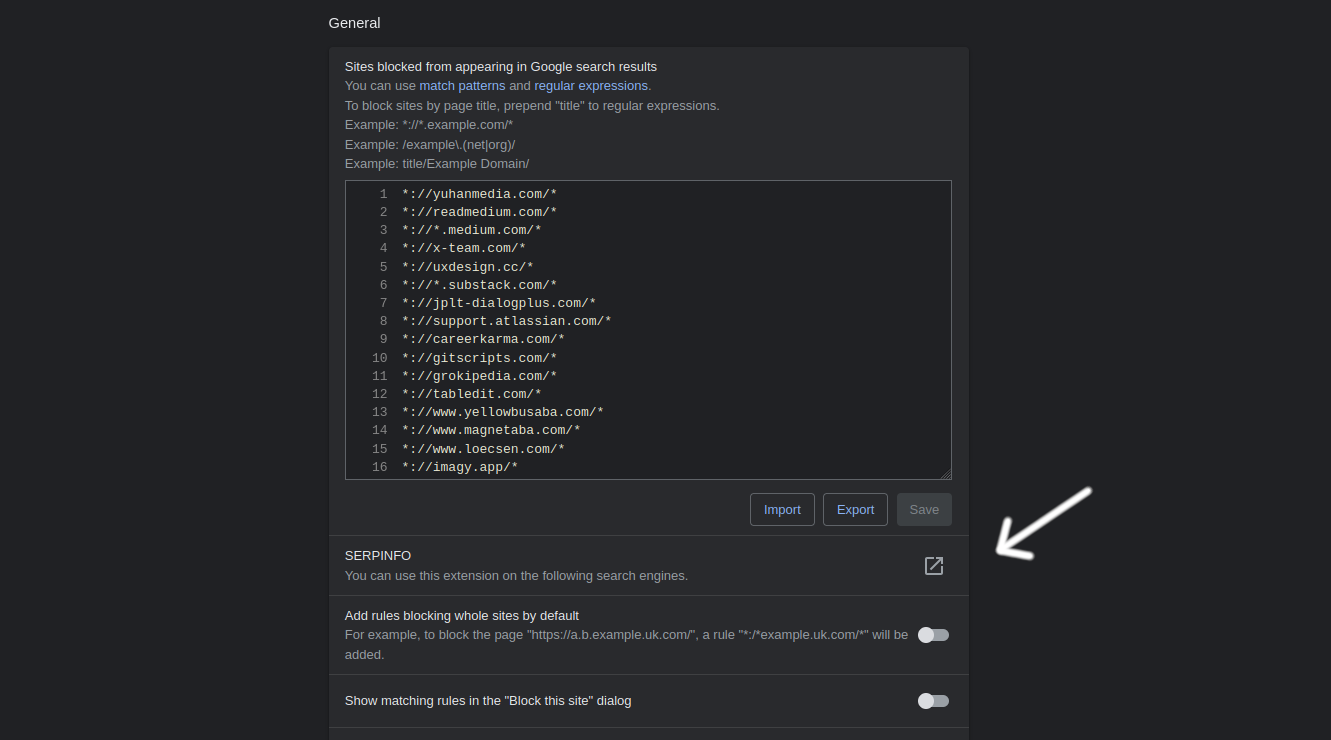
<p>To fix this, go to the extension’s Options page. Under “General”, click “SERPINFO”.</p>

<p><img src="../assets/img/serpinfo.png" alt="image" /></p>

<p>Then under “My SERPINFO”, add the following code:</p>

<div class="language-plaintext highlighter-rouge"><div class="highlight"><pre class="highlight"><code>name: SearXNG
homepage: https://github.com/ublacklist/builtin#readme

pages:
  - name: All
    includeRegex: "/search(\\?|$)"
    results:
      - root: .category-general
        url: a
        props:
          title: h3
          $category: [const, "web"]
      - root: .category-images
        url: .result-url &gt; a
        props:
          title: .title
          $category: [const, "images"]
      - root: .category-videos
        url: a
        props:
          title: h3
          $category: [const, "videos"]
      - root: .category-news
        url: a
        props:
          title: h3
          $category: [const, "news"]
    commonProps:
      $site: searx # backwards compatibility
    matches:
     - https://localhost/*
</code></pre></div></div>

<p>You should be able to use SearXNG with uBlacklist now. If you’re not using “localhost” as your domain name, you need to change the last line to match it.</p>]]></content><author><name>hedera</name></author><category term="journal" /><category term="linux" /><category term="searxng" /><category term="search engine" /><category term="search" /><category term="searx" /><summary type="html"><![CDATA[A few months ago, I set up my own local SearXNG docker image and it’s honestly been one of the best decisions I’ve ever made for my machine. It’s a way to add a layer of privacy between you and all of the search engines you use. Not only can you avoid having a profile of you get built by companies who sell your data, but I find SearXNG also gives you a better user experience because it aggregates results from many different engines at once. It’s so much easier to find what you’re actually looking for when you use SearXNG.]]></summary><media:thumbnail xmlns:media="http://search.yahoo.com/mrss/" url="/%5B%22ilovesearxng.png%22%5D" /><media:content medium="image" url="/%5B%22ilovesearxng.png%22%5D" xmlns:media="http://search.yahoo.com/mrss/" /></entry><entry><title type="html">Youtube Addiction</title><link href="/youtube-addiction" rel="alternate" type="text/html" title="Youtube Addiction" /><published>2025-10-24T00:00:00+00:00</published><updated>2025-10-24T00:00:00+00:00</updated><id>/youtube-addiction</id><content type="html" xml:base="/youtube-addiction"><![CDATA[<p>I have a problem with youtube. I watch so much of it and I rarely feel like what I’m watching is fulfilling. Sometimes I find myself in the middle of a video essay on a subject I don’t care about, or an educational video teaching something which I’m certain I won’t remember tomorrow. Why did I even click on this in the first place? What made me think that this would be a good use of my time?</p>

<h2 id="youtube-is-not-as-useful-as-i-once-thought-it-was">Youtube Is Not As Useful As I Once Thought It Was</h2>

<p>It’s been like this for over 13 years for me. The number of times I’ve sat down to eat with youtube probably vastly outnumbers the times I’ve sat to eat without it. But I’ve only started to recognize this as a huge problem recently. I was somewhat aware about how much time I’d spend on youtube, but I never viewed it as something detrimental. After all, youtube has shaped my political inclinations, helped me study for school, given me hobbies and interests, and introduced me to so much great art over the years.</p>

<p>In the online language learning community, there’s a pervasive idea about how we acquire language called the input hypothesis, which linguist Stephen Krashen originally wrote about. Put simply, it’s the idea that second language acquisition can be sped up by focusing your study on “input”: consuming material in the target language that involves reading and listening. This contrasts with studying through “output”, the process of writing and speaking. This is the theory behind how I structured my study routine with Japanese, and I’d say it’s been highly successful at getting me to a proficient level.</p>

<p>Why do I bring this up? An earlier tendency among the community that I’ve seen is to completely avoid output, effectively taking a vow of silence in their target language to focus exclusively on listening and reading media in the language they are studying. In fact, I was one of people that subscribed to this application of the hypothesis. The idea behind this practice is that output will come naturally to you once you have achieved a certain stage of proficiency in understanding the language through input. You would get the benefit of streamlining your learning process and avoid developing an accent in the target language. At some point in my studies, I had consumed so much Japanese media that I had a vocabulary of roughly 13,000 words, passed the JLPT N1, and could understand almost everything in everyday Japanese. Which made it all the more embarrassing that <strong>I was not even conversational</strong> at that point in time.</p>

<p>What actually helped me start to output? Starting to output. Not more input. It’s the only way you’re ever going to get used to doing it. It’s true that input is the only thing that teaches you actually understand the language, but neglecting to output during your learning journey comes with a risk. You can become uncomfortable and anxious with outputting, and you may start to associate outputting with the feeling of failure; which is what I experienced.</p>

<p>This is applicable not only to language learning, but to youtube as well. The act of watching a youtube video is analogous to immersing yourself in “input.” Actually, it’s not just analogous, because watching a youtube video in your target language <em>is</em> a way of getting input. I can watch a hundred videos of baseball games, but that won’t make me a pro baseball player. Youtube offers possibly the biggest library of art in the entire world. Has spending over a decade of my life religiously watching this art made me a better artist? No. Input is useful because it allows you to form your own mental model, a “deeper understanding” of the subject you are immersing in. When it comes to putting this mental model into practice, the only way you can improve your skill is not by further developing your mental model, but by <strong>doing</strong>.</p>

<h2 id="the-addictive-side-of-youtube">The Addictive Side of YouTube</h2>

<p>Okay, so I can reason my way out of over-consuming educational/informational youtube content. Maybe on some subconscious level, I understand that the next video I want to click on is not necessarily going to inform me. But the reason I get the urge to watch youtube isn’t because I’m consciously seeking knowledge, or something like that. Sometimes, I see the thumbnail and title of another video and it doesn’t even look all that interesting…</p>

<p>So why do I click on it?</p>

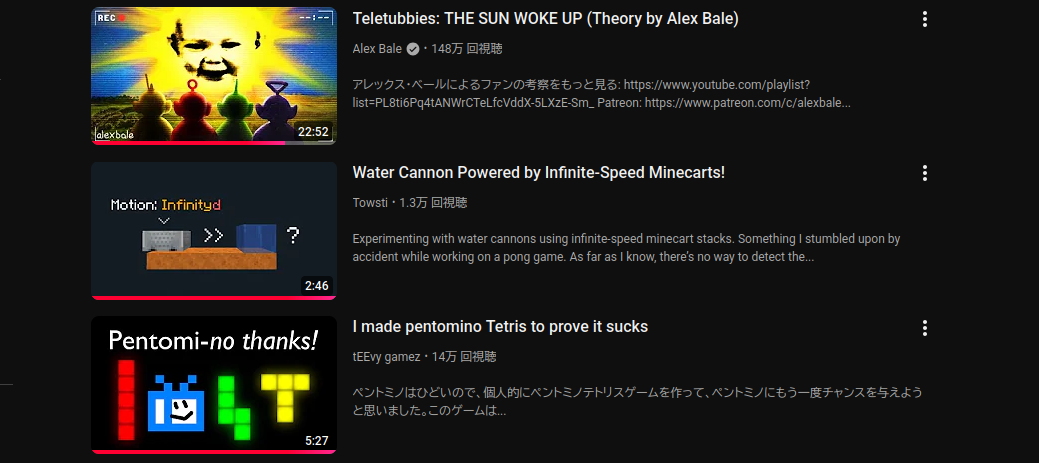
<p><img src="/assets/img/ythistory.png" alt="Some examples of my youtube history" /></p>

<p>Here are some recent videos in my youtube history. All three of these videos are ones I remember watching on my tablet in bed before going to sleep just yesterday. At that time, if I took a step back, just a second, to think about what the content of these videos could be, I probably wouldn’t have clicked on them. No hate to any of these creators, but it’s easy to say in hindsight that these videos were a waste of my time, with which I probably could have spent getting some well-needed sleep. I don’t play survival Minecraft or Tetris, and I don’t even know why the hell I decided to watch that video on Teletubbies. The problem here isn’t that I made a bad decision “choosing” to spend my time watching these videos, but in a sense, it’s that I didn’t really make that decision at all. Sometimes I click on videos because I want to have it on in the background while I look for a more interesting video to watch. Sometimes a thumbnail grabs my attention and I just click on it without thinking about anything at all, like what the video could be about or whether I’m even interested in what the thumbnail presents. Sometimes it’s because of that stupid autoplay feature that somehow keeps turning itself on.</p>

<p>It feels like there are a lot of features in youtube’s UI and algorithm that interfaces with my brain and makes it turn off. Some things that come to mind are:</p>

<ol>
  <li>The way the algorithm is so responsive to videos that you have recently watched.</li>
  <li>Videos playing as a preview within the thumbnail, something that can’t be disabled at all in the mobile app.</li>
  <li>Its infinite scrolling nature and the recommended section (you never “run out” of videos).</li>
  <li>Picture-in-picture (playing videos in the corner while you look at recommendations).</li>
  <li>The gutting of features that encourage interpersonal interaction, like private messaging and video responses.</li>
  <li>The algorithm’s tendency to fixate on categories of videos that have mass appeal (movie/TV scenes, podcast content, clickbait).</li>
  <li>The algorithm’s tendency to fixate on videos with overly long run times (video essays).</li>
  <li>Youtube shorts and autoplay.</li>
</ol>

<p>I found youtube shorts so egregious that I have an extension to block them entirely on desktop and I jailbroke my tablet to get them off of the mobile app. But not all of these “features” that I listed can be avoided so easily. Most are baked into the system and can only be avoided by not using youtube at all.</p>

<h1 id="solutions">Solutions?</h1>

<p>For the better part of a year or two now, I have been looking for ways to better manage my “relationship” with youtube so I don’t end up wasting time there. Most have come in the form of extensions that limit screen time or certain features features on youtube. These can be site-specific, browser-wide, or system-wide.</p>

<h3 id="unhook">Unhook</h3>

<p><a href="https://unhook.app/">Unhook</a> is a browser extension that lets you hide your recommendations, youtube shorts, your home feed, and a bunch of other stuff. I have found that its effectiveness is largely dependent on your own willpower. It does work to make youtube much less engaging, so you might find yourself spending a lot less time there, but it is incredibly easy to toggle youtube features back on, especially if you’re feeling particularly tempted one day or are just inattentive to your own discipline like me. In my experience, I would turn the home feed back on and leave it like that for days or weeks, before I eventually become cognizant again about how much time I’m wasting on youtube and turning it off again. And then, the cycle would repeat…</p>

<p>I have to say, though, that this is my favorite extension out of all the ones I am about to introduce, and it’s the only one I haven’t completely abandoned.</p>

<h3 id="leechblock-ng">LeechBlock NG</h3>

<p><a href="https://www.proginosko.com/leechblock/">LeechBlock NG</a> is another browser extension which lets you set limits for yourself for websites of your choice, before locking you out of the site. You can set limits depending on the day of the week or the time of day. In my experience, this one, also, is only as effective as your discipline is strong. You can set a long, complicated password to the options page that configures this extension to deter you from removing your own limits, but typing in this password is trivial. I got used to typing in the password so much that it was like the password didn’t exist at all.</p>

<h3 id="the-screen-time-setting-on-ios">The Screen Time Setting on iOS</h3>

<p>If you use an iPhone/iPad, you probably know this one. It is laughably ineffective. It literally gives you a button to bypass the limit you set for yourself once you hit it. Maybe if you have the self-discipline of a Buddhist monk, you will find this setting useful. But for me, it just turned into an minor annoyance incredibly quickly that didn’t deter me from using youtube at all.</p>

<h3 id="others-configuration-based-strategies">Others Configuration-Based Strategies</h3>

<ul>
  <li>Setting youtube or your entire desktop to black-and-white. This is possible with LeechBlock NG, or various Windows/Linux software. It’s supposed to limit your dopamine response or something.</li>
  <li><a href="https://dearrow.ajay.app/">DeArrow</a>, an extension that removes clickbait thumbnails and video titles.</li>
  <li>Tuning recommendations. You can somewhat influence youtube recommendations by clicking the three dots under the video thumbnail and clicking “Not Interested” or “Don’t Recommend Channel.”</li>
</ul>

<p>I have found all of these configuration-based strategies to be ineffective in my case, but I go into some amount of detail here in case any of you reading think this might work for you. All of these rely on the user’s own discipline, expecting them not to roll back limitations or settings they have set for themselves to reduce their youtube usage. Tuning recommendations doesn’t work very well since youtube will always sneak uninteresting or addictive videos back into your feed.</p>

<p>A more extreme config-based strategy to limit youtube usage I have heard about is setting youtube.com to <code class="language-plaintext highlighter-rouge">127.0.0.1</code> in your <code class="language-plaintext highlighter-rouge">/etc/hosts</code> file. This effectively blocks your computer from talking with youtube’s IP entirely. I have never tried this so I don’t know how effective it is, but it seems like it would be harder to self-sabotage yourself, since “turning it off” isn’t as simple as toggling a button in a UI.</p>

<h1 id="the-actual-answer">The Actual Answer</h1>

<p>You have to <strong>hate</strong> youtube.</p>

<p>Over time, I have come to realize just how much time this site has robbed from me. Sure, youtube has introduced me to good art, niche communities, and even shaped my personality. But then I think about how it’s still possible for me to have come into contact with these things I enjoy even if I had never interacted with youtube in the first place. I may have even discovered much more art and become much more learned if I had spent time reading books instead, as I used to before I started habitually using this site. Youtube has made so many horrendous changes to its site ever since I started using it in 2011, making it more addictive in the name of driving engagement. Why should I stick with it?</p>

<p>I can’t expect myself to be happier just by installing a browser extension and calling it a day. To solve my youtube addiction, I have realized that I must change my entire mindset. The only strategy that has worked for me is to <strong>adopt this hostile attitude towards youtube, and replace the time you would have spent watching youtube with something that truly fulfills you</strong>. These two points are key. So much so that I will say them again.</p>

<ol>
  <li>You must feel a visceral disgust with the algorithm and the design that makes youtube what it is. Realize how it has wronged you. Demand its apology.</li>
  <li>Have in mind what you would like to do with the time you have, now free of the suffocating grasp of the algorithm. Maybe try writing it down. When you feel the urge to watch youtube, do it.</li>
</ol>

<p>For me, some of the fulfilling things that I try to do instead of watch youtube are: reading, practicing coding, consuming Japanese media, and browsing the Internet Archive.</p>

<p>Perhaps this blog post is a bit premature, since just yesterday I found myself mindlessly scrolling in bed on my tablet again. But I’m enthusiastic because changing my mindset is the only solution that has actually worked to decrease the amount of time I spend on youtube. In essence, you need to remove the temptation you feel in the first place. About a month ago, I deleted the youtube app from my phone. I intend to keep it that way, and I have not experienced a real urge to reinstall it. I haven’t deleted the app from my tablet or blocked it on my desktop computer, because part of me is scared to quit youtube cold-turkey. The idea has been in the back of my mind ever since I read <a href="https://www.sophiajt.com/youtube-addiction-one-month-sober/">this blog post by SophiaJT</a>, who actually did quit outright. Every day, this idea seems more and more doable.</p>

<p>For those of you reading this that are struggling with the same problem I have been struggling with, I sympathize with you. I hope you will join me in this journey of getting better.</p>]]></content><author><name>hedera</name></author><category term="journal" /><category term="youtube" /><category term="addiction" /><category term="personal" /><summary type="html"><![CDATA[I have a problem with youtube. I watch so much of it and I rarely feel like what I’m watching is fulfilling. Sometimes I find myself in the middle of a video essay on a subject I don’t care about, or an educational video teaching something which I’m certain I won’t remember tomorrow. Why did I even click on this in the first place? What made me think that this would be a good use of my time?]]></summary></entry><entry><title type="html">珠算数字フォント | Abacus Number Font</title><link href="/abacus-font" rel="alternate" type="text/html" title="珠算数字フォント | Abacus Number Font" /><published>2025-09-14T00:00:00+00:00</published><updated>2025-09-14T00:00:00+00:00</updated><id>/abacus-font</id><content type="html" xml:base="/abacus-font"><![CDATA[<style>
    @font-face {
      font-family: "abacus5";
      src: url("assets/files/abacus5.ttf") format("truetype");
      font-weight: normal;
      font-style: normal;
      font-display: swap;
    }

    table.abacus-font {
      font-family: "Abacus5", system-ui, -apple-system, "Segoe UI", Roboto, "Helvetica Neue", Arial;
      font-size: 25px;
      line-height: 1.8;
      text-align: right !important;
    }
  </style>

<p>珠算で使われている数字に模したフォントを配布します。 <a href="https://kappa88.com/garakuta/%E7%84%A1%E6%96%99%E3%81%9D%E3%82%8D%E3%81%B0%E3%82%93%E6%95%B0%E5%AD%97%E3%82%A2%E3%83%90%E3%82%AB%E3%82%B9%E3%83%95%E3%82%A9%E3%83%B3%E3%83%88">伊藤そろばん教室</a> の”abacus2”をベースにして作りました。 自由に使ってくださいね!</p>

<p>This number font is designed to look like the one used in abacus math exams in Japan. It is adapted from “abacus2” by <a href="https://kappa88.com/garakuta/%E7%84%A1%E6%96%99%E3%81%9D%E3%82%8D%E3%81%B0%E3%82%93%E6%95%B0%E5%AD%97%E3%82%A2%E3%83%90%E3%82%AB%E3%82%B9%E3%83%95%E3%82%A9%E3%83%B3%E3%83%88">伊藤そろばん教室</a>.</p>

<h2 id="sample">Sample:</h2>

<table class="abacus-font" border="1">
<tr><td style="text-align: right;">86,155<br />268,547<br />-91,233<br />-905,319<br />25,661<br />301,887<br />933,469<br />-75,994</td></tr>
<tr><th style="color: #111; text-align: right;">543,173</th></tr>
</table>

<p style="font-size: 2em; line-height: 1.3em; text-align: center;">
   <a href="/assets/files/abacus5.ttf">
      .ttf のダウンロードはこちら!<br />Download the .ttf here! (226.6 KiB)<br />
   </a>
</p>]]></content><author><name>hedera</name></author><category term="journal" /><category term="soroban" /><category term="abacus" /><category term="そろばん" /><category term="font" /><category term="算盤" /><summary type="html"><![CDATA[]]></summary><media:thumbnail xmlns:media="http://search.yahoo.com/mrss/" url="/%5B%22sorobanfont.png%22%5D" /><media:content medium="image" url="/%5B%22sorobanfont.png%22%5D" xmlns:media="http://search.yahoo.com/mrss/" /></entry><entry><title type="html">Glossary of Pronunciations of Botanical Terms</title><link href="/latin-pronunciation-ac" rel="alternate" type="text/html" title="Glossary of Pronunciations of Botanical Terms" /><published>2025-03-10T00:00:00+00:00</published><updated>2025-03-10T00:00:00+00:00</updated><id>/latin-pronunciation-ac</id><content type="html" xml:base="/latin-pronunciation-ac"><![CDATA[<style>

.alphabet-links {
  display: flex;
  flex-wrap: wrap;
  gap: 10px;
  padding: 10px;
  background-color: #fff;
  border-radius: 10px;
  box-shadow: 0 4px 8px rgba(0, 0, 0, 0.1);
  text-align: center;
  justify-content: center;
}

.alphabet-links a {
  text-decoration: none;
  color: #111;
  font-size: 1.3em;
  font-weight: bold;
  padding: 4px;
  width: 1em;
  border: 2px solid #111;
  border-radius: 5px;
  transition: all 0.3s ease;
}

.alphabet-links a:hover {
  background-color: #111;
  color: #fff;
}

.alphabet-links a:focus {
  outline: none;
  background-color: #555;
  color: #fff;
}

.table-container {
    display: flex;
    gap: 0px;
    flex-wrap: wrap;
    align-items: flex-start;
}

.side-by-side {
  border-collapse: collapse;
  box-shadow: 0 4px 8px rgba(0, 0, 0, 0.1);
  border-radius: 8px;
  overflow: hidden;
  font-size: 0.90em;
  
}

.side-by-side th {
  padding: 5px;
  text-align: left;
}

.side-by-side td {
  padding: 5px;
  border-bottom: 1px solid #ddd;
}

details {
  margin-bottom: 10px;
  background-color: #111;
  border: 1px solid #ddd;
  border-radius: 5px;
  box-shadow: 0 2px 4px rgba(0, 0, 0, 0.1);
}

summary {
  padding: 10px;
  font-weight: bold;
  cursor: pointer;
  background-color: #333;
  color: #fff;
  border-radius: 5px;
}

summary:hover {
  background-color: #555;
}
</style>

<p>This is a collection of pronunciations of that are most canonically correct according to the principles of the <a href="https://en.wikipedia.org/wiki/Traditional_English_pronunciation_of_Latin">traditional English pronunciation of Latin</a>. This pronunciation system survives to this day in the way we say many words derived from Latin. For example, “error,” “area,” “cicada,” “martyr,” “species,” and “genius.”</p>

<p>Species epithets will be given in the feminine form by default.</p>

<p>Pronunciations with asterisks are irregular to the principles of traditional pronunciation. This happens because they derive from names/words of languages other than Greek or Latin, or because the pronunciation has become standardized.</p>

<div class="collapsible-table">
    <details>
      <summary>View Respelling Pronunciation Guide</summary>
      <br />
<div class="table-container">
    <table class="side-by-side">
      <thead>
        <tr>
          <th>Written</th>
          <th>Example</th>
          <th>IPA</th>
        </tr>
      </thead>
      <tbody>
        <tr>
          <td>a</td>
          <td>c<b>a</b>t</td>
          <td>/æ/</td>
        </tr>
        <tr>
          <td>ay</td>
          <td>d<b>ay</b></td>
          <td>/eɪ/</td>
        </tr>
        <tr>
          <td>air</td>
          <td>h<b>air</b></td>
          <td>/ɛər/</td>
        </tr>
        <tr>
          <td>ah</td>
          <td>f<b>a</b>ther</td>
          <td>/ɑː/</td>
        </tr>
        <tr>
          <td>ahr</td>
          <td><b>ar</b>m</td>
          <td>/ɑːr/</td>
        </tr>
        <tr>
          <td>e</td>
          <td>l<b>e</b>t</td>
          <td>/ɛ/</td>
        </tr>
        <tr>
          <td>ee</td>
          <td>s<b>ee</b></td>
          <td>/iː/</td>
        </tr>
        <tr>
          <td>ier</td>
          <td>h<b>ere</b></td>
          <td>/ɪər/</td>
        </tr>
      </tbody>
    </table>
    <table class="side-by-side">
      <thead>
        <tr>
          <th>Written</th>
          <th>Example</th>
          <th>IPA</th>
        </tr>
      </thead>
      <tbody>
        <tr>
          <td>i</td>
          <td>p<b>i</b>t</td>
          <td>/ɪ/, /ᵻ/</td>
        </tr>
        <tr>
          <td>igh</td>
          <td>b<b>y</b></td>
          <td>/aɪ/</td>
        </tr>
        <tr>
          <td>o</td>
          <td>p<b>o</b>t</td>
          <td>/ɒ/</td>
        </tr>
        <tr>
          <td>oh</td>
          <td>n<b>o</b></td>
          <td>/oʊ/</td>
        </tr>
        <tr>
          <td>aw</td>
          <td>c<b>augh</b>t</td>
          <td>/ɔː/</td>
        </tr>
        <tr>
          <td>or</td>
          <td>n<b>or</b>th</td>
          <td>/ɔːr/</td>
        </tr>
        <tr>
          <td>oy</td>
          <td>n<b>oi</b>se</td>
          <td>/ɔɪ/</td>
        </tr>
        <tr>
          <td>uu</td>
          <td>t<b>oo</b>k</td>
          <td>/ʊ/</td>
        </tr>
      </tbody>
</table>
<table class="side-by-side">
      <thead>
        <tr>
          <th>Written</th>
          <th>Example</th>
          <th>IPA</th>
        </tr>
      </thead>
      <tbody>
        <tr>
          <td>oor</td>
          <td>t<b>our</b></td>
          <td>/ʊər/</td>
        </tr>
        <tr>
          <td>oo</td>
          <td>s<b>oo</b>n</td>
          <td>/uː/</td>
        </tr>
        <tr>
          <td>ow</td>
          <td><b>ou</b>t</td>
          <td>/aʊ/</td>
        </tr>
        <tr>
          <td>u</td>
          <td>c<b>u</b>t</td>
          <td>/ʌ/</td>
        </tr>
        <tr>
          <td>ur</td>
          <td>w<b>or</b>d</td>
          <td>/ɜːr/, /ər/</td>
        </tr>
        <tr>
          <td>uh</td>
          <td><b>a</b>bout</td>
          <td>/ə/</td>
        </tr>
        <tr>
          <td>yoo</td>
          <td>v<b>iew</b></td>
          <td>/juː/</td>
        </tr>
      </tbody>
    </table>
</div>
<p style="padding:0 1em; margin-top:0;">Syllables with both primary and secondary stress are capitalized in the respelling. Primary stress always comes after the secondary stress.</p>
    </details>
</div>

<div class="collapsible-table">
    <details>
      <summary>Notes on Botanical Rank Suffixes</summary>
      <br />
<p style="padding:0 1em; margin-top:0;">The International Code of Nomenclature for algae, fungi, and plants prescribes some suffixes for names according to the taxonomic rank they represent, shown in the first table.</p>
<p style="padding:0 1em; margin-top:0;">The other two tables show more common suffixes found in botanical Latin. For suffixes that don't contain a stress, the primary stress of the full word falls on the syllable immediately before the suffix. There are some exceptions to the stress pattern of Greek-derived words that happen to have these suffixes.</p>
<div class="table-container" style="justify-content: center; grid-template-columns: minmax(300px, 600px);">
     <table class="side-by-side">
      <thead>
        <tr>
          <th>Rank</th>
          <th>Written</th>
          <th>Pronounced</th>
        </tr>
      </thead>
      <tbody>
        <tr>
          <td>Division</td>
          <td>-phyta</td>
          <td>-fi-tuh</td>
        </tr>
        <tr>
          <td>Class</td>
          <td>-opsida</td>
          <td>-OP-si-duh</td>
        </tr>
        <tr>
          <td>Subclass</td>
          <td>-idae</td>
          <td>-i-dee</td>
        </tr>
        <tr>
          <td>Order</td>
          <td>-ales</td>
          <td>-AY-leez</td>
        </tr>
        <tr>
          <td>Subrder</td>
          <td>-ineae</td>
          <td>-I-nee-ee</td>
        </tr>
        <tr>
          <td>Family</td>
          <td>-aceae</td>
          <td>-AY-see-ee</td>
        </tr>
        <tr>
          <td>Subfamily</td>
          <td>-oideae</td>
          <td>-OY-dee-ee</td>
        </tr>
        <tr>
          <td>Tribe</td>
          <td>-eae</td>
          <td>-ee-ee</td>
        </tr>
        <tr>
          <td>Subtribe</td>
          <td>-inae</td>
          <td>-i-nee</td>
        </tr>
      </tbody>
    </table>
     <table class="side-by-side">
      <thead>
        <tr>
          <th>Written</th>
          <th>Pronounced</th>
        </tr>
      </thead>
      <tbody>
        <tr>
          <td>-ago</td>
          <td>-AY-goh</td>
        </tr>
        <tr>
          <td>-ana</td>
          <td>-AY-nuh</td>
        </tr>
        <tr>
          <td>-anthemum</td>
          <td>-AN-thi-muhm</td>
        </tr>
        <tr>
          <td>-ata</td>
          <td>-AY-tuh (mostly)</td>
        </tr>
        <tr>
          <td>-bilis</td>
          <td>-bi-lis</td>
        </tr>
        <tr>
          <td>-carpa</td>
          <td>-KAHR-puh</td>
        </tr>
        <tr>
          <td>-cola</td>
          <td>-kuh-luh<br />-koh-luh</td>
        </tr>
        <tr>
          <td>-ella</td>
          <td>-E-luh</td>
        </tr>
        <tr>
          <td>-ensis</td>
          <td>-EN-sis</td>
        </tr>
        </tbody>
</table>
<table class="side-by-side">
      <thead>
        <tr>
          <th>Written</th>
          <th>Pronounced</th>
        </tr>
      </thead>
      <tbody>
        <tr>
          <td>-fera</td>
          <td>-fur-uh</td>
        </tr>
        <tr>
          <td>-flora</td>
          <td>-FLOR-uh</td>
        </tr>
        <tr>
          <td>-ia</td>
          <td>-ee-uh</td>
        </tr>
        <tr>
          <td>-ie</td>
          <td>-ee-ee</td>
        </tr>
        <tr>
          <td>-ites</td>
          <td>-IGH-teez</td>
        </tr>
        <tr>
          <td>-ium</td>
          <td>-ee-uhm</td>
        </tr>
        <tr>
          <td>-lepis</td>
          <td>-li-pis</td>
        </tr>
        <tr>
          <td>-meles</td>
          <td>-MEE-leez</td>
        </tr>
        <tr>
          <td>-opsis</td>
          <td>-OP-sis</td>
        </tr>
        <tr>
          <td>-osa</td>
          <td>-OH-suh</td>
        </tr>
        <tr>
          <td>-phylla</td>
          <td>-FI-luh</td>
        </tr>
        <tr>
          <td>-pogon</td>
          <td>-POH-gon</td>
        </tr>
        <tr>
          <td>-sperma</td>
          <td>-SPER-muh</td>
        </tr>
        <tr>
          <td>-stachys</td>
          <td>-stuh-kis</td>
        </tr>
        <tr>
          <td>-stemon</td>
          <td>-STEE-muhn</td>
        </tr>
        <tr>
          <td>-tricha</td>
          <td>-tri-kuh</td>
        </tr>
        <tr>
          <td>-uus</td>
          <td>-yoo-uhs</td>
        </tr>
      </tbody>
    </table>
</div>
<p style="padding:0 1em; margin-top:0;">Certain endings are always pronounced the same way in traditional English pronunciation.</p>
    <table class="side-by-side">
      <thead>
        <tr>
          <th>Written</th>
          <th>Pronounced</th>
        </tr>
      </thead>
      <tbody>
        <tr>
          <td>-a</td>
          <td>-uh</td>
        </tr>
        <tr>
          <td>-ae</td>
          <td>-ee</td>
        </tr>
        <tr>
          <td>-as</td>
          <td>-uhs</td>
        </tr>
        <tr>
          <td>-at</td>
          <td>-at</td>
        </tr>
        <tr>
          <td>-e</td>
          <td>-ee</td>
        </tr>
        <tr>
          <td>-es</td>
          <td>-eez</td>
        </tr>
        <tr>
          <td>-i</td>
          <td>-igh</td>
        </tr>
        <tr>
          <td>-ies</td>
          <td>-eez</td>
        </tr>
        <tr>
          <td>-ii</td>
          <td>-ee-igh</td>
        </tr>
        <tr>
          <td>-o</td>
          <td>-oh</td>
        </tr>
        <tr>
          <td>-os</td>
          <td>-os (but -ohs for the accusative plural)</td>
        </tr>
        <tr>
          <td>-u</td>
          <td>-yoo</td>
        </tr>
        <tr>
          <td>-y</td>
          <td>-igh</td>
        </tr>
      </tbody>
</table>
    </details>
</div>

<div class="alphabet-links">
    <a href="#A">A</a>
    <a href="#B">B</a>
    <a href="#C">C</a>
    <a href="#D">D</a>
    <a href="#E">E</a>
    <a href="#F">F</a>
    <a href="#G">G</a>
    <a href="#H">H</a>
    <a href="#I">I</a>
    <a href="#J">J</a>
    <a href="#K">K</a>
    <a href="#L">L</a>
    <a href="#M">M</a>
    <a href="#N">N</a>
    <a href="#O">O</a>
    <a href="#P">P</a>
    <a href="#Q">Q</a>
    <a href="#R">R</a>
    <a href="#S">S</a>
    <a href="#T">T</a>
    <a href="#U">U</a>
    <a href="#V">V</a>
    <a href="#W">W</a>
    <a href="#X">X</a>
    <a href="#Y">Y</a>
    <a href="#Z">Z</a>
  </div>

<p><br /></p>

<div class="table-container">
    <table class="side-by-side">
      <thead>
        <tr id="A" class="anchor">
          <th>A</th>
          <th>Pronunciation</th>
        </tr>
      </thead>
      <tbody>
        <tr>
          <td>Aa</td>
          <td>AH*<br />AY-uh?</td>
        </tr>
        <tr>
          <td>Abeliophyllum</td>
          <td>uh-BEE-lee-oh-FI-lum</td>
        </tr>
        <tr>
          <td>Abelmoschus</td>
          <td>AY-bel-MOS-kuhs</td>
        </tr>
        <tr>
          <td>Abies</td>
          <td>AY-beez</td>
        </tr>
        <tr>
          <td>Abronia</td>
          <td>uh-BROH-nee-uh</td>
        </tr>
        <tr>
          <td>Abrus</td>
          <td>AY-bruss</td>
        </tr>
        <tr>
          <td>Abutilon</td>
          <td>uh-BYOO-ti-lon</td>
        </tr>
        <tr>
          <td>Acacia</td>
          <td>uh-KAY-shuh</td>
        </tr>
        <tr>
          <td>Acaena</td>
          <td>uh-SEE-nuh</td>
        </tr>
        <tr>
          <td>Acalypha</td>
          <td>A-kuh-LIGH-fuh</td>
        </tr>
        <tr>
          <td>Acampe</td>
          <td>uh-KAM-pee</td>
        </tr>
        <tr>
          <td>Acanthaceae</td>
          <td>A-kuhn-THAY-see-ee<br />A-kan-THAY-see-ee</td>
        </tr>
        <tr>
          <td>Acanthocereus</td>
          <td>uh-KAN-thoh-SIER-ee-uhs</td>
        </tr>
        <tr>
          <td>Acantholimon</td>
          <td>uh-KAN-thoh-LIGH-muhn<br />uh-KAN-thoh-LIGH-mon</td>
        </tr>
        <tr>
          <td>Acanthophoenix</td>
          <td>uh-KAN-thoh-FEE-niks</td>
        </tr>
        <tr>
          <td>Acanthostachys</td>
          <td>A-kuhn-THO-stuh-kis</td>
        </tr>
        <tr>
          <td>Acanthus</td>
          <td>uh-KAN-thuhs</td>
        </tr>
        <tr>
          <td>Acca</td>
          <td>A-kuh</td>
        </tr>
        <tr>
          <td>Acer</td>
          <td>AY-sur</td>
        </tr>
        <tr>
          <td>Achillea</td>
          <td>A-ki-LEE-uh</td>
        </tr>
        <tr>
          <td>Achimenes</td>
          <td>A-ki-MEE-neez?<br />uh-KI-mi-neez?</td>
        </tr>
        <tr>
          <td>Achlys</td>
          <td>AK-lis</td>
        </tr>
        <tr>
          <td>Acineta</td>
          <td>A-si-NEE-tuh</td>
        </tr>
        <tr>
          <td>Aciphylla</td>
          <td>A-si-FI-luh</td>
        </tr>
        <tr>
          <td>Acis</td>
          <td>AY-sis</td>
        </tr>
        <tr>
          <td>Acoelorraphe</td>
          <td>A-se-LO-ruh-fee</td>
        </tr>
        <tr>
          <td>Acokanthera</td>
          <td>A-koh-kan-THIER-uh?<br />uh-KO-kan-THIER-uh?</td>
        </tr>
        <tr>
          <td>Aconitum</td>
          <td>A-kuh-NIGH-tuhm</td>
        </tr>
        <tr>
          <td>Acoraceae</td>
          <td>A-kuh-RAY-see-ee</td>
        </tr>
        <tr>
          <td>Acorus</td>
          <td>A-kuh-ruhs</td>
        </tr>
        <tr>
          <td>Acradenia</td>
          <td>A-kruh-DEE-nee-uh</td>
        </tr>
        <tr>
          <td>Acrocomia</td>
          <td>A-kruh-KOH-mee-uh</td>
        </tr>
        <tr>
          <td>Acronychia</td>
          <td>A-kruh-NI-kee-uh</td>
        </tr>
        <tr>
          <td>Acrophylluma</td>
          <td>A-kruh-FI-luhm</td>
        </tr>
        <tr>
          <td>Actaea</td>
          <td>ak-TEE-uh</td>
        </tr>
        <tr>
          <td>Actinidia</td>
          <td>AK-ti-NI-dee-uh</td>
        </tr>
        <tr>
          <td>Acrophylluma</td>
          <td>A-kruh-FI-luhm</td>
        </tr>
        <tr>
          <td>Adenanthera</td>
          <td>A-di-nan-THIER-uh</td>
        </tr>
        <tr>
          <td>Adenia</td>
          <td>uh-DEE-nee-uh</td>
        </tr>
        <tr>
          <td>Adenium</td>
          <td>uh-DEE-nee-uhm</td>
        </tr>
        <tr>
          <td>Adenocarpus</td>
          <td>A-di-noh-KAHR-puhs</td>
        </tr>
        <tr>
          <td>Adenostoma</td>
          <td>A-di-NO-stuh-muh</td>
        </tr>
        <tr>
          <td>Adiantum</td>
          <td>A-dee-AN-tuhm</td>
        </tr>
        <tr>
          <td>Adonis</td>
          <td>uh-DOH-nis</td>
        </tr>
        <tr>
          <td>Adoxa</td>
          <td>uh-DOK-suh</td>
        </tr>
        <tr>
          <td>Adoxaceae</td>
          <td>A-dok-SAY-see-ee</td>
        </tr>
        <tr>
          <td>Adromischus</td>
          <td>A-droh-MIS-kuhs</td>
        </tr>
        <tr>
          <td>Aechmea</td>
          <td>ek-MEE-uh</td>
        </tr>
        <tr>
          <td>Aegilops</td>
          <td>E-ji-lops</td>
        </tr>
        <tr>
          <td>Aegle</td>
          <td>EE-glee</td>
        </tr>
        <tr>
          <td>Aegopodium</td>
          <td>E-goh-POH-dee-uhm</td>
        </tr>
        <tr>
          <td>Aeollanthus</td>
          <td>EE-uh-LAN-thuhs</td>
        </tr>
        <tr>
          <td>Aeonium</td>
          <td>ee-OH-nee-uhm</td>
        </tr>
        <tr>
          <td>Aerangis</td>
          <td>e-RAN-jis</td>
        </tr>
        <tr>
          <td>Aeranthes</td>
          <td>AY-ur-AN-theez</td>
        </tr>
        <tr>
          <td>Aerides</td>
          <td>ay-IER-i-deez</td>
        </tr>
        <tr>
          <td>Aeschynanthus</td>
          <td>ES-ki-NAN-thuhs</td>
        </tr>
        <tr>
          <td>Aesculus</td>
          <td>ES-kyoo-luhs</td>
        </tr>
        <tr>
          <td>aestiva</td>
          <td>ES-ti-vuh</td>
        </tr>
        <tr>
          <td>Aethionema</td>
          <td>EE-thee-oh-NEE-muh</td>
        </tr>
        <tr>
          <td>Aethusa</td>
          <td>e-TH(Y)OO-zuh<br /></td>
        </tr>
        <tr>
          <td>Aframomum</td>
          <td>A-fruh-MOH-muhm</td>
        </tr>
        <tr>
          <td>Agapanthus</td>
          <td>A-guh-PAN-thuhs</td>
        </tr>
        <tr>
          <td>Agapetes</td>
          <td>A-guh-PEE-teez</td>
        </tr>
        <tr>
          <td>Agastache</td>
          <td>uh-GAS-tuh-kee</td>
        </tr>
        <tr>
          <td>Agathis</td>
          <td>A-guh-thihs</td>
        </tr>
        <tr>
          <td>Agave</td>
          <td>uh-GAY-vee<br />uh-GAW-vay*</td>
        </tr>
        <tr>
          <td>Ageratina</td>
          <td>uh-JUR-uh-TIGH-nuh</td>
        </tr>
        <tr>
          <td>Ageratum</td>
          <td>uh-JUR-uh-tuhm</td>
        </tr>
        <tr>
          <td>Aglaia</td>
          <td>uh-GLAY-uh</td>
        </tr>
        <tr>
          <td>Aglaonema</td>
          <td>uh-GLAY-oh-NEE-muh</td>
        </tr>
        <tr>
          <td>Agonis</td>
          <td>uh-GOH-nis</td>
        </tr>
        <tr>
          <td>Agoseris</td>
          <td>uh-GO-si-ris</td>
        </tr>
        <tr>
          <td>Agrimonia</td>
          <td>A-gri-MOH-nee-uh</td>
        </tr>
        <tr>
          <td>Agrostemma</td>
          <td>A-groh-STE-muh</td>
        </tr>
        <tr>
          <td>Agrostis</td>
          <td>uh-GROS-tis</td>
        </tr>
        <tr>
          <td>Aichryson</td>
          <td>ay-KRIGH-suhn<br />ay-KRIGH-son</td>
        </tr>
        <tr>
          <td>Ailanthus</td>
          <td>ay-LAN-thuhs</td>
        </tr>
        <tr>
          <td>Aiphanes</td>
          <td>AY-fuh-neez</td>
        </tr>
        <tr>
          <td>Aira</td>
          <td>AY-ruh</td>
        </tr>
        <tr>
          <td>Aizoaceae</td>
          <td>AY-zoh-AY-see-ee</td>
        </tr>
        <tr>
          <td>Aizoon</td>
          <td>ay-ZOH-on<br />ay-ZOH-uhn</td>
        </tr>
        <tr>
          <td>Ajania</td>
          <td>uh-JAY-nee-uh</td>
        </tr>
        <tr>
          <td>Ajuga</td>
          <td>uh-JOO-guh<br />A-joo-guh</td>
        </tr>
        <tr>
          <td>Akebia</td>
          <td>uh-KE-bee-uh<br />uh-KEE-bee-uh</td>
        </tr>
        <tr>
          <td>Alangium</td>
          <td>uh-LAN-jee-uhm</td>
        </tr>
        <tr>
          <td>Albuca</td>
          <td>al-BYOO-kuh</td>
        </tr>
        <tr>
          <td>Alcea</td>
          <td>AL-see-uh</td>
        </tr>
        <tr>
          <td>Alchemilla</td>
          <td>AL-ki-MI-luh</td>
        </tr>
        <tr>
          <td>Aletris</td>
          <td>uh-LEE-tris</td>
        </tr>
        <tr>
          <td>Aleurites</td>
          <td>A-lyoor-IGH-teez</td>
        </tr>
        <tr>
          <td>Alisma</td>
          <td>uh-LIZ-muh</td>
        </tr>
        <tr>
          <td>Alismataceae</td>
          <td>uh-LIZ-muh-TAY-see-ee</td>
        </tr>
        <tr>
          <td>Alkanna</td>
          <td>al-KA-nuh</td>
        </tr>
        <tr>
          <td>Alliaria</td>
          <td>A-lee-AIR-ee-uh</td>
        </tr>
        <tr>
          <td>Allium</td>
          <td>A-lee-uhm</td>
        </tr>
        <tr>
          <td>Alnus</td>
          <td>AL-nuhs</td>
        </tr>
        <tr>
          <td>Alocasia</td>
          <td>A-luh-KAY-zh(ee-)uh<br />A-luh-KAY-zee-uh</td>
        </tr>
        <tr>
          <td>Aloe</td>
          <td>A-loh-ee<br />A-loh</td>
        </tr>
        <tr>
          <td>Aloinopsis</td>
          <td>A-loh-i-NOP-sis</td>
        </tr>
        <tr>
          <td>Alopecurus</td>
          <td>uh-LO-pi-KYOOR-uhs</td>
        </tr>
        <tr>
          <td>Alseuosmia</td>
          <td>AL-syoo-OZ-mee-uh</td>
        </tr>
        <tr>
          <td>Alternanthera</td>
          <td>AL-tur-nan-THIER-uh</td>
        </tr>
        <tr>
          <td>Althaea</td>
          <td>al-THEE-uh</td>
        </tr>
        <tr>
          <td>Alyogyne</td>
          <td>A-lee-O-ji-nee</td>
        </tr>
        <tr>
          <td>Alyssum</td>
          <td>uh-LI-suhm</td>
        </tr>
        <tr>
          <td>Amaranthus</td>
          <td>A-muh-RAN-thuhs</td>
        </tr>
        <tr>
          <td>Amaryllis</td>
          <td>A-muh-RI-lis</td>
        </tr>
        <tr>
          <td>Amborella</td>
          <td>AM-buh-RE-luh</td>
        </tr>
        <tr>
          <td>Amborellaceae</td>
          <td>AM-buh-ri-LAY-see-ee</td>
        </tr>
        <tr>
          <td>Ambrosia</td>
          <td>am-BROH-zh(ee-)uh<br />am-BROH-zee-uh</td>
        </tr>
        <tr>
          <td>Amelanchier</td>
          <td>A-mi-LAN-shier</td>
        </tr>
        <tr>
          <td>Ammi</td>
          <td>A-migh</td>
        </tr>
        <tr>
          <td>Ammocharis</td>
          <td>uh-MO-kuh-ris</td>
        </tr>
        <tr>
          <td>Ammophila</td>
          <td>uh-MO-fi-luh</td>
        </tr>
        <tr>
          <td>Amomum</td>
          <td>uh-MOH-muhm</td>
        </tr>
        <tr>
          <td>Amomyrtus</td>
          <td>A-muh-MUR-tuhs</td>
        </tr>
        <tr>
          <td>Amorpha</td>
          <td>uh-MOR-fuh</td>
        </tr>
        <tr>
          <td>Amorphophallus</td>
          <td>uh-MOR-foh-FA-luhs</td>
        </tr>
        <tr>
          <td>Anacampseros</td>
          <td>A-nuh-KAMP-suh-ros</td>
        </tr>
        <tr>
          <td>Anacamptis</td>
          <td>A-nuh-KAMP-tis</td>
        </tr>
        <tr>
          <td>Anacardia</td>
          <td>A-nuh-KAHR-dee-uh</td>
        </tr>
        <tr>
          <td>Anacardiaceae</td>
          <td>A-nuh-KAHR-dee-AY-see-ee</td>
        </tr>
        <tr>
          <td>Anacyclus</td>
          <td>uh-NA-si-kluhs<br />A-nuh-SIGH-kluhs</td>
        </tr>
        <tr>
          <td>Anagyris</td>
          <td>A-nuh-JIGH-ris</td>
        </tr>
        <tr>
          <td>Ananas</td>
          <td>uh-NAY-nuhs<br />A-nuh-nuhs</td>
        </tr>
        <tr>
          <td>Anaphalis</td>
          <td>uh-NA-fuh-lis</td>
        </tr>
        <tr>
          <td>Anastatica</td>
          <td>A-nuh-STA-ti-kuh</td>
        </tr>
        <tr>
          <td>Anchusa</td>
          <td>an-KYOO-zuh</td>
        </tr>
        <tr>
          <td>Andromeda</td>
          <td>an-DRO-mi-duh</td>
        </tr>
        <tr>
          <td>Andropogon</td>
          <td>AN-droh-POH-gon</td>
        </tr>
        <tr>
          <td>Androsace</td>
          <td>an-DRO-suh-see</td>
        </tr>
        <tr>
          <td>Anemone</td>
          <td>uh-NE-muh-nee</td>
        </tr>
        <tr>
          <td>Anethum</td>
          <td>uh-NEE-thuhm</td>
        </tr>
        <tr>
          <td>Angelica</td>
          <td>an-JE-li-cuh</td>
        </tr>
        <tr>
          <td>Anethum</td>
          <td>uh-NEE-thuhm</td>
        </tr>
        <tr>
          <td>Angophora</td>
          <td>an-GO-fuh-ruh</td>
        </tr>
        <tr>
          <td>Angraecum</td>
          <td>an-GREE-kuhm</td>
        </tr>
        <tr>
          <td>Ania</td>
          <td>uh-NIGH-uh</td>
        </tr>
        <tr>
          <td>Anigozanthos</td>
          <td>uh-NI-guh-ZAN-thos</td>
        </tr>
        <tr>
          <td>Anisodontea</td>
          <td>A-ni-soh-DON-tee-uh</td>
        </tr>
        <tr>
          <td>Annona</td>
          <td>uh-NOH-nuh</td>
        </tr>
        <tr>
          <td>Anoectochilus</td>
          <td>uh-NEK-toh-KIGH-luhs</td>
        </tr>
        <tr>
          <td>Anthemis</td>
          <td>AN-thi-mis</td>
        </tr>
        <tr>
          <td>Anthericum</td>
          <td>an-THE-ri-kuhm</td>
        </tr>
        <tr>
          <td>Anthoxanthum</td>
          <td>AN-thoh-ZAN-thuhm</td>
        </tr>
        <tr>
          <td>Anthriscus</td>
          <td>an-THRIS-kuhs</td>
        </tr>
        <tr>
          <td>Anthurium</td>
          <td>an-TH(Y)OOR-ee-uhm</td>
        </tr>
        <tr>
          <td>Anthyllis</td>
          <td>an-THI-lis</td>
        </tr>
        <tr>
          <td>Antiaris</td>
          <td>AN-tee-AIR-is</td>
        </tr>
        <tr>
          <td>Anticlea</td>
          <td>AN-ti-KLEE-uh</td>
        </tr>
        <tr>
          <td>Antigonon</td>
          <td>an-TI-guh-non<br />an-TI-guh-nuhn</td>
        </tr>
        <tr>
          <td>Antirrhinum</td>
          <td>AN-ti-RIGH-nuhm</td>
        </tr>
        <tr>
          <td>Anubias</td>
          <td>uh-NOO-bee-uhs</td>
        </tr>
        <tr>
          <td>Aotus</td>
          <td>ay-OH-tuhs</td>
        </tr>
        <tr>
          <td>Aphanostephus</td>
          <td>A-fuh-NOS-ti-fuhs</td>
        </tr>
        <tr>
          <td>Aphelandra</td>
          <td>A-fi-LAN-druh</td>
        </tr>
        <tr>
          <td>Aphyllanthes</td>
          <td>A-fi-LAN-theez</td>
        </tr>
        <tr>
          <td>Apiaceae</td>
          <td>AY-pee-AY-see-ee</td>
        </tr>
        <tr>
          <td>Apios</td>
          <td>AY-pee-os</td>
        </tr>
        <tr>
          <td>Apium</td>
          <td>AY-pee-uhm</td>
        </tr>
        <tr>
          <td>Apocynaceae</td>
          <td>uh-PO-si-NAY-see-ee</td>
        </tr>
        <tr>
          <td>Apocynum</td>
          <td>uh-PO-si-nuhm</td>
        </tr>
        <tr>
          <td>Aponogeton</td>
          <td>A-puh-nuh-JEE-ton<br />A-puh-nuh-JEE-tuhn</td>
        </tr>
        <tr>
          <td>Aquifoliaceae</td>
          <td>AK-wi-FOH-lee-AY-see-ee</td>
        </tr>
        <tr>
          <td>Aquifolium</td>
          <td>AK-wi-FOH-lee-uhm</td>
        </tr>
        <tr>
          <td>Aquilegia</td>
          <td>AK-wi-LEE-juh</td>
        </tr>
        <tr>
          <td>Arabidopsis</td>
          <td>uh-RA-bi-DOP-sis</td>
        </tr>
        <tr>
          <td>Arabis</td>
          <td>A-ruh-bis</td>
        </tr>
        <tr>
          <td>Araceae</td>
          <td>uh-RAY-see-ee</td>
        </tr>
        <tr>
          <td>Arachis</td>
          <td>A-ruh-kis</td>
        </tr>
        <tr>
          <td>Aralia</td>
          <td>uh-RAY-lee-uh</td>
        </tr>
        <tr>
          <td>Araucaria</td>
          <td>A-raw-KAIR-ee-uh</td>
        </tr>
        <tr>
          <td>arborea</td>
          <td>ahr-BOR-ee-uh</td>
        </tr>
        <tr>
          <td>Arbutus</td>
          <td>AHR-byoo-tuhs</td>
        </tr>
        <tr>
          <td>Archontophoenix</td>
          <td>ahr-KON-toh-FEE-niks</td>
        </tr>
        <tr>
          <td>Arctium</td>
          <td>AHRK-tee-uhm</td>
        </tr>
        <tr>
          <td>Arctostaphylos</td>
          <td>AHRK-toh-STA-fi-los<br />AHRK-toh-STA-fi-luhs</td>
        </tr>
        <tr>
          <td>Arctotheca</td>
          <td>AHRK-toh-THEE-kuh</td>
        </tr>
        <tr>
          <td>Arctotis</td>
          <td>ahrk-TOH-tis</td>
        </tr>
        <tr>
          <td>Ardisia</td>
          <td>ahr-DI-zh(ee-)uh<br />ahr-DI-sh(ee-)uh</td>
        </tr>
        <tr>
          <td>Areca</td>
          <td>uh-REE-kuh</td>
        </tr>
        <tr>
          <td>Arecaceae</td>
          <td>A-ri-KAY-see-ee</td>
        </tr>
        <tr>
          <td>Arenaria</td>
          <td>A-ri-NAIR-ee-uh</td>
        </tr>
        <tr>
          <td>Arenga</td>
          <td>uh-REN-guh</td>
        </tr>
        <tr>
          <td>Arethusa</td>
          <td>A-ri-TH(Y)OO-zuh</td>
        </tr>
        <tr>
          <td>Argemone</td>
          <td>AHR-ji-MOH-nee</td>
        </tr>
        <tr>
          <td>Argyranthemum</td>
          <td>AHR-ji-RAN-thi-muhm</td>
        </tr>
        <tr>
          <td>Argyreia</td>
          <td>AHR-ji-REE-uh</td>
        </tr>
        <tr>
          <td>Arisaema</td>
          <td>A-ri-SEE-muh</td>
        </tr>
        <tr>
          <td>Arisarum</td>
          <td>uh-RI-suh-ruhm</td>
        </tr>
        <tr>
          <td>Aristea</td>
          <td>uh-RIS-tee-uh</td>
        </tr>
        <tr>
          <td>Aristolochia</td>
          <td>uh-RIS-tuh-LOH-kee-uh</td>
        </tr>
        <tr>
          <td>Aristolochiaceae</td>
          <td>uh-RIS-tuh-LOH-kee-AY-see-ee</td>
        </tr>
        <tr>
          <td>Armeria</td>
          <td>ahr-MIER-ee-uh</td>
        </tr>
        <tr>
          <td>Arnebia</td>
          <td>ahr-NEE-bee-uh</td>
        </tr>
        <tr>
          <td>Arnica</td>
          <td>AHR-ni-kuh</td>
        </tr>
        <tr>
          <td>Aronia</td>
          <td>uh-ROH-nee-uh</td>
        </tr>
        <tr>
          <td>Arpophyllum</td>
          <td>AHR-poh-FI-luhm</td>
        </tr>
        <tr>
          <td>Arrhenatherum</td>
          <td>A-re-NA-thi-ruhm</td>
        </tr>
        <tr>
          <td>Artabotrys</td>
          <td>ahr-TA-buh-tris</td>
        </tr>
        <tr>
          <td>Artemisia</td>
          <td>AHR-ti-MI-zhee-uh</td>
        </tr>
        <tr>
          <td>Artocarpus</td>
          <td>AHR-toh-KAHR-puhs</td>
        </tr>
        <tr>
          <td>Arum</td>
          <td>AIR-uhm</td>
        </tr>
        <tr>
          <td>Arundo</td>
          <td>uh-RUN-doh</td>
        </tr>
        <tr>
          <td>asafoetida</td>
          <td>A-suh-FE-ti-duh</td>
        </tr>
        <tr>
          <td>Asarum</td>
          <td>A-suh-ruhm</td>
        </tr>
        <tr>
          <td>Asclepias</td>
          <td>uh-SKLEE-pee-uhs</td>
        </tr>
        <tr>
          <td>Asimina</td>
          <td>uh-SI-mi-nuh</td>
        </tr>
        <tr>
          <td>Asparagaceae</td>
          <td>uh-SPA-ruh-GAY-see-ee</td>
        </tr>
        <tr>
          <td>Asparagus</td>
          <td>uh-SPAIR-uh-guhs</td>
        </tr>
        <tr>
          <td>Asperugo</td>
          <td>AS-puh-ROO-goh</td>
        </tr>
        <tr>
          <td>Asperula</td>
          <td>uh-SPAIR-(y)oo-luh</td>
        </tr>
        <tr>
          <td>Asphodeline</td>
          <td>AS-fuh-DE-li-nee</td>
        </tr>
        <tr>
          <td>Asphodelus</td>
          <td>as-FO-di-luhs</td>
        </tr>
        <tr>
          <td>Aspleniaceae</td>
          <td>uh-SPLEE-nee-AY-see-ee</td>
        </tr>
        <tr>
          <td>Asplenium</td>
          <td>uh-SPLEE-nee-uhm</td>
        </tr>
        <tr>
          <td>Astartea</td>
          <td>as-TAHR-tee-uh</td>
        </tr>
        <tr>
          <td>Astelia</td>
          <td>uh-STEE-lee-uh</td>
        </tr>
        <tr>
          <td>Aster</td>
          <td>AS-tur</td>
        </tr>
        <tr>
          <td>Asteraceae</td>
          <td>AS-tur-AY-see-ee</td>
        </tr>
        <tr>
          <td>Asteranthera</td>
          <td>uh-STE-ran-THIER-uh</td>
        </tr>
        <tr>
          <td>Asteropeia</td>
          <td>uh-STE-roh-PEE-uh</td>
        </tr>
        <tr>
          <td>Astilbe</td>
          <td>uh-STIL-bee</td>
        </tr>
        <tr>
          <td>Astragalus</td>
          <td>uh-STRA-guh-luhs</td>
        </tr>
        <tr>
          <td>Astrantia</td>
          <td>uh-STRAN-sh(ee-)uh<br />uh-STRAN-tee-uh</td>
        </tr>
        <tr>
          <td>Astrolepis</td>
          <td>uh-STRO-li-pis</td>
        </tr>
        <tr>
          <td>Astroloba</td>
          <td>uh-STRO-luh-buh</td>
        </tr>
        <tr>
          <td>Astrophytum</td>
          <td>uh-STRO-fi-tuhm</td>
        </tr>
        <tr>
          <td>Atherosperma</td>
          <td>A-thuh-roh-SPUR-muh</td>
        </tr>
        <tr>
          <td>Atriplex</td>
          <td>A-tri-pleks</td>
        </tr>
        <tr>
          <td>Atropa</td>
          <td>A-truh-puh</td>
        </tr>
        <tr>
          <td>Avena</td>
          <td>uh-VEE-nuh</td>
        </tr>
        <tr>
          <td>australis</td>
          <td>aw-STRAY-lis</td>
        </tr>
        <tr>
          <td>Austrobaileya</td>
          <td>AW-stroh-BAY-lee-uh</td>
        </tr>
        <tr>
          <td>Austrobaileyaceae</td>
          <td>AW-stroh-BAY-lee-AY-see-ee</td>
        </tr>
        <tr>
          <td>Azalea</td>
          <td>uh-ZAY-lee-uh</td>
        </tr>
        <tr>
          <td>Azolla</td>
          <td>uh-ZO-luh</td>
        </tr>
        <tr>
          <td>Azorella</td>
          <td>A-zuh-RE-luh</td>
        </tr>
        <tr>
          <td>Azorina</td>
          <td>A-zuh-RIGH-nuh</td>
        </tr>
      </tbody>
    </table>
    <table class="side-by-side">
      <thead>
        <tr id="B" class="anchor">
          <th>B</th>
          <th>Pronunciation</th>
        </tr>
      </thead>
      <tbody>
        <tr>
          <td>Babiana</td>
          <td>BA-bee-AY-nuh<br />BAY-bee-AY-nuh</td>
        </tr>
        <tr>
          <td>Baccharis</td>
          <td>BAK-uh-ris</td>
        </tr>
        <tr>
          <td>Bacopa</td>
          <td>buh-KOH-puh</td>
        </tr>
        <tr>
          <td>Bahiella</td>
          <td>BA-ee-E-luh</td>
        </tr>
        <tr>
          <td>Ballota</td>
          <td>buh-LOH-tuh</td>
        </tr>
        <tr>
          <td>Balsamorhiza</td>
          <td>BAL-suh-MO-ri-zuh</td>
        </tr>
        <tr>
          <td>Bambusa</td>
          <td>bam-BYOO-suh</td>
        </tr>
        <tr>
          <td>Baphia</td>
          <td>BAY-fee-uh</td>
        </tr>
        <tr>
          <td>Baptisia</td>
          <td>bap-TI-zh(ee-)uh<br />bap-TI-zee-uh</td>
        </tr>
        <tr>
          <td>Barbarea</td>
          <td>bahr-BAIR-ee-uh<br />BAHR-buh-REE-uh</td>
        </tr>
        <tr>
          <td>Basella</td>
          <td>buh-SE-luh</td>
        </tr>
        <tr>
          <td>Begonia</td>
          <td>buh-GOH-nee-uh</td>
        </tr>
        <tr>
          <td>Begoniaceae</td>
          <td>buh-GOH-nee-AY-see-ee</td>
        </tr>
        <tr>
          <td>Bellium</td>
          <td>BE-lee-uhm</td>
        </tr>
        <tr>
          <td>Berberidaceae</td>
          <td>BUR-bur-i-DAY-see-ee</td>
        </tr>
        <tr>
          <td>Berberidopsidaceae</td>
          <td>BUR-bur-i-DOP-si-DAY-see-ee</td>
        </tr>
        <tr>
          <td>Berberidopsis</td>
          <td>BUR-bur-i-DOP-sis</td>
        </tr>
        <tr>
          <td>Berenice</td>
          <td>BE-ri-NIGH-see</td>
        </tr>
        <tr>
          <td>Beta</td>
          <td>BEE-tuh</td>
        </tr>
        <tr>
          <td>Betonica</td>
          <td>be-TO-ni-kuh</td>
        </tr>
        <tr>
          <td>Betula</td>
          <td>BE-choo-luh</td>
        </tr>
        <tr>
          <td>Betulaceae</td>
          <td>BE-choo-LAY-see-ee</td>
        </tr>
        <tr>
          <td>Bia</td>
          <td>BIGH-uh</td>
        </tr>
        <tr>
          <td>Biarum</td>
          <td>BIGH-uh-ruhm</td>
        </tr>
        <tr>
          <td>bicolor</td>
          <td>BI-kuh-lur</td>
        </tr>
        <tr>
          <td>Bidens</td>
          <td>BIGH-denz</td>
        </tr>
        <tr>
          <td>Bifrenaria</td>
          <td>BI-fri-NAIR-ee-uh</td>
        </tr>
        <tr>
          <td>Biophytum</td>
          <td>bigh-O-fi-tuhm</td>
        </tr>
        <tr>
          <td>Biscutella</td>
          <td>BIS-kuh-TE-luh</td>
        </tr>
        <tr>
          <td>Bistorta</td>
          <td>bi-STOR-tuh</td>
        </tr>
        <tr>
          <td>Bixa</td>
          <td>BIK-suh</td>
        </tr>
        <tr>
          <td>Blechnum</td>
          <td>BLEK-nuhm</td>
        </tr>
        <tr>
          <td>Blyxa</td>
          <td>BLIK-suh</td>
        </tr>
        <tr>
          <td>Bolax</td>
          <td>BOH-laks</td>
        </tr>
        <tr>
          <td>Boophone</td>
          <td>BOO-fuh-nee<br />boh-O-fuh-nee</td>
        </tr>
        <tr>
          <td>Bombax</td>
          <td>BOM-bakss</td>
        </tr>
        <tr>
          <td>Boraginaceae</td>
          <td>buh-RA-ji-NAY-see-ee</td>
        </tr>
        <tr>
          <td>Borago</td>
          <td>buh-RAY-goh</td>
        </tr>
        <tr>
          <td>Borassus</td>
          <td>buh-RA-suhs</td>
        </tr>
        <tr>
          <td>Bothriochloa</td>
          <td>BOH-three-OK-loh-uh</td>
        </tr>
        <tr>
          <td>Bougainvillea</td>
          <td>BOO-guhn-VI-lee-uh</td>
        </tr>
        <tr>
          <td>Brabejum</td>
          <td>bruh-BEE-juhm</td>
        </tr>
        <tr>
          <td>Brachychiton</td>
          <td>bruh-KI-ki-ton<br />bruh-KI-ki-tuhn</td>
        </tr>
        <tr>
          <td>Brachycome</td>
          <td>bruh-KI-kuh-mee</td>
        </tr>
        <tr>
          <td>Brachyglottis</td>
          <td>BRA-ki-GLO-tis</td>
        </tr>
        <tr>
          <td>Brachypodium</td>
          <td>BRA-ki-POH-dee-uhm</td>
        </tr>
        <tr>
          <td>Brachyscome</td>
          <td>bruh-KIS-kuh-mee</td>
        </tr>
        <tr>
          <td>Brassica</td>
          <td>BRA-si-kuh</td>
        </tr>
        <tr>
          <td>Brassicaceae</td>
          <td>BRA-si-KAY-see-ee</td>
        </tr>
        <tr>
          <td>brevis</td>
          <td>BREE-vis</td>
        </tr>
        <tr>
          <td>Briza</td>
          <td>BRIGH-zuh</td>
        </tr>
        <tr>
          <td>Bromelia</td>
          <td>bruh-MEE-lee-uh</td>
        </tr>
        <tr>
          <td>Bromeliaceae</td>
          <td>bruh-MEE-lee-AY-see-ee</td>
        </tr>
        <tr>
          <td>Bromus</td>
          <td>BROH-muhs</td>
        </tr>
        <tr>
          <td>Brosimum</td>
          <td>BRO-si-muhm</td>
        </tr>
        <tr>
          <td>Brunia</td>
          <td>BROO-nee-uh</td>
        </tr>
        <tr>
          <td>Bruniaceae</td>
          <td>BROO-nee-AY-see-ee</td>
        </tr>
        <tr>
          <td>Bryonia</td>
          <td>brigh-OH-nee-uh</td>
        </tr>
        <tr>
          <td>Buglossoides</td>
          <td>BYOO-gluh-SOY-deez</td>
        </tr>
        <tr>
          <td>Bulbine</td>
          <td>BUL-bi-nee</td>
        </tr>
        <tr>
          <td>Bulbinella</td>
          <td>BUL-bi-NE-luh</td>
        </tr>
        <tr>
          <td>Bulbophyllum</td>
          <td>BUL-boh-FI-luhm</td>
        </tr>
        <tr>
          <td>Bunium</td>
          <td>BYOO-nee-uhm</td>
        </tr>
        <tr>
          <td>Buphthalmum</td>
          <td>buhf-THAL-muhm</td>
        </tr>
        <tr>
          <td>Bupleurum</td>
          <td>byoo-PLOOR-uhm</td>
        </tr>
        <tr>
          <td>Bursaria</td>
          <td>bur-SAIR-ee-uh</td>
        </tr>
        <tr>
          <td>Butia</td>
          <td>BYOO-sh(ee-)uh</td>
        </tr>
        <tr>
          <td>Butomus</td>
          <td>BYOO-tuh-muhs</td>
        </tr>
        <tr>
          <td>Buxaceae</td>
          <td>buk-SAY-see-ee</td>
        </tr>
        <tr>
          <td>Buxus</td>
          <td>BUK-suhs</td>
        </tr>
        <tr>
          <td>Byblis</td>
          <td>BIB-lis</td>
        </tr>
      </tbody>
    </table>
    <table class="side-by-side">
      <thead>
        <tr id="C" class="anchor">
          <th>C</th>
          <th>Pronunciation</th>
        </tr>
      </thead>
      <tbody>
        <tr>
          <td>Cabomba</td>
          <td>kuh-BOM-buh</td>
        </tr>
        <tr>
          <td>Cactaceae</td>
          <td>kak-TAY-see-ee</td>
        </tr>
        <tr>
          <td>Caiophora</td>
          <td>kay-O-fuh-ruh</td>
        </tr>
        <tr>
          <td>Cajanus</td>
          <td>kuh-JAY-nuhs</td>
        </tr>
        <tr>
          <td>Cakile</td>
          <td>KA-ki-lee</td>
        </tr>
        <tr>
          <td>Caladium</td>
          <td>kuh-LAY-dee-uhm</td>
        </tr>
        <tr>
          <td>Calamagrostis</td>
          <td>KA-luh-muh-GROS-tis</td>
        </tr>
        <tr>
          <td>Calamus</td>
          <td>KA-luh-muhs</td>
        </tr>
        <tr>
          <td>Calanthe</td>
          <td>kuh-LAN-thee</td>
        </tr>
        <tr>
          <td>Calathea</td>
          <td>KA-luh-THEE-uh</td>
        </tr>
        <tr>
          <td>Calceolaria</td>
          <td>KAL-see-oh-LAIR-ee-uh</td>
        </tr>
        <tr>
          <td>Calendula</td>
          <td>kuh-LEN-joo-luh</td>
        </tr>
        <tr>
          <td>californica</td>
          <td>KA-li-FOR-ni-kuh</td>
        </tr>
        <tr>
          <td>Calla</td>
          <td>KA-luh</td>
        </tr>
        <tr>
          <td>Calliandra</td>
          <td>KA-lee-AN-druh</td>
        </tr>
        <tr>
          <td>Callicarpa</td>
          <td>KA-li-KAHR-puh</td>
        </tr>
        <tr>
          <td>Callicoma</td>
          <td>kuh-LI-kuh-muh</td>
        </tr>
        <tr>
          <td>Callirhoe</td>
          <td>kuh-LI-roh-ee</td>
        </tr>
        <tr>
          <td>Callisia</td>
          <td>kuh-LI-zh(ee-)uh<br />kuh-LI-zee-uh</td>
        </tr>
        <tr>
          <td>Callistemon</td>
          <td>KA-li-STEE-muhn</td>
        </tr>
        <tr>
          <td>Callistephus</td>
          <td>kuh-LIS-ti-fuhs</td>
        </tr>
        <tr>
          <td>Callitriche</td>
          <td>kuh-LI-tri-kee</td>
        </tr>
        <tr>
          <td>Callitris</td>
          <td>KA-li-tris</td>
        </tr>
        <tr>
          <td>Calluna</td>
          <td>kuh-LOO-nuh</td>
        </tr>
        <tr>
          <td>Calocedrus</td>
          <td>kuh-LO-si-druhs</td>
        </tr>
        <tr>
          <td>Calocephalus</td>
          <td>KA-loh-SE-fuh-luhs</td>
        </tr>
        <tr>
          <td>Calochortus</td>
          <td>KA-loh-KOR-tuhs</td>
        </tr>
        <tr>
          <td>Calodendrum</td>
          <td>KA-loh-DEN-druhm</td>
        </tr>
        <tr>
          <td>Calophaca</td>
          <td>kuh-LO-fuh-kuh</td>
        </tr>
        <tr>
          <td>Calophyllum</td>
          <td>KA-loh-FI-luhm</td>
        </tr>
        <tr>
          <td>Calopogon</td>
          <td>KA-luh-POH-gon</td>
        </tr>
        <tr>
          <td>Calothamnus</td>
          <td>KA-loh-THAM-nuhs</td>
        </tr>
        <tr>
          <td>Calotropis</td>
          <td>kuh-LO-truh-pis</td>
        </tr>
        <tr>
          <td>Caltha</td>
          <td>KAL-thuh</td>
        </tr>
        <tr>
          <td>Calycanthus</td>
          <td>KA-li-KAN-thuhs</td>
        </tr>
        <tr>
          <td>Calypso</td>
          <td>kuh-LIP-soh</td>
        </tr>
        <tr>
          <td>Calystegia</td>
          <td>KA-li-STEE-j(ee-)uh</td>
        </tr>
        <tr>
          <td>Calytrix</td>
          <td>KA-li-triks?<br />kuh-LIGH-triks?</td>
        </tr>
        <tr>
          <td>Camassia</td>
          <td>kuh-MA-see-uh</td>
        </tr>
        <tr>
          <td>Camellia</td>
          <td>kuh-ME-lee-uh</td>
        </tr>
        <tr>
          <td>Camonea</td>
          <td>KA-muh-NEE-uh</td>
        </tr>
        <tr>
          <td>Campanula</td>
          <td>kam-PA-nyoo-luh</td>
        </tr>
        <tr>
          <td>Campanulaceae</td>
          <td>kam-PA-nyoo-LAY-see-ee</td>
        </tr>
        <tr>
          <td>Camphorosma</td>
          <td>kam-FOR-uhz-muh</td>
        </tr>
        <tr>
          <td>Campsidium</td>
          <td>kamp-SI-dee-uhm</td>
        </tr>
        <tr>
          <td>Campsis</td>
          <td>KAMP-sis</td>
        </tr>
        <tr>
          <td>Cananga</td>
          <td>kuh-NAN-guh</td>
        </tr>
        <tr>
          <td>Canarina</td>
          <td>KA-nuh-RIGH-nuh</td>
        </tr>
        <tr>
          <td>Canarium</td>
          <td>kuh-NAIR-ee-uhm</td>
        </tr>
        <tr>
          <td>Canavalia</td>
          <td>KA-nuh-VAY-lee-uh</td>
        </tr>
        <tr>
          <td>Canella</td>
          <td>kuh-NE-luh</td>
        </tr>
        <tr>
          <td>Canellaceae</td>
          <td>KA-ni-LAY-see-ee</td>
        </tr>
        <tr>
          <td>Canistrum</td>
          <td>kuh-NIS-truhm</td>
        </tr>
        <tr>
          <td>Canna</td>
          <td>KA-nuh</td>
        </tr>
        <tr>
          <td>Cannabaceae</td>
          <td>KA-nuh-BAY-see-ee</td>
        </tr>
        <tr>
          <td>Cannabis</td>
          <td>KA-nuh-bis</td>
        </tr>
        <tr>
          <td>Capparis</td>
          <td>KA-puh-ris</td>
        </tr>
        <tr>
          <td>Capsicum</td>
          <td>KAP-si-kuhm</td>
        </tr>
        <tr>
          <td>Caragana</td>
          <td>KA-ruh-GAY-nuh</td>
        </tr>
        <tr>
          <td>Caralluma</td>
          <td>?</td>
        </tr>
        <tr>
          <td>Cardamine</td>
          <td>kahr-DA-mi-nee</td>
        </tr>
        <tr>
          <td>Cardiocrinum</td>
          <td>KAHR-dee-oh-KRIGH-nuhm</td>
        </tr>
        <tr>
          <td>Cardiospermum</td>
          <td>KAHR-dee-oh-SPUR-muhm</td>
        </tr>
        <tr>
          <td>Carduncellus</td>
          <td>KAHR-duhn-SE-luhs</td>
        </tr>
        <tr>
          <td>Carduus</td>
          <td>KAHR-joo-uhs</td>
        </tr>
        <tr>
          <td>Carex</td>
          <td>KAIR-eks</td>
        </tr>
        <tr>
          <td>Carica</td>
          <td>KAIR-i-kuh</td>
        </tr>
        <tr>
          <td>Carissa</td>
          <td>kuh-RI-suh</td>
        </tr>
        <tr>
          <td>Carpentaria</td>
          <td>KAHR-pen-TAIR-ee-uh</td>
        </tr>
        <tr>
          <td>Carpinus</td>
          <td>kahr-PIGH-nuhs</td>
        </tr>
        <tr>
          <td>Carpobrotus</td>
          <td>KAHR-poh-BROH-tuhs</td>
        </tr>
        <tr>
          <td>Carpodetus</td>
          <td>kahr-PO-di-tuhs</td>
        </tr>
        <tr>
          <td>Carthamus</td>
          <td>KAHR-thuh-muhs</td>
        </tr>
        <tr>
          <td>Carum</td>
          <td>KAIR-uhm</td>
        </tr>
        <tr>
          <td>Carya</td>
          <td>KAIR-ee-uh</td>
        </tr>
        <tr>
          <td>Caryophyllaceae</td>
          <td>KA-ree-oh-fi-LAY-see-ee</td>
        </tr>
        <tr>
          <td>Caryophyllus</td>
          <td>KA-ree-oh-FI-luhs</td>
        </tr>
        <tr>
          <td>Caryopteris</td>
          <td>KA-ree-OP-tuh-ris</td>
        </tr>
        <tr>
          <td>Caryota</td>
          <td>KA-ree-OH-tuh</td>
        </tr>
        <tr>
          <td>Cassia</td>
          <td>KA-see-uh<br />KA-sh(ee-)uh</td>
        </tr>
        <tr>
          <td>Cassiope</td>
          <td>kuh-SIGH-uh-pee</td>
        </tr>
        <tr>
          <td>Castanea</td>
          <td>kas-TAY-nee-uh</td>
        </tr>
        <tr>
          <td>Castanopsis</td>
          <td>KAS-tuh-NOP-sis</td>
        </tr>
        <tr>
          <td>Castanospermum</td>
          <td>KAS-tuh-noh-SPER-muhm</td>
        </tr>
        <tr>
          <td>Casuarina</td>
          <td>KA-zhyoo-wuh-REE-nuh*<br />KA-zhyoo-wuh-RIGH-nuh</td>
        </tr>
        <tr>
          <td>Catalpa</td>
          <td>kuh-TAL-puh</td>
        </tr>
        <tr>
          <td>Catananche</td>
          <td>KA-tuh-NAN-kee</td>
        </tr>
        <tr>
          <td>Catasetum</td>
          <td>KA-tuh-SEE-tuhm</td>
        </tr>
        <tr>
          <td>Catha</td>
          <td>KA-thuh*<br />KAY-thuh</td>
        </tr>
        <tr>
          <td>Catharanthus</td>
          <td>KA-thuh-RAN-thuhs</td>
        </tr>
        <tr>
          <td>Caulophyllum</td>
          <td>KAW-loh-FI-luhm</td>
        </tr>
        <tr>
          <td>Ceanothus</td>
          <td>SEE-uh-NOH-thuhs</td>
        </tr>
        <tr>
          <td>Cecropia</td>
          <td>se-KROH-pee-uh</td>
        </tr>
        <tr>
          <td>Cedrela</td>
          <td>se-DREE-luh</td>
        </tr>
        <tr>
          <td>Cedronella</td>
          <td>SE-druh-NE-luh</td>
        </tr>
        <tr>
          <td>Cedrus</td>
          <td>SE-druhs</td>
        </tr>
        <tr>
          <td>Ceiba</td>
          <td>SAY-buh*<br />SIGH-buh</td>
        </tr>
        <tr>
          <td>Celastraceae</td>
          <td>SE-luhs-TRAY-see-ee<br />SE-las-TRAY-see-ee</td>
        </tr>
        <tr>
          <td>Celastrus</td>
          <td>se-LAS-truhs</td>
        </tr>
        <tr>
          <td>Celmisia</td>
          <td>sel-MI-zh(ee-)uh<br />sel-MI-zee-uh</td>
        </tr>
        <tr>
          <td>Celosia</td>
          <td>se-LOH-zh(ee-)uh<br />se-LOH-zee-uh<br />see-LOH-zhuh*</td>
        </tr>
        <tr>
          <td>Celtis</td>
          <td>SEL-tis</td>
        </tr>
        <tr>
          <td>Cenchrus</td>
          <td>SEN-kruhs</td>
        </tr>
        <tr>
          <td>Centaurea</td>
          <td>SEN-tor-EE-uh<br />sen-TOR-ee-uh*</td>
        </tr>
        <tr>
          <td>Centaurium</td>
          <td>sen-TOR-ee-uhm</td>
        </tr>
        <tr>
          <td>Centauropsis</td>
          <td>SEN-tor-OP-sis</td>
        </tr>
        <tr>
          <td>Centradenia</td>
          <td>SEN-truh-DEE-nee-uh</td>
        </tr>
        <tr>
          <td>Centropogon</td>
          <td>SEN-truh-POH-gon</td>
        </tr>
        <tr>
          <td>Centrosema</td>
          <td>SEN-truh-SEE-muh</td>
        </tr>
        <tr>
          <td>Cephalanthus</td>
          <td>SE-fuh-LAN-thuhs</td>
        </tr>
        <tr>
          <td>Cephalaria</td>
          <td>SE-fuh-LAIR-ee-uh</td>
        </tr>
        <tr>
          <td>Cephalocereus</td>
          <td>SE-fuh-loh-SIER-ee-uhs</td>
        </tr>
        <tr>
          <td>Cephalostachyum</td>
          <td>SE-fuh-loh-STA-kee-uhm</td>
        </tr>
        <tr>
          <td>Cephalotaxus</td>
          <td>SE-fuh-loh-TAK-suhs</td>
        </tr>
        <tr>
          <td>Cephalotus</td>
          <td>SE-fuh-LOH-tuhs</td>
        </tr>
        <tr>
          <td>Cerastium</td>
          <td>se-RAS-chee-uhm<br />se-RAS-tee-uhm</td>
        </tr>
        <tr>
          <td>Ceratonia</td>
          <td>SE-ruh-TOH-nee-uh</td>
        </tr>
        <tr>
          <td>Ceratopetalum</td>
          <td>SE-ruh-toh-PE-tuh-luhm</td>
        </tr>
        <tr>
          <td>Ceratophyllaceae</td>
          <td>SE-ruh-toh-fi-LAY-see-ee</td>
        </tr>
        <tr>
          <td>Ceratophyllum</td>
          <td>SE-ruh-toh-FI-luhm</td>
        </tr>
        <tr>
          <td>Ceratostigma</td>
          <td>SE-ruh-toh-STIG-muh</td>
        </tr>
        <tr>
          <td>Ceratozamia</td>
          <td>SE-ruh-toh-ZAY-mee-uh</td>
        </tr>
        <tr>
          <td>Cerbera</td>
          <td>SUR-buh-ruh</td>
        </tr>
        <tr>
          <td>Cercidiphyllum</td>
          <td>SUR-si-di-FI-luhm</td>
        </tr>
        <tr>
          <td>Cercis</td>
          <td>SUR-sis</td>
        </tr>
        <tr>
          <td>Cercocarpus</td>
          <td>SUR-koh-KAHR-puhs</td>
        </tr>
        <tr>
          <td>Cereus</td>
          <td>SEE-ree-uhs</td>
        </tr>
        <tr>
          <td>Cerinthe</td>
          <td>suh-RIN-thee</td>
        </tr>
        <tr>
          <td>Ceropegia</td>
          <td>SE-ruh-PEE-jee-uh</td>
        </tr>
        <tr>
          <td>Ceroxylon</td>
          <td>suh-ROK-si-lon</td>
        </tr>
        <tr>
          <td>Cestrum</td>
          <td>SES-truhm</td>
        </tr>
        <tr>
          <td>Chaenomeles</td>
          <td>KEE-nuh-MEE-leez</td>
        </tr>
        <tr>
          <td>Chaenorhinum</td>
          <td>KEE-nuh-RIGH-nuhm</td>
        </tr>
        <tr>
          <td>Chaenostoma</td>
          <td>kuh-NOS-tuh-muh</td>
        </tr>
        <tr>
          <td>Chaerophyllum</td>
          <td>KEE-roh-FI-luhm<br />KE-roh-FI-luhm</td>
        </tr>
        <tr>
          <td>Chamaebatia</td>
          <td>KA-me-BAY-sh(ee-)uh</td>
        </tr>
        <tr>
          <td>Chamaecyparis</td>
          <td>KA-me-SI-puh-ris</td>
        </tr>
        <tr>
          <td>Chamaecytisus</td>
          <td>KA-me-SI-ti-suhs</td>
        </tr>
        <tr>
          <td>Chamaedaphne</td>
          <td>KA-me-DAF-nee</td>
        </tr>
        <tr>
          <td>Chamaedorea</td>
          <td>KA-me-DOR-ee-uh</td>
        </tr>
        <tr>
          <td>Chamaelirium</td>
          <td>KA-me-LI-ree-uhm</td>
        </tr>
        <tr>
          <td>Chamaemelum</td>
          <td>KA-me-MEE-luhm</td>
        </tr>
        <tr>
          <td>Chamaeranthemum</td>
          <td>KA-me-RAN-thuh-muhm</td>
        </tr>
        <tr>
          <td>Chamaerops</td>
          <td>kuh-MEE-rops</td>
        </tr>
        <tr>
          <td>Chamelaucium</td>
          <td>KA-me-LAW-see-uhm</td>
        </tr>
        <tr>
          <td>Chasmanthe</td>
          <td>kaz-MAN-thee</td>
        </tr>
        <tr>
          <td>Chasmanthium</td>
          <td>kaz-MAN-thee-uhm</td>
        </tr>
        <tr>
          <td>Chelidonium</td>
          <td>KE-li-DOH-nee-uhm</td>
        </tr>
        <tr>
          <td>Chelone</td>
          <td>ke-LOH-nee</td>
        </tr>
        <tr>
          <td>Chelonopsis</td>
          <td>KE-luh-NOP-sis</td>
        </tr>
        <tr>
          <td>Chenopodium</td>
          <td>KEE-noh-POH-dee-uhm</td>
        </tr>
        <tr>
          <td>Chiastophyllum</td>
          <td>kigh-AS-tuh-FI-luhm</td>
        </tr>
        <tr>
          <td>Chiliotrichum</td>
          <td>KI-lee-O-tri-kuhm</td>
        </tr>
        <tr>
          <td>Chilopsis</td>
          <td>kigh-LOP-sis</td>
        </tr>
        <tr>
          <td>Chimaerochloa</td>
          <td>KIGH-me-ROK-loh-uh</td>
        </tr>
        <tr>
          <td>Chimaphila</td>
          <td>kigh-MA-fi-luh</td>
        </tr>
        <tr>
          <td>Chimonanthus</td>
          <td>KIGH-muh-NAN-thuhs</td>
        </tr>
        <tr>
          <td>Chimonobambusa</td>
          <td>kigh-MO-noh-bam-BYOO-suh</td>
        </tr>
        <tr>
          <td>Chiococca</td>
          <td>KIGH-uh-KO-kuh</td>
        </tr>
        <tr>
          <td>Chionanthus</td>
          <td>KIGH-uh-NAN-thuhs</td>
        </tr>
        <tr>
          <td>Chionochloa</td>
          <td>KIGH-uh-NOK-loh-uh</td>
        </tr>
        <tr>
          <td>Chionophila</td>
          <td>KIGH-uh-NO-fi-luh</td>
        </tr>
        <tr>
          <td>Chironia</td>
          <td>kigh-ROH-nee-uh</td>
        </tr>
        <tr>
          <td>Chlidanthus</td>
          <td>kli-DAN-thuhs</td>
        </tr>
        <tr>
          <td>Chloraea</td>
          <td>kluh-REE-uh</td>
        </tr>
        <tr>
          <td>Chloranthaceae</td>
          <td>KLOR-uhn-THAY-see-ee<br />KLOR-an-THAY-see-ee</td>
        </tr> 
        <tr>
          <td>Chloranthus</td>
          <td>kluh-RAN-thuhs</td>
        </tr>
        <tr>
          <td>Chloris</td>
          <td>KLOR-is</td>
        </tr>
        <tr>
          <td>Chlorogalum</td>
          <td>kluh-RO-guh-luhm</td>
        </tr>
        <tr>
          <td>Chlorophytum</td>
          <td>kluh-RO-fi-tuhm</td>
        </tr>
        <tr>
          <td>Chorizema</td>
          <td>KOR-i-ZEE-muh</td>
        </tr>
        <tr>
          <td>Chrozophora</td>
          <td>kruh-ZO-fuh-ruh</td>
        </tr>
        <tr>
          <td>Chrysanthemum</td>
          <td>kri-SAN-thi-muhm</td>
        </tr>
        <tr>
          <td>Chrysobalanus</td>
          <td>KRI-suh-BA-luh-nuhs</td>
        </tr>
        <tr>
          <td>Chrysocoma</td>
          <td>kri-SO-kuh-muh</td>
        </tr>
        <tr>
          <td>Chrysogonum</td>
          <td>kri-SO-guh-nuhm</td>
        </tr>
        <tr>
          <td>Chrysolepis</td>
          <td>kri-SO-li-pis</td>
        </tr>
        <tr>
          <td>Chrysopsis</td>
          <td>kri-SOP-sis</td>
        </tr>
        <tr>
          <td>Chrysosplenium</td>
          <td>KRI-suh-SPLEE-nee-uhm</td>
        </tr>
        <tr>
          <td>Chrysothamnus</td>
          <td>KRI-suh-THAM-nuhs</td>
        </tr>
        <tr>
          <td>Chysis</td>
          <td>KIGH-sis</td>
        </tr>
        <tr>
          <td>Cicer</td>
          <td>SIGH-sur</td>
        </tr>
        <tr>
          <td>Cicerbita</td>
          <td>SI-sur-BIGH-tuh</td>
        </tr>
        <tr>
          <td>Cichorium</td>
          <td>si-KOR-ee-uhm</td>
        </tr>
        <tr>
          <td>Cicuta</td>
          <td>si-KYOO-tuh</td>
        </tr>
        <tr>
          <td>Cineraria</td>
          <td>SI-nuh-RAIR-ee-uh</td>
        </tr>
        <tr>
          <td>cinerea</td>
          <td>si-NIER-ee-uh</td>
        </tr>
        <tr>
          <td>Cinnamomum</td>
          <td>SI-nuh-MOH-muhm</td>
        </tr>
        <tr>
          <td>Circaea</td>
          <td>sur-SEE-uh</td>
        </tr>
        <tr>
          <td>Circaeaster</td>
          <td>SUR-see-AS-tur</td>
        </tr>
        <tr>
          <td>Circaeasteraceae</td>
          <td>SUR-see-AS-tur-AY-see-ee</td>
        </tr>
        <tr>
          <td>Cirrhaea</td>
          <td>si-REE-uh</td>
        </tr>
        <tr>
          <td>Cirsium</td>
          <td>SUR-s(h)ee-uhm</td>
        </tr>
        <tr>
          <td>Cissus</td>
          <td>SI-suhs</td>
        </tr>
        <tr>
          <td>Cistus</td>
          <td>SIS-tuhs</td>
        </tr>
        <tr>
          <td>Citharexylum</td>
          <td>SI-thuh-REK-si-luhm</td>
        </tr>
        <tr>
          <td>Citropsis</td>
          <td>si-TROP-sis</td>
        </tr>
        <tr>
          <td>Citrullus</td>
          <td>si-TRUH-luhs</td>
        </tr>
        <tr>
          <td>Citrus</td>
          <td>SI-truhs</td>
        </tr>
        <tr>
          <td>Cladanthus</td>
          <td>kluh-DAN-thuhs</td>
        </tr>
        <tr>
          <td>Cladium</td>
          <td>KLAY-dee-uhm</td>
        </tr>
        <tr>
          <td>Cladrastis</td>
          <td>kluh-DRAS-tis</td>
        </tr>
        <tr>
          <td>Cleistocactus</td>
          <td>KLIGHS-toh-KAK-tuhs</td>
        </tr>
        <tr>
          <td>Compositae</td>
          <td>kuhm-PO-zi-tee<br />kom-PO-zi-tee</td>
        </tr>
        <tr>
          <td>Clematis</td>
          <td>KLE-muh-tis</td>
        </tr>
        <tr>
          <td>Clematoclethra</td>
          <td>KLE-muh-toh-KLETH-ruh</td>
        </tr>
        <tr>
          <td>Cleome</td>
          <td>klee-OH-mee</td>
        </tr>
        <tr>
          <td>Clerodendrum</td>
          <td>KLE-ruh-DEN-druhm</td>
        </tr>
        <tr>
          <td>Clethra</td>
          <td>KLETH-ruh</td>
        </tr>
        <tr>
          <td>Clianthus</td>
          <td>kligh-AN-thuhs</td>
        </tr>
        <tr>
          <td>Clitoria</td>
          <td>kli-TOR-ee-uh</td>
        </tr>
        <tr>
          <td>Clusia</td>
          <td>KLOO-zh(ee-)uh<br />KLOO-zee-uh</td>
        </tr>
        <tr>
          <td>Clusiaceae</td>
          <td>KLOO-zhee-AY-see-ee<br />KLOO-zee-AY-see-ee</td>
        </tr>
        <tr>
          <td>Clymenia</td>
          <td>kli-MEE-nee-uh<br />kligh-MEE-nee-uh</td>
        </tr>
        <tr>
          <td>Cneorum</td>
          <td>nee-OR-uhm</td>
        </tr>
        <tr>
          <td>Cnicus</td>
          <td>NIGH-kuhs</td>
        </tr>
        <tr>
          <td>Coccinia</td>
          <td>kok-SI-nee-uh</td>
        </tr>
        <tr>
          <td>Coccoloba</td>
          <td>kuh-KO-luh-buh</td>
        </tr>
        <tr>
          <td>Coccothrinax</td>
          <td>KO-kuh-THRIGH-naks</td>
        </tr>
        <tr>
          <td>Cocculus</td>
          <td>KO-kyoo-luhs</td>
        </tr>
        <tr>
          <td>Cochlearia</td>
          <td>KOK-lee-AIR-ee-uh</td>
        </tr>
        <tr>
          <td>Cochliostema</td>
          <td>KOK-lee-oh-STEE-muh</td>
        </tr>
        <tr>
          <td>Cochlospermum</td>
          <td>KOK-luh-SPUR-muhm</td>
        </tr>
        <tr>
          <td>Cocos</td>
          <td>KOH-kohs*<br />KOH-kuhs</td>
        </tr>
        <tr>
          <td>Codiaeum</td>
          <td>KOH-dee-EE-uhm</td>
        </tr>
        <tr>
          <td>Codonanthe</td>
          <td>KO-duh-NAN-thee</td>
        </tr>
        <tr>
          <td>Codonopsis</td>
          <td>KO-duh-NOP-sis</td>
        </tr>
        <tr>
          <td>Coelia</td>
          <td>SEE-lee-uh</td>
        </tr>
        <tr>
          <td>Coelogyne</td>
          <td>se-LO-ji-nee</td>
        </tr>
        <tr>
          <td>Coffea</td>
          <td>KO-fee-uh</td>
        </tr>
        <tr>
          <td>Coix</td>
          <td>KOH-iks</td>
        </tr>
        <tr>
          <td>Cola</td>
          <td>KOH-luh</td>
        </tr>
        <tr>
          <td>Colchicum</td>
          <td>KOL-ki-kuhm<br />KOL-chi-kuhm*</td>
        </tr>
        <tr>
          <td>Coleonema</td>
          <td>KOH-lee-uh-NEE-muh</td>
        </tr>
        <tr>
          <td>Coleotrype</td>
          <td>KOH-lee-O-tri-pee<br />KO-lee-O-tri-pee</td>
        </tr>
        <tr>
          <td>Coleus</td>
          <td>KOH-lee-uhs</td>
        </tr>
        <tr>
          <td>Collomia</td>
          <td>kuh-LOH-mee-uh</td>
        </tr>
        <tr>
          <td>Colocasia</td>
          <td>KO-luh-KAY-zh(ee-)uh</td>
        </tr>
        <tr>
          <td>Colutea</td>
          <td>kuh-LOO-tee-uh</td>
        </tr>
        <tr>
          <td>Comarum</td>
          <td>KO-muh-ruhm</td>
        </tr>
        <tr>
          <td>Combretum</td>
          <td>kuhm-BREE-tuhm</td>
        </tr>
        <tr>
          <td>Comesperma</td>
          <td>KO-mi-SPUR-muh</td>
        </tr>
        <tr>
          <td>Conandron</td>
          <td>kuh-NAN-dron<br />kuh-NAN-druhn</td>
        </tr>
        <tr>
          <td>Conicosia</td>
          <td>KO-ni-KOH-zh(ee-)uh<br />KO-ni-KOH-zee-uh</td>
        </tr>
        <tr>
          <td>Commelina</td>
          <td>KO-mi-LIGH-nuh</td>
        </tr>
        <tr>
          <td>Commelinaceae</td>
          <td>kuh-ME-li-NAY-see-ee</td>
        </tr>
        <tr>
          <td>Conium</td>
          <td>kuh-NIGH-um</td>
        </tr>
        <tr>
          <td>Conophytum</td>
          <td>kuh-NO-fi-tuhm</td>
        </tr>
        <tr>
          <td>Consolida</td>
          <td>kuhn-SO-li-duh</td>
        </tr>
        <tr>
          <td>Convallaria</td>
          <td>KON-vuh-LAIR-ee-uh</td>
        </tr>
        <tr>
          <td>Convolvulus</td>
          <td>kuhn-VOL-vyoo-luhs</td>
        </tr>
        <tr>
          <td>Copaifera</td>
          <td>KOH-pay-I-fuh-ruh</td>
        </tr>
        <tr>
          <td>Copiapoa</td>
          <td>KOH-pee-uh-POH-uh</td>
        </tr>
        <tr>
          <td>Coprosma</td>
          <td>kuh-PROZ-muh</td>
        </tr>
        <tr>
          <td>Coptis</td>
          <td>KOP-tis</td>
        </tr>
        <tr>
          <td>Corchorus</td>
          <td>KOR-kuh-ruhs</td>
        </tr>
        <tr>
          <td>Cordyline</td>
          <td>KOR-di-LIGH-nee</td>
        </tr>
        <tr>
          <td>Corema</td>
          <td>kuh-REE-muh<br />kor-EE-muh</td>
        </tr>
        <tr>
          <td>Coreopsis</td>
          <td>KOR-ee-OP-sis</td>
        </tr>
        <tr>
          <td>Coriandrum</td>
          <td>KOR-ee-AN-druhm</td>
        </tr>
        <tr>
          <td>Coriaria</td>
          <td>KOR-ee-AIR-ee-uh</td>
        </tr>
        <tr>
          <td>Cornaceae</td>
          <td>kor-NAY-see-ee</td>
        </tr>
        <tr>
          <td>Cornales</td>
          <td>kor-NAY-leez</td>
        </tr>
        <tr>
          <td>Cornus</td>
          <td>KOR-nuhs</td>
        </tr>
        <tr>
          <td>Cornus</td>
          <td>KOR-nuhs</td>
        </tr>
        <tr>
          <td>Corokia</td>
          <td>kuh-ROH-kee-uh</td>
        </tr>
        <tr>
          <td>Coronilla</td>
          <td>KOR-uh-NI-luh</td>
        </tr>
        <tr>
          <td>Cortaderia</td>
          <td>KOR-tuh-DIER-ee-uh</td>
        </tr>
        <tr>
          <td>Coryanthes</td>
          <td>KOR-ee-AN-theez</td>
        </tr>
        <tr>
          <td>Corydalis</td>
          <td>kuh-RI-duh-lis</td>
        </tr>
        <tr>
          <td>Corylopsis</td>
          <td>KOR-i-LOP-sis</td>
        </tr>
        <tr>
          <td>Corylus</td>
          <td>KOR-i-luhs</td>
        </tr>
        <tr>
          <td>Corymbia</td>
          <td>kuh-RIM-bee-uh</td>
        </tr>
        <tr>
          <td>Corynocarpus</td>
          <td>KOR-i-noh-KAHR-puhs</td>
        </tr>
        <tr>
          <td>Corypha</td>
          <td>KOR-i-fuh</td>
        </tr>
        <tr>
          <td>Coryphantha</td>
          <td>KOR-i-FAN-thuh</td>
        </tr>
        <tr>
          <td>Cosmos</td>
          <td>KOZ-muhs</td>
        </tr>
        <tr>
          <td>Costus</td>
          <td>KOS-tuhs</td>
        </tr>
        <tr>
          <td>Cotinus</td>
          <td>KO-ti-nuhs</td>
        </tr>
        <tr>
          <td>Cotoneaster</td>
          <td>kuh-TOH-nee-AS-tur</td>
        </tr>
        <tr>
          <td>Cotula</td>
          <td>KO-chuh-luh</td>
        </tr>
        <tr>
          <td>cotyledon</td>
          <td>KO-ti-LEE-duhn</td>
        </tr>
        <tr>
          <td>cotyledon</td>
          <td>KO-ti-LEE-duhn</td>
        </tr>
        <tr>
          <td>Coutarea</td>
          <td>koo-TAIR-ee-uh</td>
        </tr>
        <tr>
          <td>Crambe</td>
          <td>KRAM-bee</td>
        </tr>
        <tr>
          <td>Craspedia</td>
          <td>kras-PEE-dee-uh</td>
        </tr>
        <tr>
          <td>Crassula</td>
          <td>KRA-syoo-luh<br />KRA-suh-luh</td>
        </tr>
        <tr>
          <td>Crataegus</td>
          <td>kruh-TEE-guhs</td>
        </tr>
        <tr>
          <td>Cremanthodium</td>
          <td>KRE-muhn-THOH-dee-uhm</td>
        </tr>
        <tr>
          <td>Crepis</td>
          <td>KREE-pis</td>
        </tr>
        <tr>
          <td>Crinodendron</td>
          <td>KRI-nuh-DEN-druhn</td>
        </tr>
        <tr>
          <td>Crinum</td>
          <td>KRIGH-nuhm</td>
        </tr>
        <tr>
          <td>Crithmum</td>
          <td>KRITH-muhm</td>
        </tr>
        <tr>
          <td>Crocosmia</td>
          <td>kruh-KOZ-mee-uh</td>
        </tr>
        <tr>
          <td>Crocus</td>
          <td>KROH-kuhs</td>
        </tr>
        <tr>
          <td>Crossandra</td>
          <td>kruh-SAN-druh</td>
        </tr>
        <tr>
          <td>Crossossoma</td>
          <td>KRO-suh-SOH-muh</td>
        </tr>
        <tr>
          <td>Crossossomataceae</td>
          <td>KRO-suh-SOH-muh-TAY-see-ee<br />KRO-suh-SO-muh-TAY-see-ee</td>
        </tr>
        <tr>
          <td>Crotalaria</td>
          <td>KRO-tuh-LAIR-ee-uh<br />KROH-tuh-LAIR-ee-uh</td>
        </tr>
        <tr>
          <td>Croton</td>
          <td>KROH-tuhn<br />KROH-ton</td>
        </tr>
        <tr>
          <td>Crucianella</td>
          <td>KROO-sh(ee-)uh-NE-luh</td>
        </tr>
        <tr>
          <td>Cruciferae</td>
          <td>kroo-SI-fuh-ree</td>
        </tr>
        <tr>
          <td>Crupina</td>
          <td>KROO-pi-nuh</td>
        </tr>
        <tr>
          <td>Cryptantha</td>
          <td>krip-TAN-thuh</td>
        </tr>
        <tr>
          <td>Cryptanthus</td>
          <td>krip-TAN-thuhs</td>
        </tr>
        <tr>
          <td>Cryptocoryne</td>
          <td>KRIP-toh-KOR-i-nee</td>
        </tr>
        <tr>
          <td>Cryptomeria</td>
          <td>KRIP-toh-MIER-ee-uh</td>
        </tr>
        <tr>
          <td>Cryptostegia</td>
          <td>KRIP-toh-STEE-jee-uh</td>
        </tr>
        <tr>
          <td>Ctenanthe</td>
          <td>te-NAN-thee</td>
        </tr>
        <tr>
          <td>Cucumis</td>
          <td>KYOO-kyoo-mis</td>
        </tr>
        <tr>
          <td>Cucurbita</td>
          <td>kyoo-KUR-bi-tuh</td>
        </tr>
        <tr>
          <td>Cucurbitaceae</td>
          <td>KYOO-kur-bi-TAY-see-ee</td>
        </tr>
        <tr>
          <td>Cuminum</td>
          <td>kyoo-MIGH-nuhm</td>
        </tr>
        <tr>
          <td>Cunila</td>
          <td>kyoo-NIGH-luh</td>
        </tr>
        <tr>
          <td>Cuphea</td>
          <td>KYOO-fee-uh</td>
        </tr>
        <tr>
          <td>Cupressus</td>
          <td>kyoo-PRE-suhs</td>
        </tr>
        <tr>
          <td>Curculigo</td>
          <td>KUR-kyoo-LIGH-goh?<br />kur-KYOO-li-goh?</td>
        </tr>
        <tr>
          <td>Curcuma</td>
          <td>KUR-kyoo-muh</td>
        </tr>
        <tr>
          <td>Cuscuta</td>
          <td>kuhs-KYOO-tuh</td>
        </tr>
        <tr>
          <td>Cyananthus</td>
          <td>SIGH-uh-NAN-thuhs</td>
        </tr>
        <tr>
          <td>Cyanella</td>
          <td>SIGH-uh-NE-luh</td>
        </tr>
        <tr>
          <td>Cyanotis</td>
          <td>SIGH-uh-NOH-tis</td>
        </tr>
        <tr>
          <td>Cyathea</td>
          <td>sigh-A-thee-uh</td>
        </tr>
        <tr>
          <td>Cyathodes</td>
          <td>SIGH-uh-THOH-deez</td>
        </tr>
        <tr>
          <td>Cycadaceae</td>
          <td>SIGH-kuh-DAY-see-ee</td>
        </tr>
        <tr>
          <td>Cycas</td>
          <td>SIGH-kuhs</td>
        </tr>
        <tr>
          <td>Cyclamen</td>
          <td>SIK-luh-men</td>
        </tr>
        <tr>
          <td>Cyclanthera</td>
          <td>SIK-lan-THIER-uh</td>
        </tr>
        <tr>
          <td>Cyclanthus</td>
          <td>sik-LAN-thuhs</td>
        </tr>
        <tr>
          <td>Cyclopia</td>
          <td>sik-LOH-pee-uh</td>
        </tr>
        <tr>
          <td>Cycnoches</td>
          <td>SIK-nuh-keez</td>
        </tr>
        <tr>
          <td>Cydonia</td>
          <td>sigh-DOH-nee-uh<br />si-DOH-nee-uh</td>
        </tr>
        <tr>
          <td>Cylindropuntia</td>
          <td>si-LIN-droh-PUN-sh(ee-)uh</td>
        </tr>
        <tr>
          <td>Cymbalaria</td>
          <td>SIM-buh-LAIR-ee-uh</td>
        </tr>
        <tr>
          <td>Cymbidium</td>
          <td>sim-BI-dee-uhm</td>
        </tr>
        <tr>
          <td>Cymbopogon</td>
          <td>SIM-buh-POH-gon</td>
        </tr>
        <tr>
          <td>Cymodocea</td>
          <td>si-MO-duh-SEE-uh</td>
        </tr>
        <tr>
          <td>Cynanchum</td>
          <td>si-NAN-kuhm</td>
        </tr>
        <tr>
          <td>cynapium</td>
          <td>si-NAY-pee-uhm</td>
        </tr>
        <tr>
          <td>Cynara</td>
          <td>SI-nuh-ruh</td>
        </tr>
        <tr>
          <td>Cynodon</td>
          <td>SI-nuh-don</td>
        </tr>
        <tr>
          <td>Cynoglossum</td>
          <td>SI-nuh-GLO-suhm<br />SIGH-nuh-GLO-suhm</td>
        </tr>
        <tr>
          <td>Cynosurus</td>
          <td>SI-nuh-S(H)OOR-us<br />SIGH-nuh-S(H)OOR-us</td>
        </tr>
        <tr>
          <td>Cypella</td>
          <td>si-PE-luh<br />sigh-PE-luh</td>
        </tr>
        <tr>
          <td>Cyperus</td>
          <td>si-PIER-uhs<br />sigh-PIER-uhs</td>
        </tr>
        <tr>
          <td>Cyphostemma</td>
          <td>SI-fuh-STE-muh<br />SIGH-fuh-STE-muh</td>
        </tr>
        <tr>
          <td>Cypripedium</td>
          <td>SI-pri-PEE-dee-uhm</td>
        </tr>
        <tr>
          <td>Cyrtandra</td>
          <td>sur-TAN-druh</td>
        </tr>
        <tr>
          <td>Cyrtanthus</td>
          <td>sur-TAN-thuhs</td>
        </tr>
        <tr>
          <td>Cyrtopodium</td>
          <td>SUR-tuh-POH-dee-uhm</td>
        </tr>
        <tr>
          <td>Cyrtostachys</td>
          <td>sur-TO-stuh-kis</td>
        </tr>
        <tr>
          <td>Cytisus</td>
          <td>SI-ti-suhs</td>
        </tr>
      </tbody>
    </table>
    <table class="side-by-side">
      <thead>
        <tr id="D" class="anchor">
          <th>D</th>
          <th>Pronunciation</th>
        </tr>
      </thead>
      <tbody>
        <tr>
          <td>Daboecia</td>
          <td>duh-BEE-sh(ee-)uh</td>
        </tr>
        <tr>
          <td>Dacrydium</td>
          <td>duh-KRI-dee-uhm</td>
        </tr>
        <tr>
          <td>Dactylicapnos</td>
          <td>DAK-ti-li-KAP-nohs<br />DAK-ti-li-KAP-nos</td>
        </tr>
        <tr>
          <td>Dactylis</td>
          <td>DAK-ti-lis</td>
        </tr>
        <tr>
          <td>Dactylorhiza</td>
          <td>DAK-ti-LO-ri-zuh</td>
        </tr>
        <tr>
          <td>Daemonorops</td>
          <td>de-MO-nuh-ROPS<br />dee-MO-nuh-ROPS</td>
        </tr>
        <tr>
          <td>Dais</td>
          <td>DAY-is</td>
        </tr>
        <tr>
          <td>Damasonium</td>
          <td>DA-muh-SOH-nee-uhm</td>
        </tr>
        <tr>
          <td>Danae</td>
          <td>DA-nuh-ee</td>
        </tr>
        <tr>
          <td>Danais</td>
          <td>duh-NAY-is</td>
        </tr>
        <tr>
          <td>Daphne</td>
          <td>DAF-nee</td>
        </tr>
        <tr>
          <td>Daphniphyllum</td>
          <td>DAF-ni-FI-luhm</td>
        </tr>
        <tr>
          <td>Dasiphora</td>
          <td>duh-SI-fuh-ruh</td>
        </tr>
        <tr>
          <td>Dasylirion</td>
          <td>DA-si-LI-ree-uhn<br />DA-si-LI-ree-on</td>
        </tr>
        <tr>
          <td>Datisca</td>
          <td>duh-TIS-kuh</td>
        </tr>
        <tr>
          <td>Datura</td>
          <td>duh-TYOOR-uh<br />duh-CHOOR-uh</td>
        </tr>
        <tr>
          <td>Daucus</td>
          <td>DAW-kuhs</td>
        </tr>
        <tr>
          <td>Decazyx</td>
          <td>DE-kuh-ziks</td>
        </tr>
        <tr>
          <td>Decodon</td>
          <td>DE-kuh-don<br />DE-kuh-duhn</td>
        </tr>
        <tr>
          <td>Decumaria</td>
          <td>DE-kyoo-MAIR-ee-uh</td>
        </tr>
        <tr>
          <td>Deianira</td>
          <td>DEE-yuh-NIGH-ruh</td>
        </tr>
        <tr>
          <td>Deidamia</td>
          <td>DIGH-duh-MIGH-uh</td>
        </tr>
        <tr>
          <td>Deinanthe</td>
          <td>digh-NAN-thee</td>
        </tr>
        <tr>
          <td>Delonix</td>
          <td>DE-luh-niks</td>
        </tr>
        <tr>
          <td>Delosperma</td>
          <td>DE-luh-SPUR-muh<br />DEE-luh-SPUR-muh</td>
        </tr>
        <tr>
          <td>Delostoma</td>
          <td>de-LO-stuh-muh</td>
        </tr>
        <tr>
          <td>Delphinium</td>
          <td>del-FI-nee-uhm</td>
        </tr>
        <tr>
          <td>Dendrobium</td>
          <td>den-DROH-bee-uhm</td>
        </tr>
        <tr>
          <td>Dendrocalamus</td>
          <td>DEN-droh-KA-luh-muhs</td>
        </tr>
        <tr>
          <td>Dendrochilum</td>
          <td>DEN-droh-KIGH-luhm</td>
        </tr>
        <tr>
          <td>Dendromecon</td>
          <td>DEN-droh-MEE-kuhn<br />DEN-droh-MEE-kon</td>
        </tr>
        <tr>
          <td>Dendropanax</td>
          <td>den-DRO-puh-naks</td>
        </tr>
        <tr>
          <td>Denmoza</td>
          <td>den-MOH-zuh</td>
        </tr>
        <tr>
          <td>deodara</td>
          <td>DEE-oh-DAIR-uh</td>
        </tr>
        <tr>
          <td>Derris</td>
          <td>DE-ris</td>
        </tr>
        <tr>
          <td>Desmanthus</td>
          <td>dez-MAN-thuhs</td>
        </tr>
        <tr>
          <td>Desmodium</td>
          <td>dez-MOH-dee-uhm</td>
        </tr>
        <tr>
          <td>Desmoncus</td>
          <td>dez-MON-kuhs</td>
        </tr>
        <tr>
          <td>Deverra</td>
          <td>de-VE-ruh</td>
        </tr>
        <tr>
          <td>Dianella</td>
          <td>DIGH-uh-NE-luh</td>
        </tr>
        <tr>
          <td>Dianthus</td>
          <td>digh-AN-thus</td>
        </tr>
        <tr>
          <td>Diapensia</td>
          <td>DIGH-uh-PEN-see-uh</td>
        </tr>
        <tr>
          <td>Diascia</td>
          <td>digh-A-see-uh</td>
        </tr>
        <tr>
          <td>Dicentra</td>
          <td>digh-SEN-truh</td>
        </tr>
        <tr>
          <td>Dichelostemma</td>
          <td>digh-KEE-luh-STE-muh</td>
        </tr>
        <tr>
          <td>Dichondra</td>
          <td>digh-KON-druh</td>
        </tr>
        <tr>
          <td>Dichorisandra</td>
          <td>digh-KOR-i-SAN-druh</td>
        </tr>
        <tr>
          <td>Dichroa</td>
          <td>digh-KROH-uh</td>
        </tr>
        <tr>
          <td>Dicliptera</td>
          <td>digh-KLIP-tuh-ruh</td>
        </tr>
        <tr>
          <td>Dicranostigma</td>
          <td>DI-kruh-noh-STIG-muh</td>
        </tr>
        <tr>
          <td>Dictamnus</td>
          <td>dik-TAM-nuhs</td>
        </tr>
        <tr>
          <td>Dictyosperma</td>
          <td>DIK-tee-oh-SPUR-muh</td>
        </tr>
        <tr>
          <td>Didymocarpus</td>
          <td>DI-di-muh-KAHR-puhs</td>
        </tr>
        <tr>
          <td>Diegodendron</td>
          <td>dee-E-goh-DEN-druhn</td>
        </tr>
        <tr>
          <td>Dierama</td>
          <td>digh-E-ruh-muh</td>
        </tr>
        <tr>
          <td>Dietes</td>
          <td>DIGH-e-teez</td>
        </tr>
        <tr>
          <td>Digitalis</td>
          <td>DI-ji-TAY-lis</td>
        </tr>
        <tr>
          <td>Digitaria</td>
          <td>DI-ji-TAIR-ee-uh</td>
        </tr>
        <tr>
          <td>Dillenia</td>
          <td>di-LEE-nee-uh<br />digh-LEE-nee-uh</td>
        </tr>
        <tr>
          <td>Dilleniaceae</td>
          <td>di-LEE-nee-AY-see-ee<br />digh-LEE-nee-AY-see-ee</td>
        </tr>
        <tr>
          <td>Dimorphotheca</td>
          <td>digh-MOR-fuh-THEE-kuh</td>
        </tr>
        <tr>
          <td>Dionaea</td>
          <td>DIGH-uh-NEE-uh</td>
        </tr>
        <tr>
          <td>Dionysia</td>
          <td>DIGH-uh-NI-zhee-uh</td>
        </tr>
        <tr>
          <td>Dioon</td>
          <td>digh-OH-on</td>
        </tr>
        <tr>
          <td>Dioscorea</td>
          <td>DIGH-oh-SKOR-ee-uh</td>
        </tr>
        <tr>
          <td>Dioscoreaceae</td>
          <td>DIGH-oh-SKOR-ee-AY-see-ee</td>
        </tr>
        <tr>
          <td>Diosma</td>
          <td>digh-OZ-muh</td>
        </tr>
        <tr>
          <td>Diospyros</td>
          <td>DIGH-oh-SPIGH-ros<br />digh-OS-pi-rohs*</td>
        </tr>
        <tr>
          <td>Diphylleia</td>
          <td>DIGH-fi-LEE-uh</td>
        </tr>
        <tr>
          <td>Diplarrena</td>
          <td>DI-pluh-REE-nuh</td>
        </tr>
        <tr>
          <td>Diploglottis</td>
          <td>DI-pluh-GLO-tis</td>
        </tr>
        <tr>
          <td>Dipsacaceae</td>
          <td>DIP-suh-KAY-see-ee</td>
        </tr>
        <tr>
          <td>Dipsacus</td>
          <td>DIP-suh-kuhs</td>
        </tr>
        <tr>
          <td>Dipteronia</td>
          <td>DIP-tuh-ROH-nee-uh</td>
        </tr>
        <tr>
          <td>Dirca</td>
          <td>DUR-kuh</td>
        </tr>
        <tr>
          <td>Disa</td>
          <td>DIGH-suh</td>
        </tr>
        <tr>
          <td>Disanthus</td>
          <td>digh-SAN-thuhs</td>
        </tr>
        <tr>
          <td>Discaria</td>
          <td>dis-KAIR-ee-uh</td>
        </tr>
        <tr>
          <td>Dischidia</td>
          <td>dis-KI-dee-uh</td>
        </tr>
        <tr>
          <td>Discocactus</td>
          <td>DIS-kuh-KAK-tuhs</td>
        </tr>
        <tr>
          <td>Diselma</td>
          <td>digh-SEL-muh</td>
        </tr>
        <tr>
          <td>Disocactus</td>
          <td>DIGH-suh-kak-tuhs</td>
        </tr>
        <tr>
          <td>Disporopsis</td>
          <td>DIS-puh-ROP-sis</td>
        </tr>
        <tr>
          <td>Disporum</td>
          <td>DIS-puh-ruhm<br />DIGH-spor-uhm*</td>
        </tr>
        <tr>
          <td>Distylium</td>
          <td>digh-STI-lee-uhm</td>
        </tr>
        <tr>
          <td>Diuris</td>
          <td>digh-YOOR-is</td>
        </tr>
        <tr>
          <td>Docynia</td>
          <td>duh-SI-nee-uh</td>
        </tr>
        <tr>
          <td>Dolichandra</td>
          <td>DO-li-KAN-druh</td>
        </tr>
        <tr>
          <td>Dolichos</td>
          <td>DO-li-kos</td>
        </tr>
        <tr>
          <td>Donax</td>
          <td>DOH-naks</td>
        </tr>
        <tr>
          <td>Doronicum</td>
          <td>duh-RO-ni-kuhm</td>
        </tr>
        <tr>
          <td>Doryanthes</td>
          <td>DOR-ee-AN-theez</td>
        </tr>
        <tr>
          <td>Dovyalis</td>
          <td>DOH-vee-AY-lis?<br />duh-VIGH-uh-lis?</td>
        </tr>
        <tr>
          <td>Draba</td>
          <td>DRAY-buh</td>
        </tr>
        <tr>
          <td>Dracaena</td>
          <td>druh-SEE-nuh</td>
        </tr>
        <tr>
          <td>Dracocephalum</td>
          <td>DRAY-koh-SE-fuh-luhm</td>
        </tr>
        <tr>
          <td>Dracophyllum</td>
          <td>DRAY-koh-FI-luhm</td>
        </tr>
        <tr>
          <td>Dracula</td>
          <td>DRA-kyoo-luh</td>
        </tr>
        <tr>
          <td>Dracunculus</td>
          <td>druh-KUN-kyoo-luhs</td>
        </tr>
        <tr>
          <td>Drimia</td>
          <td>dri-MIGH-uh</td>
        </tr>
        <tr>
          <td>Drimiopsis</td>
          <td>DRI-mee-OP-sis</td>
        </tr>
        <tr>
          <td>Drimys</td>
          <td>DRIGH-mis</td>
        </tr>
        <tr>
          <td>Drosanthemum</td>
          <td>druh-SAN-thi-muhm</td>
        </tr>
        <tr>
          <td>Drosera</td>
          <td>DRO-suh-ruh</td>
        </tr>
        <tr>
          <td>Droseraceae</td>
          <td>DRO-si-RAY-see-ee</td>
        </tr>
        <tr>
          <td>Dryadella</td>
          <td>DRIGH-uh-DE-luh</td>
        </tr>
        <tr>
          <td>Dryas</td>
          <td>DRIGH-uhs</td>
        </tr>
        <tr>
          <td>Drypis</td>
          <td>DRIGH-pis</td>
        </tr>
        <tr>
          <td>Durio</td>
          <td>D(Y)OO-ree-oh</td>
        </tr>
        <tr>
          <td>Dyschoriste</td>
          <td>DIS-kuh-RIS-tee<br />DIS-kor-IS-tee</td>
        </tr>
        <tr>
          <td>Dysosma</td>
          <td>di-SOZ-muh</td>
        </tr>
        <tr>
          <td>Dysoxylum</td>
          <td>di-SOK-si-luhm</td>
        </tr>
      </tbody>
    </table>
    <table class="side-by-side">
      <thead>
        <tr id="E" class="anchor">
          <th>E</th>
          <th>Pronunciation</th>
        </tr>
      </thead>
      <tbody>
        <tr>
          <td>Ebenus</td>
          <td>E-bi-nuhs</td>
        </tr>
        <tr>
          <td>Ecballium</td>
          <td>ek-BA-lee-uhm</td>
        </tr>
        <tr>
          <td>Eccremocarpus</td>
          <td>EK-ri-muh-KAHR-puhs</td>
        </tr>
        <tr>
          <td>Echeveria</td>
          <td>E-she-VIER-ee-uh*</td>
        </tr>
        <tr>
          <td>Echidnopsis</td>
          <td>E-kid-NOP-sis</td>
        </tr>
        <tr>
          <td>Echinacea</td>
          <td>E-ki-NAY-sh(ee-)uh<br />E-ki-NAY-see-uh</td>
        </tr>
        <tr>
          <td>Echinocactus</td>
          <td>e-KIGH-noh-KAK-tuhs</td>
        </tr>
        <tr>
          <td>Echinocereus</td>
          <td>e-KIGH-noh-SIER-ee-uhs</td>
        </tr>
        <tr>
          <td>Echinochloa</td>
          <td>E-ki-NOK-loh-uh</td>
        </tr>
        <tr>
          <td>Echinocystis</td>
          <td>e-KIGH-noh-SIS-tis</td>
        </tr>
        <tr>
          <td>Echinodorus</td>
          <td>E-ki-NO-duh-ruhs</td>
        </tr>
        <tr>
          <td>Echinops</td>
          <td>e-KIGH-nops</td>
        </tr>
        <tr>
          <td>Echinopsis</td>
          <td>E-ki-NOP-sis</td>
        </tr>
        <tr>
          <td>echioides</td>
          <td>e-kee-OI-deez</td>
        </tr>
        <tr>
          <td>Echites</td>
          <td>e-KIGH-teez</td>
        </tr>
        <tr>
          <td>Echium</td>
          <td>E-kee-uhm</td>
        </tr>
        <tr>
          <td>Edraianthus</td>
          <td>E-druh-YAN-thuhs<br />E-dray-AN-thuhs</td>
        </tr>
        <tr>
          <td>Eidothea</td>
          <td>igh-DO-thee-uh</td>
        </tr>
        <tr>
          <td>Elaeagnus</td>
          <td>E-lee-AG-nuhs</td>
        </tr>
        <tr>
          <td>elegans</td>
          <td>E-li-ganz</td>
        </tr>
        <tr>
          <td>Elaeis</td>
          <td>e-LEE-is</td>
        </tr>
        <tr>
          <td>Elaeocarpus</td>
          <td>e-LEE-uh-KAHR-puhs</td>
        </tr>
        <tr>
          <td>Elaeodendron</td>
          <td>e-LEE-uh-DEN-druhn</td>
        </tr>
        <tr>
          <td>Elatine</td>
          <td>e-LA-ti-nee</td>
        </tr>
        <tr>
          <td>Elatostema</td>
          <td>E-luh-toh-STEE-muh</td>
        </tr>
        <tr>
          <td>Elegia</td>
          <td>E-le-JIGH-uh</td>
        </tr>
        <tr>
          <td>Elettaria</td>
          <td>E-le-TAIR-ee-uh</td>
        </tr>
        <tr>
          <td>Eleusine</td>
          <td>E-lyoo-SIGH-nee</td>
        </tr>
        <tr>
          <td>Eleutherococcus</td>
          <td>e-LYOO-thi-ruh-KO-kuhs</td>
        </tr>
        <tr>
          <td>Elleanthus</td>
          <td>E-lee-AN-thuhs</td>
        </tr>
        <tr>
          <td>Elodea</td>
          <td>e-LOH-dee-uh</td>
        </tr>
        <tr>
          <td>Elymus</td>
          <td>E-li-muhs</td>
        </tr>
        <tr>
          <td>Embothrium</td>
          <td>em-BO-three-uhm</td>
        </tr>
        <tr>
          <td>Embryophyta</td>
          <td>EM-bree-O-fi-tuh</td>
        </tr>
        <tr>
          <td>Emilia</td>
          <td>e-MI-lee-uh</td>
        </tr>
        <tr>
          <td>Emmenanthe</td>
          <td>E-mi-NAN-thee</td>
        </tr>
        <tr>
          <td>Emmenopterys</td>
          <td>E-mi-NOP-tuh-ris</td>
        </tr>
        <tr>
          <td>Empetrum</td>
          <td>EM-pi-truhm</td>
        </tr>
        <tr>
          <td>Encelia</td>
          <td>en-SEE-lee-uh</td>
        </tr>
        <tr>
          <td>Encephalartos</td>
          <td>en-SE-fuh-LAHR-tuhs</td>
        </tr>
        <tr>
          <td>Encyclia</td>
          <td>en-SIK-lee-uh</td>
        </tr>
        <tr>
          <td>Enkianthus</td>
          <td>EN-kee-AN-thuhs</td>
        </tr>
        <tr>
          <td>Ensete</td>
          <td>EN-set*</td>
        </tr>
        <tr>
          <td>Entada</td>
          <td>en-TO-duh*<br />en-TAY-duh</td>
        </tr>
        <tr>
          <td>Entelea</td>
          <td>EN-ti-LEE-uh<br />en-TEE-lee-uh</td>
        </tr>
        <tr>
          <td>Eomecon</td>
          <td>EE-uh-MEE-kuhn<br />EE-uh-MEE-kon</td>
        </tr>
        <tr>
          <td>Epacris</td>
          <td>E-puh-kris</td>
        </tr>
        <tr>
          <td>Ephedra</td>
          <td>E-fi-druh</td>
        </tr>
        <tr>
          <td>Ephedraceae</td>
          <td>E-fi-DRAY-see-ee</td>
        </tr>
        <tr>
          <td>Epidendrum</td>
          <td>E-pi-DEN-druhm</td>
        </tr>
        <tr>
          <td>Epigaea</td>
          <td>E-pi-JEE-uh</td>
        </tr>
        <tr>
          <td>Epilobium</td>
          <td>E-pi-LOH-bee-uhm</td>
        </tr>
        <tr>
          <td>Epimedium</td>
          <td>E-pi-MEE-dee-uhm</td>
        </tr>
        <tr>
          <td>Epipactis</td>
          <td>E-pi-PAK-tis</td>
        </tr>
        <tr>
          <td>Epiphyllum</td>
          <td>E-pi-FI-luhm</td>
        </tr>
        <tr>
          <td>Epipremnum</td>
          <td>E-pi-PREM-nuhm</td>
        </tr>
        <tr>
          <td>Episcia</td>
          <td>e-PI-sh(ee-)uh</td>
        </tr>
        <tr>
          <td>Epithelantha</td>
          <td>E-pi-thi-LAN-thuh</td>
        </tr>
        <tr>
          <td>Equisetum</td>
          <td>E-kwi-SEE-tuhm</td>
        </tr>
        <tr>
          <td>Eragrostis</td>
          <td>E-ruh-GROS-tis</td>
        </tr>
        <tr>
          <td>Eranthemum</td>
          <td>e-RAN-thi-muhm</td>
        </tr>
        <tr>
          <td>Eranthis</td>
          <td>e-RAN-this</td>
        </tr>
        <tr>
          <td>Erato</td>
          <td>E-ruh-toh</td>
        </tr>
        <tr>
          <td>erecta</td>
          <td>e-REK-tuh</td>
        </tr>
        <tr>
          <td>Eremaea</td>
          <td>E-ri-MEE-uh</td>
        </tr>
        <tr>
          <td>Eremanthus</td>
          <td>E-ri-MAN-thuhs</td>
        </tr>
        <tr>
          <td>Eremophila</td>
          <td>E-ri-MO-fi-luh</td>
        </tr>
        <tr>
          <td>Eremurus</td>
          <td>E-ri-MYOOR-uhs</td>
        </tr>
        <tr>
          <td>Erepsia</td>
          <td>e-REP-see-uh</td>
        </tr>
        <tr>
          <td>Eria</td>
          <td>EE-ree-uh</td>
        </tr>
        <tr>
          <td>Erica</td>
          <td>e-RIGH-kuh</td>
        </tr>
        <tr>
          <td>Ericaceae</td>
          <td>E-ri-KAY-see-ee</td>
        </tr>
        <tr>
          <td>Erigenia</td>
          <td>E-ri-JEE-nee-uh</td>
        </tr>
        <tr>
          <td>Erigeron</td>
          <td>e-RI-juh-ron</td>
        </tr>
        <tr>
          <td>Erinacea</td>
          <td>E-ri-NAY-sh(ee-)uh</td>
        </tr>
        <tr>
          <td>Erinus</td>
          <td>e-RIGH-nuhs</td>
        </tr>
        <tr>
          <td>Eriobotrya</td>
          <td>E-ree-oh-BO-tree-uh</td>
        </tr>
        <tr>
          <td>Eriocephalus</td>
          <td>E-ree-oh-SE-fuh-luhs</td>
        </tr>
        <tr>
          <td>Eriogonum</td>
          <td>E-ree-O-guh-nuhm</td>
        </tr>
        <tr>
          <td>Eriope</td>
          <td>E-ree-OH-pee</td>
        </tr>
        <tr>
          <td>Eriophorum</td>
          <td>E-ree-O-fuh-ruhm</td>
        </tr>
        <tr>
          <td>Eriophyllum</td>
          <td>E-ree-oh-FI-luhm</td>
        </tr>
        <tr>
          <td>Eriopidion</td>
          <td>E-ree-oh-PI-dee-uhn<br />E-ree-oh-PI-dee-on</td>
        </tr>
        <tr>
          <td>Eriopsis</td>
          <td>E-ree-OP-sis</td>
        </tr>
        <tr>
          <td>Eriostemon</td>
          <td>E-ree-oh-STEE-muhn</td>
        </tr>
        <tr>
          <td>Erodium</td>
          <td>e-ROH-dee-uhm</td>
        </tr>
        <tr>
          <td>Erysimum</td>
          <td>e-RI-si-muhm</td>
        </tr>
        <tr>
          <td>Escallonia</td>
          <td>ES-kuh-LOH-nee-uh</td>
        </tr>
        <tr>
          <td>Escalloniaceae</td>
          <td>ES-kuh-LOH-nee-AY-see-ee</td>
        </tr>
        <tr>
          <td>Eucalyptus</td>
          <td>YOO-kuh-LIP-tuhs</td>
        </tr>
        <tr>
          <td>Eugenia</td>
          <td>yoo-JEE-nee-uh</td>
        </tr>
        <tr>
          <td>Euphorbia</td>
          <td>yoo-FOR-bee-uh</td>
        </tr>
        <tr>
          <td>Euphorbiaceae</td>
          <td>yoo-FOR-bee-AY-see-ee</td>
        </tr>
      </tbody>
    </table>
    <table class="side-by-side">
      <thead>
        <tr id="F" class="anchor">
          <th>F</th>
          <th>Pronunciation</th>
        </tr>
      </thead>
      <tbody>
        <tr>
          <td>faba</td>
          <td>FAY-buh</td>
        </tr>
        <tr>
          <td>Fabaceae</td>
          <td>fuh-BAY-see-ee</td>
        </tr>
        <tr>
          <td>Fagaceae</td>
          <td>fuh-GAY-see-ee</td>
        </tr>
        <tr>
          <td>Fagus</td>
          <td>FAY-guhs</td>
        </tr>
        <tr>
          <td>Felicia</td>
          <td>fe-LI-sh(ee-)uh</td>
        </tr>
        <tr>
          <td>Festuca</td>
          <td>fes-T(Y)OO-kuh</td>
        </tr>
        <tr>
          <td>Ferula</td>
          <td>FAIR-(y)uh-luh</td>
        </tr>
        <tr>
          <td>Ficus</td>
          <td>FIGH-kuhs</td>
        </tr>
        <tr>
          <td>Fragaria</td>
          <td>fruh-GAIR-ee-uh</td>
        </tr>
        <tr>
          <td>Fraxinus</td>
          <td>FRAK-si-nuhs</td>
        </tr>
        <tr>
          <td>Freesia</td>
          <td>FREE-zh(ee-)uh<br />FREE-zee-uh</td>
        </tr>
      </tbody>
    </table>
    <table class="side-by-side">
      <thead>
        <tr id="G" class="anchor">
          <th>G</th>
          <th>Pronunciation</th>
        </tr>
      </thead>
      <tbody>
        <tr>
          <td>Galium</td>
          <td>GAY-lee-uhm</td>
        </tr>
        <tr>
          <td>Gardenia</td>
          <td>gahr-DEE-nee-uh</td>
        </tr>
        <tr>
          <td>Garrya</td>
          <td>GAIR-ee-uh</td>
        </tr>
        <tr>
          <td>Garryaceae</td>
          <td>GAIR-ee-AY-see-ee</td>
        </tr>
        <tr>
          <td>Gelasine</td>
          <td>je-LA-si-nee</td>
        </tr>
        <tr>
          <td>genera</td>
          <td>JE-nuh-ruh</td>
        </tr>
        <tr>
          <td>genus</td>
          <td>JEE-nuhs</td>
        </tr>
        <tr>
          <td>Gentiana</td>
          <td>JEN-shee-AY-nuh</td>
        </tr>
        <tr>
          <td>Gentianaceae</td>
          <td>JEN-shee-uh-NAY-see-ee</td>
        </tr>
        <tr>
          <td>Geraniaceae</td>
          <td>juh-RAY-nee-AY-see-ee</td>
        </tr>
        <tr>
          <td>Geranium</td>
          <td>juh-RAY-nee-uhm</td>
        </tr>
        <tr>
          <td>Gesneria</td>
          <td>jes-NIER-ee-uh</td>
        </tr>
        <tr>
          <td>Gesneriaceae</td>
          <td>jes-NIER-ee-AY-see-ee</td>
        </tr>
        <tr>
          <td>gigas</td>
          <td>JIGH-guhs</td>
        </tr>
        <tr>
          <td>Ginkgo</td>
          <td>GEEN-koh*</td>
        </tr>
        <tr>
          <td>Ginkgoaceae</td>
          <td>GEEN-koh-AY-see-ee*</td>
        </tr>
        <tr>
          <td>Gladiolus</td>
          <td>gluh-DIGH-uh-luhs</td>
        </tr>
        <tr>
          <td>globifer</td>
          <td>GLO-bi-fur</td>
        </tr>
        <tr>
          <td>globifera</td>
          <td>gluh-BI-fur-uh</td>
        </tr>
        <tr>
          <td>Glycine</td>
          <td>GLI-si-nee<br />gli-SIGH-nee</td>
        </tr>
        <tr>
          <td>Gonialoe</td>
          <td>GO-nee-A-loh-ee<br />GOH-nee-A-loh-ee</td>
        </tr>
        <tr>
          <td>Gnetaceae</td>
          <td>ne-TAY-see-ee</td>
        </tr>
        <tr>
          <td>Gnetophyta</td>
          <td>ne-TO-fi-tuh</td>
        </tr>
        <tr>
          <td>Gnetum</td>
          <td>NEE-tuhm</td>
        </tr>
        <tr>
          <td>gramineus</td>
          <td>gruh-MI-nee-uhs</td>
        </tr>
        <tr>
          <td>Gramineae</td>
          <td>gruh-MI-nee-ee</td>
        </tr>
        <tr>
          <td>Gunnera</td>
          <td>gu-NE-ruh<br />GU-nur-uh</td>
        </tr>
        <tr>
          <td>Gunneraceae</td>
          <td>GU-nur-AY-see-ee</td>
        </tr>
        <tr>
          <td>Guttiferae</td>
          <td>guh-TI-fe-ree</td>
        </tr>
      </tbody>
    </table>
    <table class="side-by-side">
      <thead>
        <tr id="H" class="anchor">
          <th>H</th>
          <th>Pronunciation</th>
        </tr>
      </thead>
      <tbody>
        <tr>
          <td>Hedera</td>
          <td>HE-duh-ruh</td>
        </tr>
        <tr>
          <td>Helianthus</td>
          <td>HEE-lee-AN-thuhs</td>
        </tr>
        <tr>
          <td>Helichrysum</td>
          <td>HE-li-KRIGH-suhm</td>
        </tr>
        <tr>
          <td>Helminthotheca</td>
          <td>hel-MIN-thoh-THEE-kuh</td>
        </tr>
        <tr>
          <td>Heteromeles</td>
          <td>HE-tuh-roh-MEE-leez</td>
        </tr>
        <tr>
          <td>Hibiscus</td>
          <td>hi-BIS-kuhs<br />high-BIS-kuhs</td>
        </tr>
        <tr>
          <td>Hordeum</td>
          <td>HOR-dee-uhm</td>
        </tr>
        <tr>
          <td>Huerteales</td>
          <td>HWAIR-tee-AY-leez</td>
        </tr>
        <tr>
          <td>Huertea</td>
          <td>HWAIR-tee-uh</td>
        </tr>
        <tr>
          <td>Hydrangea</td>
          <td>high-DRAN-jee-uh</td>
        </tr>
      </tbody>
    </table>
    <table class="side-by-side">
      <thead>
        <tr id="I" class="anchor">
          <th>I</th>
          <th>Pronunciation</th>
        </tr>
      </thead>
      <tbody>
        <tr>
          <td>Impatiens</td>
          <td>im-PAY-shenz</td>
        </tr>
        <tr>
          <td>Indigofera</td>
          <td>IN-di-GO-fuh-ruh</td>
        </tr>
        <tr>
          <td>Ipomea</td>
          <td>I-puh-MEE-uh</td>
        </tr>
        <tr>
          <td>Iridaceae</td>
          <td>I-ri-DAY-see-ee<br />IGH-ri-DAY-see-ee</td>
        </tr>
        <tr>
          <td>Iris</td>
          <td>IGH-ris</td>
        </tr>
        <tr>
          <td>Ixora</td>
          <td>IK-suh-ruh</td>
        </tr>
      </tbody>
    </table>
    <table class="side-by-side">
      <thead>
        <tr id="J" class="anchor">
          <th>J</th>
          <th>Pronunciation</th>
        </tr>
      </thead>
      <tbody>
        <tr>
          <td>japonica</td>
          <td>juh-PO-ni-kuh</td>
        </tr>
        <tr>
          <td>Jasminum</td>
          <td>JAZ-mi-nuhm</td>
        </tr>
        <tr>
          <td>Juglandaceae</td>
          <td>JOO-gluhn-DAY-see-ee<br />JOO-glan-DAY-see-ee</td>
        </tr>
        <tr>
          <td>Juglans</td>
          <td>JOO-glanz</td>
        </tr>
        <tr>
          <td>Juncaceae</td>
          <td>jun-KAY-see-ee</td>
        </tr>
        <tr>
          <td>Juncus</td>
          <td>JUN-kuhs</td>
        </tr>
        <tr>
          <td>Justicia</td>
          <td>jus-TI-shee-uh</td>
        </tr>
      </tbody>
    </table>
    <table class="side-by-side">
      <thead>
        <tr id="K" class="anchor">
          <th>K</th>
          <th>Pronunciation</th>
        </tr>
      </thead>
      <tbody>
        <tr>
          <td>Kalanchoe</td>
          <td>KA-luhn-KOH-ee<br />kuh-LANG-kuh-wee</td>
        </tr>
        <tr>
          <td>Kigelia</td>
          <td>ki-JEE-lee-uh<br />kigh-JEE-lee-uh</td>
        </tr>
        <tr>
          <td>Kumara</td>
          <td>KYOO-muh-ruh<br />KOO-muh-ruh</td>
        </tr>
      </tbody>
    </table>
    <table class="side-by-side">
      <thead>
        <tr id="L" class="anchor">
          <th>L</th>
          <th>Pronunciation</th>
        </tr>
      </thead>
      <tbody>
        <tr>
          <td>Labiatae</td>
          <td>LAY-bee-AY-tee</td>
        </tr>
        <tr>
          <td>Lamiaceae</td>
          <td>LAY-mee-AY-see-ee</td>
        </tr>
        <tr>
          <td>Lamium</td>
          <td>LAY-mee-uhm</td>
        </tr>
        <tr>
          <td>lanatus</td>
          <td>luh-NAY-tuhs</td>
        </tr>
        <tr>
          <td>Lauraceae</td>
          <td>law-RAY-see-ee</td>
        </tr>
        <tr>
          <td>Laurus</td>
          <td>LAW-ruhs</td>
        </tr>
        <tr>
          <td>Leguminosae</td>
          <td>le-GYOO-mi-NOH-see</td>
        </tr>
        <tr>
          <td>Lentibulariaceae</td>
          <td>len-TI-byoo-LAIR-ee-AY-see-ee</td>
        </tr>
        <tr>
          <td>Lepidium</td>
          <td>le-PI-dee-uhm</td>
        </tr>
        <tr>
          <td>lepidus</td>
          <td>LE-pi-duhs</td>
        </tr>
        <tr>
          <td>Ligustrum</td>
          <td>li-GUS-truhm<br />ligh-GUS-truhm</td>
        </tr>
        <tr>
          <td>Liliaceae</td>
          <td>LI-lee-AY-see-ee</td>
        </tr>
        <tr>
          <td>Lilium</td>
          <td>LI-lee-uhm</td>
        </tr>
        <tr>
          <td>Linaceae</td>
          <td>li-NAY-see-ee</td>
        </tr>
        <tr>
          <td>Linum</td>
          <td>LIGH-nuhm</td>
        </tr>
        <tr>
          <td>Liquidambar</td>
          <td>LI-kwi-DAM-bur</td>
        </tr>
        <tr>
          <td>lobata</td>
          <td>luh-BAY-tuh<br />loh-BAY-tuh</td>
        </tr>
        <tr>
          <td>Lobularia</td>
          <td>LO-byoo-LAIR-ee-uh</td>
        </tr>
        <tr>
          <td>Lolium</td>
          <td>LOH-lee-uhm</td>
        </tr>
        <tr>
          <td>longa</td>
          <td>LON-guh</td>
        </tr>
        <tr>
          <td>Lonicera</td>
          <td>luh-NI-suh-ruh<br />loh-NI-suh-ruh</td>
        </tr>
        <tr>
          <td>Lotus</td>
          <td>LOH-tuhs</td>
        </tr>
        <tr>
          <td>lurida</td>
          <td>L(Y)OOR-i-duh</td>
        </tr>
        <tr>
          <td>Lythrum</td>
          <td>LI-thruhm</td>
        </tr>
        <tr>
          <td>Lythraceae</td>
          <td>li-THRAY-see-ee</td>
        </tr>
      </tbody>
    </table>
    <table class="side-by-side">
      <thead>
        <tr id="M" class="anchor">
          <th>M</th>
          <th>Pronunciation</th>
        </tr>
      </thead>
      <tbody>
        <tr>
          <td>Magnolia</td>
          <td>mag-NOH-lee-uh</td>
        </tr>
        <tr>
          <td>Magnoliaceae</td>
          <td>mag-NOH-lee-AY-see-ee</td>
        </tr>
        <tr>
          <td>Malpighia</td>
          <td>mal-PI-gee-uh</td>
        </tr>
        <tr>
          <td>Malpighiaceae</td>
          <td>mal-PI-gee-AY-see-ee</td>
        </tr>
        <tr>
          <td>Malva</td>
          <td>MAL-vuh</td>
        </tr>
        <tr>
          <td>Malvaceae</td>
          <td>mal-VAY-see-ee</td>
        </tr>
        <tr>
          <td>Melastoma</td>
          <td>me-LAS-toh-muh</td>
        </tr>
        <tr>
          <td>Melastomataceae</td>
          <td>me-LAS-toh-muh-TAY-see-ee</td>
        </tr>
        <tr>
          <td>Miconia</td>
          <td>mi-KOH-nee-uh<br />migh-KOH-nee-uh</td>
        </tr>
        <tr>
          <td>Monstera</td>
          <td>mon-STIER-uh<br />mon-STAIR-uh</td>
        </tr>
        <tr>
          <td>Moraceae</td>
          <td>muh-RAY-see-ee</td>
        </tr>
        <tr>
          <td>Morus</td>
          <td>MOR-uhs</td>
        </tr>
        <tr>
          <td>moschata</td>
          <td>mos-KAY-tuh</td>
        </tr>
        <tr>
          <td>Musa</td>
          <td>MYOO-zuh</td>
        </tr>
        <tr>
          <td>Musaceae</td>
          <td>myoo-ZAY-see-ee</td>
        </tr>
        <tr>
          <td>Myosotis</td>
          <td>MIGH-oh-SOH-tis</td>
        </tr>
        <tr>
          <td>Myrtaceae</td>
          <td>mur-TAY-see-ee</td>
        </tr>
        <tr>
          <td>Myrtus</td>
          <td>MUR-tuhs</td>
        </tr>
      </tbody>
    </table>
    <table class="side-by-side">
      <thead>
        <tr id="N" class="anchor">
          <th>N</th>
          <th>Pronunciation</th>
        </tr>
      </thead>
      <tbody>
        <tr>
          <td>Najas</td>
          <td>NAY-juhs</td>
        </tr>
        <tr>
          <td>nana</td>
          <td>NAY-nuh</td>
        </tr>
        <tr>
          <td>Nannorrhops</td>
          <td>nuh-NOR-ops</td>
        </tr>
        <tr>
          <td>Napaea</td>
          <td>nuh-PEE-uh</td>
        </tr>
        <tr>
          <td>Narcissus</td>
          <td>nahr-SI-suhs</td>
        </tr>
        <tr>
          <td>Narthecium</td>
          <td>nahr-THEE-see-uhm</td>
        </tr>
        <tr>
          <td>Nassella</td>
          <td>nuh-SE-luh</td>
        </tr>
        <tr>
          <td>Nasturtium</td>
          <td>nuh-STUR-sh(ee-)uhm</td>
        </tr>
        <tr>
          <td>Nauclea</td>
          <td>naw-KLEE-uh</td>
        </tr>
        <tr>
          <td>Nelumbo</td>
          <td>ne-LUM-boh</td>
        </tr>
        <tr>
          <td>Nemastylis</td>
          <td>NE-muh-STIGH-lis</td>
        </tr>
        <tr>
          <td>Nematanthus</td>
          <td>NE-muh-TAN-thuhs</td>
        </tr>
        <tr>
          <td>Nemesia</td>
          <td>ne-MEE-zh(ee-)uh<br />ne-MEE-zee-uh</td>
        </tr>
        <tr>
          <td>Nemophila</td>
          <td>ne-MO-fi-luh</td>
        </tr>
        <tr>
          <td>Nepenthaceae</td>
          <td>NE-pen-THAY-see-ee</td>
        </tr>
        <tr>
          <td>Nepenthes</td>
          <td>ne-PEN-theez</td>
        </tr>
        <tr>
          <td>Nepeta</td>
          <td>NE-pe-tuh</td>
        </tr>
        <tr>
          <td>Nephthytis</td>
          <td>NEF-thi-tis</td>
        </tr>
        <tr>
          <td>Nerine</td>
          <td>ne-RIGH-nee</td>
        </tr>
        <tr>
          <td>Nerium</td>
          <td>NIER-ee-uhm</td>
        </tr>
        <tr>
          <td>Nertera</td>
          <td>NUR-tuh-ruh</td>
        </tr>
        <tr>
          <td>Nicotiana</td>
          <td>ni-KOH-shee-AY-nuh</td>
        </tr>
        <tr>
          <td>Nidularium</td>
          <td>NI-joo-LAIR-ee-uhm</td>
        </tr>
        <tr>
          <td>Nigella</td>
          <td>ni-JE-luh</td>
        </tr>
        <tr>
          <td>nigra</td>
          <td>NIGH-gruh</td>
        </tr>
        <tr>
          <td>Niphaea</td>
          <td>ni-FEE-uh</td>
        </tr>
        <tr>
          <td>nobilis</td>
          <td>NO-bi-lis</td>
        </tr>
        <tr>
          <td>Nolana</td>
          <td>nuh-LAY-nuh<br />noh-LAY-nuh</td>
        </tr>
        <tr>
          <td>Nothofagus</td>
          <td>NO-thuh-FAY-guhs</td>
        </tr>
        <tr>
          <td>Notholirion</td>
          <td>NO-thuh-LI-ree-on<br />NO-thuh-LI-ree-uhn</td>
        </tr>
        <tr>
          <td>Notholithocarpus</td>
          <td>NO-thuh-LI-thuh-KAHR-puhs</td>
        </tr>
        <tr>
          <td>Nothoscordum</td>
          <td>NO-thuh-SKOR-duhm</td>
        </tr>
        <tr>
          <td>Notylia</td>
          <td>nuh-TI-lee-uh<br />noh-TI-lee-uh</td>
        </tr>
        <tr>
          <td>Nuphar</td>
          <td>NYOO-fur</td>
        </tr>
        <tr>
          <td>Nymphaea</td>
          <td>nim-FEE-uh</td>
        </tr>
        <tr>
          <td>Nymphaeaceae</td>
          <td>NIM-fee-AY-see-ee</td>
        </tr>
        <tr>
          <td>Nymphoides</td>
          <td>nim-FOY-deez</td>
        </tr>
        <tr>
          <td>Nyssa</td>
          <td>NI-suh</td>
        </tr>
      </tbody>
    </table>
    <table class="side-by-side">
      <thead>
        <tr id="O" class="anchor">
          <th>O</th>
          <th>Pronunciation</th>
        </tr>
      </thead>
      <tbody>
        <tr>
          <td>Oberonia</td>
          <td>O-buh-ROH-nee-uh</td>
        </tr>
        <tr>
          <td>Ochna</td>
          <td>OK-nuh</td>
        </tr>
        <tr>
          <td>Ocimum</td>
          <td>O-si-muhm</td>
        </tr>
        <tr>
          <td>Ochnaceae</td>
          <td>ok-NAY-see-ee</td>
        </tr>
        <tr>
          <td>Oenanthe</td>
          <td>e-NAN-thee</td>
        </tr>
        <tr>
          <td>Oenothera</td>
          <td>EE-nuh-THIER-uh</td>
        </tr>
        <tr>
          <td>officinalis</td>
          <td>uh-fi-si-NAY-lis</td>
        </tr>
        <tr>
          <td>Olea</td>
          <td>OH-lee-uh</td>
        </tr>
        <tr>
          <td>Oleaceae</td>
          <td>OH-lee-AY-see-ee</td>
        </tr>
        <tr>
          <td>oleracea</td>
          <td>O-luh-RAY-see-uh</td>
        </tr>
        <tr>
          <td>Olsynium</td>
          <td>ol-SI-nee-uhm</td>
        </tr>
        <tr>
          <td>Omphalodes</td>
          <td>OM-fuh-LOH-deez</td>
        </tr>
        <tr>
          <td>Oncidium</td>
          <td>on-SI-dee-uhm</td>
        </tr>
        <tr>
          <td>Onobrychis</td>
          <td>uh-NO-bri-kis</td>
        </tr>
        <tr>
          <td>Onoclea</td>
          <td>O-noh-KLEE-uh</td>
        </tr>
        <tr>
          <td>Onocleaceae</td>
          <td>O-noh-klee-AY-see-ee</td>
        </tr>
        <tr>
          <td>Onopordum</td>
          <td>O-noh-POR-duhm</td>
        </tr>
        <tr>
          <td>Ophiopogon</td>
          <td>OH-fee-oh-POH-gon</td>
        </tr>
        <tr>
          <td>Ophrys</td>
          <td>OH-fris</td>
        </tr>
        <tr>
          <td>Oplismenus</td>
          <td>uh-PLIZ-mi-nuhs<br />oh-PLIZ-mi-nuhs</td>
        </tr>
        <tr>
          <td>Opuntia</td>
          <td>uh-PUN-sh(ee-)uh<br />oh-PUN-sh(ee-)uh</td>
        </tr>
        <tr>
          <td>Orchidaceae</td>
          <td>OR-ki-DAY-see-ee</td>
        </tr>
        <tr>
          <td>Orchis</td>
          <td>OR-kis</td>
        </tr>
        <tr>
          <td>Oreocereus</td>
          <td>OR-ee-oh-SIER-ee-uhs</td>
        </tr>
        <tr>
          <td>Origanum</td>
          <td>uh-RI-guh-nuhm<br />oh-RI-guh-nuhm</td>
        </tr>
        <tr>
          <td>Ornithogalum</td>
          <td>OR-ni-THO-guh-luhm</td>
        </tr>
        <tr>
          <td>Orobanche</td>
          <td>OR-oh-BAN-kee</td>
        </tr>
        <tr>
          <td>Orostachys</td>
          <td>uh-RO-stuh-kis<br />oh-RO-stuh-kis</td>
        </tr>
        <tr>
          <td>Oroxylum</td>
          <td>uh-ROK-si-luhm<br />oh-ROK-si-luhm</td>
        </tr>
        <tr>
          <td>Oryza</td>
          <td>uh-RIGH-zuh<br />oh-RIGH-zuh</td>
        </tr>
        <tr>
          <td>Osmanthus</td>
          <td>oz-MAN-thuhs</td>
        </tr>
        <tr>
          <td>Osteomeles</td>
          <td>OS-tee-oh-MEE-leez</td>
        </tr>
        <tr>
          <td>Osteospermum</td>
          <td>OS-tee-oh-SPUR-muhm</td>
        </tr>
        <tr>
          <td>Ostrya</td>
          <td>OS-tree-uh</td>
        </tr>
        <tr>
          <td>Othonna</td>
          <td>uh-THO-nuh<br />oh-THO-nuh</td>
        </tr>
        <tr>
          <td>Ottelia</td>
          <td>uh-TEE-lee-uh<br />oh-TEE-lee-uh</td>
        </tr>
        <tr>
          <td>Oxalidaceae</td>
          <td>ok-SA-li-DAY-see-ee</td>
        </tr>
        <tr>
          <td>Oxalis</td>
          <td>OK-sa-lis</td>
        </tr>
        <tr>
          <td>Oxydendrum</td>
          <td>OK-si-DEN-druhm</td>
        </tr>
        <tr>
          <td>Oxyria</td>
          <td>ok-SI-ree-uh</td>
        </tr>
        <tr>
          <td>Oxytropis</td>
          <td>ok-SI-truh-pis</td>
        </tr>
        <tr>
          <td>Oziroe</td>
          <td>uh-ZI-roh-ee</td>
        </tr>
      </tbody>
    </table>
    <table class="side-by-side">
      <thead>
        <tr id="P" class="anchor">
          <th>P</th>
          <th>Pronunciation</th>
        </tr>
      </thead>
      <tbody>
        <tr>
          <td>Pachycereus</td>
          <td>PA-ki-SIER-ee-uhs</td>
        </tr>
        <tr>
          <td>Pachyphytum</td>
          <td>pa-KI-fi-tuhm</td>
        </tr>
        <tr>
          <td>Pachypodium</td>
          <td>PA-ki-POH-dee-uhm</td>
        </tr>
        <tr>
          <td>Pachyrhizus</td>
          <td>pa-KI-ri-zuhs</td>
        </tr>
        <tr>
          <td>Pachysandra</td>
          <td>PA-ki-SAN-druh</td>
        </tr>
        <tr>
          <td>Pachystachys</td>
          <td>pa-KI-stuh-kis</td>
        </tr>
        <tr>
          <td>Paederia</td>
          <td>pe-DIER-ee-uh</td>
        </tr>
        <tr>
          <td>Paeonia</td>
          <td>pee-OH-nee-uh</td>
        </tr>
        <tr>
          <td>Paliurus</td>
          <td>PAY-lee-OOR-uhs</td>
        </tr>
        <tr>
          <td>Palmae</td>
          <td>PAHL-mee</td>
        </tr>
        <tr>
          <td>Panax</td>
          <td>PAY-naks</td>
        </tr>
        <tr>
          <td>Pancratium</td>
          <td>pan-KRAY-sh(ee-)uhm</td>
        </tr>
        <tr>
          <td>Pandanaceae</td>
          <td>PAN-duh-NAY-see-ee</td>
        </tr>
        <tr>
          <td>Pandanus</td>
          <td>PAN-duh-nuhs</td>
        </tr>
        <tr>
          <td>Panicum</td>
          <td>PA-ni-kuhm</td>
        </tr>
        <tr>
          <td>Papaver</td>
          <td>puh-PAY-vur</td>
        </tr>
        <tr>
          <td>Papaveraceae</td>
          <td>puh-PAY-vur-AY-see-ee</td>
        </tr>
        <tr>
          <td>Paphia</td>
          <td>PAY-fee-uh</td>
        </tr>
        <tr>
          <td>Paphiopedilum</td>
          <td>PAY-fee-oh-PE-di-luhm</td>
        </tr>
        <tr>
          <td>Paracryphia</td>
          <td>PA-ruh-KRI-fee-uh</td>
        </tr>
        <tr>
          <td>Paracryphiaceae</td>
          <td>PA-ruh-KRI-fee-AY-see-ee</td>
        </tr>
        <tr>
          <td>Paraserianthes</td>
          <td>PA-ruh-SIER-ee-AN-theez<br />PA-ruh-SE-ree-AN-theez</td>
        </tr>
        <tr>
          <td>Parietaria</td>
          <td>PA-ree-i-TAIR-ee-uh</td>
        </tr>
        <tr>
          <td>Paris</td>
          <td>PAIR-is</td>
        </tr>
        <tr>
          <td>Parnassia</td>
          <td>pahr-NA-see-uh<br />pahr-NA-sh(ee-)uh</td>
        </tr>
        <tr>
          <td>Parochetus</td>
          <td>puh-RO-ki-tuhs</td>
        </tr>
        <tr>
          <td>Parthenium</td>
          <td>pahr-THEE-nee-uhm</td>
        </tr>
        <tr>
          <td>Parthenocissus</td>
          <td>PAHR-thi-noh-SI-suhs</td>
        </tr>
        <tr>
          <td>Pasithea</td>
          <td>puh-SI-thee-uh</td>
        </tr>
        <tr>
          <td>Paspalum</td>
          <td>PAS-puh-luhm</td>
        </tr>
        <tr>
          <td>Passiflora</td>
          <td>PA-si-FLOR-uh</td>
        </tr>
        <tr>
          <td>Pastinaca</td>
          <td>PAS-ti-NAY-kuh</td>
        </tr>
        <tr>
          <td>Pavetta</td>
          <td>puh-VE-tuh</td>
        </tr>
        <tr>
          <td>Pedicularis</td>
          <td>pe-DI-kyoo-LAIR-is</td>
        </tr>
        <tr>
          <td>Pediocactus</td>
          <td>PEE-dee-oh-KAK-tuhs</td>
        </tr>
        <tr>
          <td>Pelargonium</td>
          <td>PE-lar-GOH-nee-uhm</td>
        </tr>
        <tr>
          <td>Pelecyphora</td>
          <td>PE-li-SI-fuh-ruh</td>
        </tr>
        <tr>
          <td>Peltophorum</td>
          <td>pel-TO-fuh-ruhm</td>
        </tr>
        <tr>
          <td>Peniocereus</td>
          <td>PEE-nee-oh-SIER-ee-uhs</td>
        </tr>
        <tr>
          <td>Pennisetum</td>
          <td>PE-ni-SEE-tuhm</td>
        </tr>
        <tr>
          <td>Penstemon</td>
          <td>pen-STEE-muhn<br />PEN-sti-muhn</td>
        </tr>
        <tr>
          <td>Pentas</td>
          <td>PEN-tuhs</td>
        </tr>
        <tr>
          <td>Peperomia</td>
          <td>PE-puh-ROH-mee-uh</td>
        </tr>
        <tr>
          <td>Pericallis</td>
          <td>PE-ri-KA-lis</td>
        </tr>
        <tr>
          <td>Perilla</td>
          <td>pe-RI-luh</td>
        </tr>
        <tr>
          <td>Periploca</td>
          <td>pe-RI-pluh-cuh</td>
        </tr>
        <tr>
          <td>Peristrophe</td>
          <td>pe-RIS-truh-fee</td>
        </tr>
        <tr>
          <td>Persea</td>
          <td>PUR-see-uh</td>
        </tr>
        <tr>
          <td>Persicaria</td>
          <td>PUR-si-KAIR-ee-uh</td>
        </tr>
        <tr>
          <td>Petasites</td>
          <td>PE-tuh-SIGH-teez</td>
        </tr>
        <tr>
          <td>Petrorhagia</td>
          <td>PE-troh-RAY-jee-uh</td>
        </tr>
        <tr>
          <td>Petrosavia</td>
          <td>PE-troh-SAY-vee-uh</td>
        </tr>
        <tr>
          <td>Petrosaviaceae</td>
          <td>PE-troh-SAY-vee-AY-see-ee</td>
        </tr>
        <tr>
          <td>Petroselinum</td>
          <td>PE-troh-si-LIGH-nuhm</td>
        </tr>
        <tr>
          <td>Petunia</td>
          <td>pe-T(Y)OO-nee-uh<br />pe-T(Y)OON-yuh</td>
        </tr>
        <tr>
          <td>Peucedanum</td>
          <td>pyoo-SE-duh-nuhm</td>
        </tr>
        <tr>
          <td>Peumus</td>
          <td>PYOO-muhs</td>
        </tr>
        <tr>
          <td>Phacelia</td>
          <td>fuh-SEE-lee-uh</td>
        </tr>
        <tr>
          <td>Phaedranassa</td>
          <td>FE-druh-NA-suh</td>
        </tr>
        <tr>
          <td>Phaius</td>
          <td>FAY-yuhs</td>
        </tr>
        <tr>
          <td>Phalaenopsis</td>
          <td>FA-li-NOP-sis</td>
        </tr>
        <tr>
          <td>Phalaris</td>
          <td>fuh-LAIR-is</td>
        </tr>
        <tr>
          <td>Phaseolus</td>
          <td>fuh-SEE-uh-luhs</td>
        </tr>
        <tr>
          <td>Phellodendron</td>
          <td>FE-luh-DEN-druhn</td>
        </tr>
        <tr>
          <td>Philesia</td>
          <td>fi-LEE-zh(ee-)uh<br />fi-LEE-zee-uh</td>
        </tr>
        <tr>
          <td>Phillyria</td>
          <td>fi-LI-ree-uh</td>
        </tr>
        <tr>
          <td>Philodendron</td>
          <td>FI-luh-DEN-druhn</td>
        </tr>
        <tr>
          <td>Phleum</td>
          <td>FLEE-uhm</td>
        </tr>
        <tr>
          <td>Phlomis</td>
          <td>FLOH-mis</td>
        </tr>
        <tr>
          <td>Phlox</td>
          <td>FLOKS</td>
        </tr>
        <tr>
          <td>Phoebe</td>
          <td>FEE-bee</td>
        </tr>
        <tr>
          <td>Phoenix</td>
          <td>FEE-niks</td>
        </tr>
        <tr>
          <td>Pholidota</td>
          <td>FO-li-DOH-tuh</td>
        </tr>
        <tr>
          <td>Phormium</td>
          <td>FOR-mee-uhm</td>
        </tr>
        <tr>
          <td>Photinia</td>
          <td>fuh-TI-nee-uh<br />foh-TI-nee-uh</td>
        </tr>
        <tr>
          <td>Phragmites</td>
          <td>frag-MIGH-teez</td>
        </tr>
        <tr>
          <td>Phragmipedium</td>
          <td>FRAG-mi-PEE-dee-uhm</td>
        </tr>
        <tr>
          <td>Phylica</td>
          <td>FI-li-kuh</td>
        </tr>
        <tr>
          <td>Phyllanthus</td>
          <td>fi-LAN-thuhs<br />figh-LAN-thuhs</td>
        </tr>
        <tr>
          <td>Phyllocladus</td>
          <td>fi-LO-kluh-duhs<br />figh-LO-kluh-duhs</td>
        </tr>
        <tr>
          <td>Phyllodoce</td>
          <td>fi-LO-duh-see</td>
        </tr>
        <tr>
          <td>Phyllostachys</td>
          <td>fi-LO-stuh-kis<br />figh-LO-stuh-kis</td>
        </tr>
        <tr>
          <td>Physalis</td>
          <td>FI-suh-lis<br />figh-SAY-lis<br />FIGH-suh-lis</td>
        </tr>
        <tr>
          <td>Physocarpus</td>
          <td>FI-soh-KAHR-puhs</td>
        </tr>
        <tr>
          <td>Physochlaina</td>
          <td>FI-soh-KLAY-nuh</td>
        </tr>
        <tr>
          <td>Phytelephas</td>
          <td>fi-TE-li-fuhs<br />figh-TE-li-fuhs</td>
        </tr>
        <tr>
          <td>Phyteuma</td>
          <td>fi-TYOO-muh<br />figh-TYOO-muh</td>
        </tr>
        <tr>
          <td>Phytolacca</td>
          <td>FI-toh-LA-kuh</td>
        </tr>
        <tr>
          <td>Picea</td>
          <td>PI-see-uh</td>
        </tr>
        <tr>
          <td>Picramnia</td>
          <td>pi-KRAM-nee-uh</td>
        </tr>
        <tr>
          <td>Picramniaceae</td>
          <td>pi-KRAM-nee-AY-see-ee</td>
        </tr>
        <tr>
          <td>Pieris</td>
          <td>PIGH-e-ris</td>
        </tr>
        <tr>
          <td>Pilea</td>
          <td>PI-lee-uh</td>
        </tr>
        <tr>
          <td>Pilosella</td>
          <td>PI-luh-SE-luh</td>
        </tr>
        <tr>
          <td>Pilosocereus</td>
          <td>pi-LO-soh-SIER-ee-uhs<br />pigh-LO-soh-SIER-ee-uhs</td>
        </tr>
        <tr>
          <td>pilosum</td>
          <td>pi-LOH-suhm<br />pigh-LOH-suhm</td>
        </tr>
        <tr>
          <td>Pimelea</td>
          <td>pi-MEE-lee-uh<br />pigh-MEE-lee-uh</td>
        </tr>
        <tr>
          <td>Pimpinella</td>
          <td>PIM-pi-NE-luh</td>
        </tr>
        <tr>
          <td>Pinaceae</td>
          <td>pi-NAY-see-ee<br />pigh-NAY-see-ee</td>
        </tr>
        <tr>
          <td>Pinguicula</td>
          <td>pin-GWI-kyoo-luh</td>
        </tr>
        <tr>
          <td>Pinus</td>
          <td>PIGH-nuhs</td>
        </tr>
        <tr>
          <td>Piper</td>
          <td>PIGH-pur</td>
        </tr>
        <tr>
          <td>Piperaceae</td>
          <td>PI-pur-AY-see-ee<br />PIGH-pur-AY-see-ee**</td>
        </tr>
        <tr>
          <td>Pistacia</td>
          <td>pis-TAY-shee-uh</td>
        </tr>
        <tr>
          <td>Pistia</td>
          <td>PIS-tee-uh</td>
        </tr>
        <tr>
          <td>Pisum</td>
          <td>PIGH-suhm</td>
        </tr>
        <tr>
          <td>Pittosporum</td>
          <td>pi-TOS-puh-ruhm</td>
        </tr>
        <tr>
          <td>Plantae</td>
          <td>PLAN-tee</td>
        </tr>
        <tr>
          <td>Plantaginaceae</td>
          <td>plan-TA-ji-NAY-see-ee</td>
        </tr>
        <tr>
          <td>Plantago</td>
          <td>plan-TAY-goh</td>
        </tr>
        <tr>
          <td>Platanus</td>
          <td>PLA-tuh-nuhs</td>
        </tr>
        <tr>
          <td>Platanaceae</td>
          <td>PLA-tuh-NAY-see-ee</td>
        </tr>
        <tr>
          <td>Platycarya</td>
          <td>PLA-ti-KAIR-ee-uh</td>
        </tr>
        <tr>
          <td>Platycodon</td>
          <td>PLA-ti-KOH-duhn<br />PLA-ti-KOH-don</td>
        </tr>
        <tr>
          <td>Pleione</td>
          <td>PLIGH-uh-nee</td>
        </tr>
        <tr>
          <td>Pleioblastus</td>
          <td>PLIGH-oh-BLAS-tuhs</td>
        </tr>
        <tr>
          <td>Pleiospilos</td>
          <td>pligh-O-spi-los</td>
        </tr>
        <tr>
          <td>Pleurothallis</td>
          <td>PLOO-roh-THA-lis</td>
        </tr>
        <tr>
          <td>Plumbago</td>
          <td>plum-BAY-goh</td>
        </tr>
        <tr>
          <td>Poa</td>
          <td>POH-uh</td>
        </tr>
        <tr>
          <td>Poaceae</td>
          <td>poh-AY-see-ee</td>
        </tr>
        <tr>
          <td>Podocarpus</td>
          <td>PO-doh-KAHR-puhs<br />POH-doh-KAHR-puhs</td>
        </tr>
        <tr>
          <td>Podophyllum</td>
          <td>puh-DO-fi-luhm<br />poh-DO-fi-luhm</td>
        </tr>
        <tr>
          <td>Pogonia</td>
          <td>puh-GOH-nee-uh</td>
        </tr>
        <tr>
          <td>Pogostemon</td>
          <td>PO-guh-STEE-muhn<br />PO-goh-STEE-muhn</td>
        </tr>
        <tr>
          <td>Polemonium</td>
          <td>PO-li-MOH-nee-uhm</td>
        </tr>
        <tr>
          <td>Polygala</td>
          <td>puh-LI-guh-luh</td>
        </tr>
        <tr>
          <td>Polygonaceae</td>
          <td>puh-LI-guh-NAY-see-ee</td>
        </tr>
        <tr>
          <td>Polygonatum</td>
          <td>PO-li-GO-nuh-tuhm</td>
        </tr>
        <tr>
          <td>Polygonum</td>
          <td>puh-LI-guh-nuhm</td>
        </tr>
        <tr>
          <td>Polyscias</td>
          <td>puh-LI-shee-uhs</td>
        </tr>
        <tr>
          <td>Polystachya</td>
          <td>PO-li-STA-kee-uh</td>
        </tr>
        <tr>
          <td>Pontederia</td>
          <td>PON-te-DIER-ee-uh</td>
        </tr>
        <tr>
          <td>Populus</td>
          <td>PO-pyoo-luhs</td>
        </tr>
        <tr>
          <td>Portulaca</td>
          <td>POR-tyoo-LAY-kuh<br />POR-choo-LAY-kuh</td>
        </tr>
        <tr>
          <td>Posidonia</td>
          <td>PO-si-DOH-nee-uh</td>
        </tr>
        <tr>
          <td>Potamogeton</td>
          <td>PO-tuh-muh-JEE-tuhn<br />PO-tuh-muh-JEE-ton</td>
        </tr>
        <tr>
          <td>Potentilla</td>
          <td>POH-ten-TI-luh</td>
        </tr>
        <tr>
          <td>Pothos</td>
          <td>POH-thuhs<br />POH-thos</td>
        </tr>
        <tr>
          <td>Pouteria</td>
          <td>pow-TIER-ee-uh</td>
        </tr>
        <tr>
          <td>praecox</td>
          <td>PREE-coks</td>
        </tr>
        <tr>
          <td>pratensis</td>
          <td>pruh-TEN-sis</td>
        </tr>
        <tr>
          <td>Primula</td>
          <td>PRI-myoo-luh</td>
        </tr>
        <tr>
          <td>Primulaceae</td>
          <td>PRI-myoo-LAY-see-ee</td>
        </tr>
        <tr>
          <td>Prosopsis</td>
          <td>pruh-SOP-sis</td>
        </tr>
        <tr>
          <td>Protea</td>
          <td>PROH-tee-uh</td>
        </tr>
        <tr>
          <td>Proteaceae</td>
          <td>PROH-tee-AY-see-ee</td>
        </tr>
        <tr>
          <td>Prumnopitys</td>
          <td>pruhm-NO-pi-tis</td>
        </tr>
        <tr>
          <td>Prunella</td>
          <td>proo-NE-luh</td>
        </tr>
        <tr>
          <td>Prunus</td>
          <td>PROO-nuhs</td>
        </tr>
        <tr>
          <td>Pseuderanthemum</td>
          <td>SOO-dur-AN-thi-muhm</td>
        </tr>
        <tr>
          <td>Pseudopanax</td>
          <td>soo-DO-puh-naks</td>
        </tr>
        <tr>
          <td>Pseudosasa</td>
          <td>SOO-doh-SAY-suh<br />SOO-doh-SAH-sah*</td>
        </tr>
        <tr>
          <td>Pseudotsuga</td>
          <td>SOO-doh-TSOO-gah*</td>
        </tr>
        <tr>
          <td>Psychotria</td>
          <td>sai-KOH-tree-uh</td>
        </tr>
        <tr>
          <td>Psidium</td>
          <td>SI-dee-uhm</td>
        </tr>
        <tr>
          <td>Psoralea</td>
          <td>suh-RAY-lee-uh</td>
        </tr>
        <tr>
          <td>Psychotria</td>
          <td>si-KOH-tree-uh<br />sigh-KOH-tree-uh</td>
        </tr>
        <tr>
          <td>Ptelea</td>
          <td>TEE-lee-uh</td>
        </tr>
        <tr>
          <td>Pterocarya</td>
          <td>TE-roh-KAIR-ee-uh</td>
        </tr>
        <tr>
          <td>Pulicaria</td>
          <td>PYOO-li-KAIR-ee-uh</td>
        </tr>
        <tr>
          <td>Pulmonaria</td>
          <td>PUL-muh-NAIR-ee-uh</td>
        </tr>
        <tr>
          <td>Pulsatilla</td>
          <td>PUL-suh-TI-luh</td>
        </tr>
        <tr>
          <td>Punica</td>
          <td>PYOO-ni-kuh</td>
        </tr>
        <tr>
          <td>Pycnanthemum</td>
          <td>pik-NAN-thi-muhm</td>
        </tr>
        <tr>
          <td>Pyracantha</td>
          <td>PIGH-ruh-KAN-thuh<br />PI-ruh-KAN-thuh</td>
        </tr>
        <tr>
          <td>Pyrola</td>
          <td>PI-ruh-luh</td>
        </tr>
        <tr>
          <td>Pyrus</td>
          <td>PIGH-ruhs</td>
        </tr>
      </tbody>
    </table>
    <table class="side-by-side">
      <thead>
        <tr id="Q" class="anchor">
          <th>Q</th>
          <th>Pronunciation</th>
        </tr>
      </thead>
      <tbody>
        <tr>
          <td>Quercus</td>
          <td>KWUR-kuhs</td>
        </tr>
        <tr>
          <td>quince</td>
          <td>KWINS</td>
        </tr>
      </tbody>
    </table>
    <table class="side-by-side">
      <thead>
        <tr id="R" class="anchor">
          <th>R</th>
          <th>Pronunciation</th>
        </tr>
      </thead>
      <tbody>
        <tr>
          <td>rachis</td>
          <td>RAY-kis</td>
        </tr>
        <tr>
          <td>Rafflesia</td>
          <td>ruh-FLEE-zh(ee-)uh<br />ruh-FLEE-zee-uh</td>
        </tr>
        <tr>
          <td>Rafflesiaceae</td>
          <td>ruh-FLEE-zhee-AY-see-ee<br />ruh-FLEE-zee-AY-see-ee</td>
        </tr>
        <tr>
          <td>Ranunculaceae</td>
          <td>ruh-NUHN-kyoo-LAY-see-ee</td>
        </tr>
        <tr>
          <td>Ranunculus</td>
          <td>ruh-NUHN-kyoo-luhs</td>
        </tr>
        <tr>
          <td>rapa</td>
          <td>RAY-puh</td>
        </tr>
        <tr>
          <td>Raphanus</td>
          <td>RA-fuh-nuhs</td>
        </tr>
        <tr>
          <td>repens</td>
          <td>REE-penz</td>
        </tr>
        <tr>
          <td>Rhamnaceae</td>
          <td>ram-NAY-see-ee</td>
        </tr>
        <tr>
          <td>Rhamnus</td>
          <td>RAM-nuhs</td>
        </tr>
        <tr>
          <td>Rhododendron</td>
          <td>ROH-duh-DEN-druhn</td>
        </tr>
        <tr>
          <td>Rhus</td>
          <td>RUHS</td>
        </tr>
        <tr>
          <td>Ribes</td>
          <td>RIGH-beez</td>
        </tr>
        <tr>
          <td>Rosa</td>
          <td>ROH-zuh</td>
        </tr>
        <tr>
          <td>Rosaceae</td>
          <td>roh-ZAY-see-ee</td>
        </tr>
        <tr>
          <td>Rubia</td>
          <td>ROO-bee-uh</td>
        </tr>
        <tr>
          <td>Rubiaceae</td>
          <td>ROO-bee-AY-see-ee</td>
        </tr>
        <tr>
          <td>Rubus</td>
          <td>ROO-buhs</td>
        </tr>
        <tr>
          <td>Rumex</td>
          <td>ROO-meks</td>
        </tr>
      </tbody>
    </table>
    <table class="side-by-side">
      <thead>
        <tr id="S" class="anchor">
          <th>S</th>
          <th>Pronunciation</th>
        </tr>
      </thead>
      <tbody>
        <tr>
          <td>Sabia</td>
          <td>SAY-bee-uh</td>
        </tr>
        <tr>
          <td>Sabiaceae</td>
          <td>SAY-bee-AY-see-ee</td>
        </tr>
        <tr>
          <td>Sambucus</td>
          <td>sam-BYOO-kuhs</td>
        </tr>
        <tr>
          <td>Salix</td>
          <td>SAY-liks</td>
        </tr>
        <tr>
          <td>Salsola</td>
          <td>SAL-suh-luh<br />SAL-soh-luh</td>
        </tr>
        <tr>
          <td>Salvia</td>
          <td>SAL-vee-uh</td>
        </tr>
        <tr>
          <td>Salvinia</td>
          <td>sal-VIN-ee-uh</td>
        </tr>
        <tr>
          <td>Santalaceae</td>
          <td>SAN-tuh-LAY-see-ee</td>
        </tr>
        <tr>
          <td>Santalum</td>
          <td>SAN-tuh-luhm</td>
        </tr>
        <tr>
          <td>Sapindaceae</td>
          <td>SA-pin-DAY-see-ee</td>
        </tr>
        <tr>
          <td>Sapindus</td>
          <td>suh-PIN-duhs</td>
        </tr>
        <tr>
          <td>Sarracenia</td>
          <td>SA-ruh-SEE-nee-uh</td>
        </tr>
        <tr>
          <td>Sarraceniaceae</td>
          <td>SA-ruh-SEE-nee-AY-see-see</td>
        </tr>
        <tr>
          <td>Sasa</td>
          <td>SAY-suh<br />SAH-sah*</td>
        </tr>
        <tr>
          <td>sativa</td>
          <td>suh-TIGH-vuh</td>
        </tr>
        <tr>
          <td>Saxifraga</td>
          <td>sak-SI-fruh-guh</td>
        </tr>
        <tr>
          <td>Saxifragaceae</td>
          <td>SAK-si-fruh-GAY-see-ee</td>
        </tr>
        <tr>
          <td>Schoenoplectus</td>
          <td>SKE-noh-PLEK-tuhs<br />SKEE-noh-PLEK-tuhs</td>
        </tr>
        <tr>
          <td>Scrophularia</td>
          <td>SKRO-fyoo-LAIR-ee-uh</td>
        </tr>
        <tr>
          <td>Secale</td>
          <td>se-KAY-lee</td>
        </tr>
        <tr>
          <td>Sedum</td>
          <td>SEE-duhm</td>
        </tr>
        <tr>
          <td>Selaginella</td>
          <td>se-LA-ji-NE-luh</td>
        </tr>
        <tr>
          <td>Selinum</td>
          <td>se-LIGH-nuhm</td>
        </tr>
        <tr>
          <td>Sempervivum</td>
          <td>SEM-pur-VIGH-vuhm</td>
        </tr>
        <tr>
          <td>sempervirens</td>
          <td>sem-PUR-vi-renz</td>
        </tr>
        <tr>
          <td>Senecio</td>
          <td>se-NEE-shee-oh</td>
        </tr>
        <tr>
          <td>Senna</td>
          <td>SE-nuh</td>
        </tr>
        <tr>
          <td>Sequoia</td>
          <td>se-KWOY-uh</td>
        </tr>
        <tr>
          <td>Sequoiadendron</td>
          <td>se-KWOY-uh-DEN-druhn</td>
        </tr>
        <tr>
          <td>Seriphidium</td>
          <td>SE-ri-FI-dee-uhm</td>
        </tr>
        <tr>
          <td>Sidalcea</td>
          <td>si-DAL-see-uh<br />sigh-DAL-see-uh</td>
        </tr>
        <tr>
          <td>Silene</td>
          <td>si-LEE-nee<br />sigh-LEE-nee</td>
        </tr>
        <tr>
          <td>Silybum</td>
          <td>SI-li-buhm</td>
        </tr>
        <tr>
          <td>sinensis</td>
          <td>si-NEN-sis</td>
        </tr>
        <tr>
          <td>Sisyrinchium</td>
          <td>SI-si-RIN-kee-uhm</td>
        </tr>
        <tr>
          <td>Smilacaceae</td>
          <td>SMI-luh-KAY-see-ee<br />SMIGH-luh-KAY-see-ee</td>
        </tr>
        <tr>
          <td>Smilax</td>
          <td>SMIGH-laks</td>
        </tr>
        <tr>
          <td>Solanaceae</td>
          <td>SO-luh-NAY-see-ee</td>
        </tr>
        <tr>
          <td>Solanum</td>
          <td>suh-LAY-nuhm</td>
        </tr>
        <tr>
          <td>Solidago</td>
          <td>SO-li-DAY-goh</td>
        </tr>
        <tr>
          <td>spadix</td>
          <td>SPAY-diks</td>
        </tr>
        <tr>
          <td>Sphenoclea</td>
          <td>SFEE-noh-KLEE-uh</td>
        </tr>
        <tr>
          <td>Spiraea</td>
          <td>spi-REE-uh<br />spigh-REE-uh</td>
        </tr>
        <tr>
          <td>stomata</td>
          <td>STOH-muh-tuh</td>
        </tr>
        <tr>
          <td>straminea</td>
          <td>struh-MI-nee-uh</td>
        </tr>
        <tr>
          <td>Striga</td>
          <td>STRIGH-guh</td>
        </tr>
        <tr>
          <td>Syzigium</td>
          <td>si-ZI-jee-uhm</td>
        </tr>
      </tbody>
    </table>
    <table class="side-by-side">
      <thead>
        <tr id="T" class="anchor">
          <th>T</th>
          <th>Pronunciation</th>
        </tr>
      </thead>
      <tbody>
       <tr>
          <td>Thalia</td>
          <td>thuh-LIGH-uh</td>
        </tr>
       <tr>
          <td>thaliana</td>
          <td>THAY-lee-AY-nuh</td>
        </tr>
        <tr>
          <td>Theaceae</td>
          <td>thee-AY-see-ee</td>
        </tr>
        <tr>
          <td>titanum</td>
          <td>tigh-TAY-nuhm<br />ti-TAY-nuhm</td>
        </tr>
        <tr>
          <td>Toxicodendron</td>
          <td>TOK-si-koh-DEN-druhn</td>
        </tr>
        <tr>
          <td>Tragus</td>
          <td>TRAY-guhs</td>
        </tr>
        <tr>
          <td>tricolor</td>
          <td>TRI-kuh-lur</td>
        </tr>
        <tr>
          <td>Triticum</td>
          <td>TRI-ti-kuhm</td>
        </tr>
        <tr>
          <td>Trochodendron</td>
          <td>TRO-koh-DEN-druhn</td>
        </tr>
        <tr>
          <td>Trochodendraceae</td>
          <td>TRO-koh-den-DRAY-see-ee</td>
        </tr>
        <tr>
          <td>Tsuga</td>
          <td>TSOO-gah*</td>
        </tr>
      </tbody>
    </table>
    <table class="side-by-side">
      <thead>
        <tr id="U" class="anchor">
          <th>U</th>
          <th>Pronunciation</th>
        </tr>
      </thead>
      <tbody>
        <tr>
          <td>Ulmaceae</td>
          <td>ul-MAY-see-ee</td>
        </tr>
        <tr>
          <td>Ulmus</td>
          <td>UL-muhs</td>
        </tr>
        <tr>
          <td>Umbelliferae</td>
          <td>UM-bi-LI-fuh-ree</td>
        </tr>
        <tr>
          <td>Urtica</td>
          <td>ur-TIGH-kuh</td>
        </tr>
        <tr>
          <td>Urticaceae</td>
          <td>UR-ti-KAY-see-ee</td>
        </tr>
        <tr>
          <td>Utricularia</td>
          <td>yoo-TRI-kyoo-LAIR-ee-uh</td>
        </tr>
      </tbody>
    </table>
    <table class="side-by-side">
      <thead>
        <tr id="V" class="anchor">
          <th>V</th>
          <th>Pronunciation</th>
        </tr>
      </thead>
      <tbody>
        <tr>
          <td>variegata</td>
          <td>vuh-RIGH-i-GAY-tuh</td>
        </tr>
        <tr>
          <td>Verbena</td>
          <td>vur-BEE-nuh</td>
        </tr>
        <tr>
          <td>Viburnum</td>
          <td>vi-BUR-nuhm</td>
        </tr>
        <tr>
          <td>Vicia</td>
          <td>VI-sh(ee-)uh<br />VI-see-uh</td>
        </tr>
        <tr>
          <td>Vinca</td>
          <td>VIN-kuh</td>
        </tr>
        <tr>
          <td>Viola</td>
          <td>VIGH-uh-luh</td>
        </tr>
        <tr>
          <td>Violaceae</td>
          <td>VIGH-uh-LAY-see-ee</td>
        </tr>
        <tr>
          <td>Viridiplantae</td>
          <td>VI-ri-di-PLAN-tee</td>
        </tr>
        <tr>
          <td>Vitaceae</td>
          <td>vi-TAY-see-ee<br />vigh-TAY-see-ee</td>
        </tr>
        <tr>
          <td>Vitis</td>
          <td>VIGH-tis</td>
        </tr>
        <tr>
          <td>vulgaris</td>
          <td>vul-GAIR-is</td>
        </tr>
      </tbody>
    </table>
    <table class="side-by-side">
      <thead>
        <tr id="W" class="anchor">
          <th>W</th>
          <th>Pronunciation</th>
        </tr>
      </thead>
      <tbody>
        <tr>
          <td>Washingtonia</td>
          <td>WAW-sheeng-TOH-nee-uh</td>
        </tr>
        <tr>
          <td>Welwitschia</td>
          <td>wel-WI-chee-uh</td>
        </tr>
        <tr>
          <td>Welwitschiaceae</td>
          <td>wel-WI-chee-AY-see-ee</td>
        </tr>
      </tbody>
    </table>
    <table class="side-by-side">
      <thead>
        <tr id="X" class="anchor">
          <th>X</th>
          <th>Pronunciation</th>
        </tr>
      </thead>
      <tbody>
        <tr>
          <td>Xyridaceae</td>
          <td>ZI-ri-DAY-see-ee</td>
        </tr>
        <tr>
          <td>Xyris</td>
          <td>ZIGH-ris</td>
        </tr>
      </tbody>
    </table>
    <table class="side-by-side">
      <thead>
        <tr id="Y" class="anchor">
          <th>Y</th>
          <th>Pronunciation</th>
        </tr>
      </thead>
      <tbody>
        <tr>
          <td>Yucca</td>
          <td>YU-kuh</td>
        </tr>
      </tbody>
    </table>
    <table class="side-by-side">
      <thead>
        <tr id="Z" class="anchor">
          <th>Z</th>
          <th>Pronunciation</th>
        </tr>
      </thead>
      <tbody>
        <tr>
          <td>Zea</td>
          <td>ZEE-uh</td>
        </tr>
        <tr>
          <td>Zingiber</td>
          <td>ZIN-ji-bur</td>
        </tr>
        <tr>
          <td>Zingiberaceae</td>
          <td>ZIN-ji-bur-AY-see-ee</td>
        </tr>
        <tr>
          <td>Ziziphus</td>
          <td>ZI-zi-fuhs</td>
        </tr>
        <tr>
          <td>Zygophyllaceae</td>
          <td>ZIGH-guh-fi-LAY-see-ee**<br />ZI-guh-fi-LAY-see-ee**<br />ZIGH-goh-fi-LAY-see-ee<br />ZI-goh-fi-LAY-see-ee</td>
        </tr>
        <tr>
          <td>Zygophyllum</td>
          <td>ZIGH-guh-FI-luhm<br />ZI-guh-FI-luhm<br />ZIGH-goh-FI-luhm<br />ZI-goh-FI-luhm</td>
        </tr>
      </tbody>
    </table>
    
</div>]]></content><author><name>hedera</name></author><category term="journal" /><category term="plants" /><summary type="html"><![CDATA[]]></summary></entry><entry><title type="html">Wa and Ga Addendum - Atypical Noun Sentences</title><link href="/wa-ga-addendum" rel="alternate" type="text/html" title="Wa and Ga Addendum - Atypical Noun Sentences" /><published>2024-12-22T00:00:00+00:00</published><updated>2024-12-22T00:00:00+00:00</updated><id>/wa-ga-addendum</id><content type="html" xml:base="/wa-ga-addendum"><![CDATA[<div style="justify-content: flex-start !important; margin-top: 1rem;" class="arrow-container">
     <a href="wa-ga-other.html" class="nav-arrow">← 7. Other Usages and More は Structures </a>
</div>

<p>Since writing <a href="wa-ga-basics">A Guide to Wa and Ga</a>, I’ve come to realize that some usages of が are difficult to explain with the typology given by Noda (野田 1996). Technically, his sentence typology covers most of the sentences I will explain in this chapter, but they function distinctly from typical sentences you will see in Noda’s categories, so I believe they deserve their own descriptions. Also, I am writing this because I’ve never seen any of these sentence forms described in English-language Japanese-learning resources (except for a mention of breakdown sentences in Kuno’s <em>The Structure of the Japanese Language</em>). <strong>All information and examples that follow come from 今田 (2010).</strong></p>

<p>“Noun sentences” are sentences with a noun as its predicate. We will look at four sentence forms, all of which are topicless noun sentences, and all of which contain が.</p>

<p>I call these “atypical” noun sentences, but that doesn’t mean that they are exceedingly rare. I notice these sentences used in both speech and writing quite often, but the “typical” sentences described in the main guide still make up the vast majority of sentences.</p>

<h1 id="neutral-description-noun-sentences-中立叙述型名詞述語文"><a name="ndns" style="text-decoration: none; pointer-events: none;">Neutral-Description Noun Sentences (中立叙述型名詞述語文)</a></h1>

<p>The “neutral-description sentences” make up the vast majority of typical topicless sentences as described by Noda. The term “neutral-description” is just the formal name for sentences that use <a href="wa-ga-basics#subj-ga">descriptive が</a>, which I introduced in the main guide. Thus, all sentences given as examples of topicless sentences in the main guide are neutral-description sentences. In this section, I will specifically be focusing on neutral-description <strong>noun</strong> sentences, as these are much rarer than their adjective or verb counterparts.</p>

<p>When we use が in a noun sentence with no further context, the interpretation of the sentence which uses exclusive が is usually the one the speaker means.</p>

<blockquote>
  <p>1. 私が<ruby>田中<rp>(</rp><rt>たなか</rt><rp>)</rp></ruby>です。(Exclusive が)<br /><em><strong>I</strong> am Tanaka.</em></p>
</blockquote>

<blockquote>
  <p>2. (？) 私が田中です。(Descriptive が)<br />(？) <em>Look, I’m Tanaka!</em></p>
</blockquote>

<p>Consider example (1), a noun sentence using exclusive が. We can imagine that this is a sentence spoken by Tanaka in response to someone asking “Who in this group is Tanaka?” Tanaka is specifying that <strong>he</strong> is Tanaka, so this is the natural interpretation.</p>

<p>But if we were to interpret the same sentence using descriptive が, as in example (2), it comes across as awkward. In <a href="wa-ga-topic-presence">The Principle of Topic Presence</a>, I explained the conditions under which a sentence is likely to be expressed as a topicless sentence (i.e. use descriptive が). One of those conditions was that “a temporary state directly observable to the speaker, expressed at that moment,” was being conveyed. Descriptive が imparts a nuance that the sentence is describing an event or something the speaker is percieving. Thus, this interpretation is unnatural unless we imagine a fantastical situation where the speaker has magically assumed Tanaka’s body and is pointing it out (or something similar).</p>

<p>Nevertheless, neutral-description noun sentences are grammatical and will sound natural if the context allows for it. The following examples (3) to (10) all use descriptive が.</p>

<blockquote>
  <p>3. あっ、<u><ruby>家<rp>(</rp><rt>いえ</rt><rp>)</rp></ruby>が</u>ドーム<ruby>型<rp>(</rp><rt>がた</rt><rp>)</rp></ruby>だ！<br /><em>Woah, the house is dome-shaped!</em></p>
</blockquote>

<blockquote>
  <p>4. あっ、<u>イチローが</u><ruby>四番<rp>(</rp><rt>よんばん</rt><rp>)</rp></ruby><ruby>打者<rp>(</rp><rt>だしゃ</rt><rp>)</rp></ruby>だ！<br /><em>Hey look, Ichiro’s batting fourth!</em></p>
</blockquote>

<blockquote>
  <p>5. <u><ruby>信号<rp>(</rp><rt>しんごう</rt><rp>)</rp></ruby>が</u><ruby>赤<rp>(</rp><rt>あか</rt><rp>)</rp></ruby>だ。<br /><em>The traffic light’s red.</em></p>
</blockquote>

<p>Examples (3) through (5) are neutral-description noun sentences in which something directly perceptible to the speaker is described. But as outlined in the introductory section on <a href="wa-ga-basics#topicless-sentences">Topicless Sentences</a> in the main guide, there are other categories of topicless sentences which don’t describe perceptible events/states. (6) through (10) are examples of such sentences.</p>

<blockquote>
  <p>6. <ruby>日本<rp>(</rp><rt>にほん</rt><rp>)</rp></ruby>チームの<ruby>負<rp>(</rp><rt>ま</rt><rp>)</rp></ruby>けは<ruby>濃厚<rp>(</rp><rt>のうこう</rt><rp>)</rp></ruby>だ。<u><ruby>主力選手<rp>(</rp><rt>しゅりょくせんしゅ</rt><rp>)</rp></ruby>が</u>ベンチウォーマーだ。<br /><em>The Japanese team is on the verge of defeat. Their best guy’s on the bench.</em></p>
</blockquote>

<blockquote>
  <p>7. <u><ruby>上司<rp>(</rp><rt>じょうし</rt><rp>)</rp></ruby>が</u>あいつですよ。やる<ruby>気<rp>(</rp><rt>き</rt><rp>)</rp></ruby>が<ruby>出<rp>(</rp><rt>で</rt><rp>)</rp></ruby>ませんよ、まったく。<br /><em>My boss is that guy. I can’t stand it.</em></p>
</blockquote>

<blockquote>
  <p>8. <ruby>彼女<rp>(</rp><rt>かのじょ</rt><rp>)</rp></ruby>を<ruby>信頼<rp>(</rp><rt>しんらい</rt><rp>)</rp></ruby>して<ruby>全<rp>(</rp><rt>すべ</rt><rp>)</rp></ruby>てをまかせたのだが、<u>これが</u>とんだペテン<ruby>師<rp>(</rp><rt>し</rt><rp>)</rp></ruby>だった。<br /><em>I put my trust in her and left it all in her hands, but she turned out to be a crook.</em></p>
</blockquote>

<blockquote>
  <p>9. <ruby>友人<rp>(</rp><rt>ゆうじん</rt><rp>)</rp></ruby>を<ruby>家<rp>(</rp><rt>いえ</rt><rp>)</rp></ruby>に<ruby>泊<rp>(</rp><rt>と</rt><rp>)</rp></ruby>めた。ところがその<u><ruby>男<rp>(</rp><rt>おとこ</rt><rp>)</rp></ruby>が</u><ruby>大酒<rp>(</rp><rt>おおざけ</rt><rp>)</rp></ruby>のみだ。<ruby>飲<rp>(</rp><rt>の</rt><rp>)</rp></ruby>み<ruby>始<rp>(</rp><rt>はじ</rt><rp>)</rp></ruby>めたら<ruby>止<rp>(</rp><rt>と</rt><rp>)</rp></ruby>まらない。<br /><em>I let my friend stay at my house. But it turns out, he was a drunkard. Once he started drinking, he wouldn’t stop.</em></p>
</blockquote>

<blockquote>
  <p>10. と、その<ruby>時<rp>(</rp><rt>とき</rt><rp>)</rp></ruby>、ぼくの<ruby>右手<rp>(</rp><rt>みぎて</rt><rp>)</rp></ruby>の<ruby>下<rp>(</rp><rt>した</rt><rp>)</rp></ruby>の<ruby>布地<rp>(</rp><rt>ぬのじ</rt><rp>)</rp></ruby>が<ruby>動<rp>(</rp><rt>うご</rt><rp>)</rp></ruby>く、ハッとした。ひょっとすると、<u><ruby>席<rp>(</rp><rt>せき</rt><rp>)</rp></ruby>の布地だとばかり<ruby>思<rp>(</rp><rt>おも</rt><rp>)</rp></ruby>っていたところが</u>、彼女の。まさか。やっぱりそうだった。彼女のスカートだった。<br /><em>At that moment, the fabric under my right hand shifted, and I gasped. I thought I had my hand on the fabric of the seat… it couldn’t be. But it was… my hand was on her skirt.</em></p>
</blockquote>

<p>Examples (6) and (7) are neutral-description noun sentences which don’t describe directly perceptible states, but temporary states occurring in the present.</p>

<p>Examples (8) through (10) are neutral-description noun sentences which function like a description of a temporary state or event as experienced by the speaker. These examples are of recounted stories (events that happened in the past), so they demonstrate that descriptive が isn’t only used in statements narrated in the moment.</p>

<h1 id="enumeration-and-breakdown-項目の列挙内訳"><a name="enumeration" style="text-decoration: none; pointer-events: none;">Enumeration and Breakdown (項目の列挙・内訳)</a></h1>

<p>が may be used to list items or to present a breakdown of data in a noun sentence. These sentences are a subcategory of the neutral-description noun sentences, so there is no nuance of exclusion in them.</p>

<h2 id="examples-of-sentences-with-enumeration">Examples of Sentences With Enumeration</h2>

<blockquote>
  <p>11. <ruby>利益<rp>(</rp><rt>りえき</rt><rp>)</rp></ruby><ruby>面<rp>(</rp><rt>めん</rt><rp>)</rp></ruby>でも<u>「<ruby>減益<rp>(</rp><rt>げんえき</rt><rp>)</rp></ruby>は<ruby>避<rp>(</rp><rt>さ</rt><rp>)</rp></ruby>けられない」が</u><ruby>二十四社<rp>(</rp><rt>にじゅうよんしゃ</rt><rp>)</rp></ruby>、<u>「<ruby>増収<rp>(</rp><rt>ぞうしゅう</rt><rp>)</rp></ruby>、<ruby>生産性向上<rp>(</rp><rt>せいさんせいこうじょう</rt><rp>)</rp></ruby>などで<ruby>増益<rp>(</rp><rt>ぞうえき</rt><rp>)</rp></ruby>が<ruby>可能<rp>(</rp><rt>かのう</rt><rp>)</rp></ruby>」が</u><ruby>二十二社<rp>(</rp><rt>にじゅうにしゃ</rt><rp>)</rp></ruby>できっこう。<br /><em>As opposed to the 24 companies that say that “a decrease in profits is unavoidable,” 22 companies say that “increasing profits is possible through improving yield and productivity.”</em></p>
</blockquote>

<blockquote>
  <p>12. <u>チンパンジーが</u><ruby>先<rp>(</rp><rt>さき</rt><rp>)</rp></ruby>で<u>ヒトが</u>あとである。<br /><em>Chimpanzees came first, and humans came afterward.</em></p>
</blockquote>

<blockquote>
  <p>13. <u><ruby>上<rp>(</rp><rt>うえ</rt><rp>)</rp></ruby>の<ruby>子<rp>(</rp><rt>こ</rt><rp>)</rp></ruby>が</u><ruby>二歳<rp>(</rp><rt>にさい</rt><rp>)</rp></ruby><ruby>三ヵ月<rp>(</rp><rt>さんかげつ</rt><rp>)</rp></ruby>、<u><ruby>下<rp>(</rp><rt>した</rt><rp>)</rp></ruby>の子が</u><ruby>六ヶ月<rp>(</rp><rt>ろっかげつ</rt><rp>)</rp></ruby>。<br /><em>My older kid is 2 years and 3 months old, and my younger kid is 6 months old.</em></p>
</blockquote>

<blockquote>
  <p>14. <ruby>正面<rp>(</rp><rt>しょうめん</rt><rp>)</rp></ruby>のドアを<ruby>入<rp>(</rp><rt>はい</rt><rp>)</rp></ruby>るとすぐ<u><ruby>右手<rp>(</rp><rt>みぎて</rt><rp>)</rp></ruby>が</u>リビングルーム、<u><ruby>隣<rp>(</rp><rt>となり</rt><rp>)</rp></ruby>が</u><ruby>寝室<rp>(</rp><rt>しんしつ</rt><rp>)</rp></ruby>、<u><ruby>次<rp>(</rp><rt>つぎ</rt><rp>)</rp></ruby>が</u>ダイニングルーム。<br /><em>When you enter from the front door, the living room is to your right, the one after that is the bedroom, and then you have the dining room.</em></p>
</blockquote>

<blockquote>
  <p>15. <u><ruby>山田君<rp>(</rp><rt>やまだくん</rt><rp>)</rp></ruby>が</u><ruby>受付<rp>(</rp><rt>うけつけ</rt><rp>)</rp></ruby>、<u><ruby>田中<rp>(</rp><rt>たなか</rt><rp>)</rp></ruby>さんが</u><ruby>司会<rp>(</rp><rt>しかい</rt><rp>)</rp></ruby>、<u><ruby>佐藤<rp>(</rp><rt>さとう</rt><rp>)</rp></ruby><ruby>君<rp>(</rp><rt>くん</rt><rp>)</rp></ruby>が</u><ruby>会計<rp>(</rp><rt>かいけい</rt><rp>)</rp></ruby>だ。<br /><em>Yamada is doing reception, Tanaka will be the presenter, and Satou will do the accounting.</em></p>
</blockquote>

<h2 id="examples-of-sentences-with-a-breakdown">Examples of Sentences With a Breakdown</h2>

<blockquote>
  <p>16. <ruby>二十件<rp>(</rp><rt>にじゅっけん</rt><rp>)</rp></ruby>のうち<u><ruby>十六件<rp>(</rp><rt>じゅうろっけん</rt><rp>)</rp></ruby>が</u><ruby>六十五歳<rp>(</rp><rt>ろくじゅうごさい</rt><rp>)</rp></ruby><ruby>以上<rp>(</rp><rt>いじょう</rt><rp>)</rp></ruby>のお<ruby>年寄<rp>(</rp><rt>としよ</rt><rp>)</rp></ruby>りだった。<br /><em>Of the 20 instances, 16 of them involved people over 65 years of age.</em></p>
</blockquote>

<blockquote>
  <p>17. <ruby>米国<rp>(</rp><rt>べいこく</rt><rp>)</rp></ruby>の<ruby>貿易赤字<rp>(</rp><rt>ぼうえきあかじ</rt><rp>)</rp></ruby>は<ruby>約<rp>(</rp><rt>やく</rt><rp>)</rp></ruby><ruby>千五百億<rp>(</rp><rt>せんごひゃくおく</rt><rp>)</rp></ruby>ドルに<ruby>達<rp>(</rp><rt>たっ</rt><rp>)</rp></ruby>し、そのうち、<ruby>約<rp>(</rp><rt>やく</rt><rp>)</rp></ruby><u><ruby>半分<rp>(</rp><rt>はんぶん</rt><rp>)</rp></ruby>が</u><ruby>対日貿易<rp>(</rp><rt>たいにちぼうえき</rt><rp>)</rp></ruby>によるものだ。<br /><em>The US trade deficit is over $150 billion, of which about half is with Japan.</em></p>
</blockquote>

<blockquote>
  <p>18. 私のクラスでは、<u><ruby>五<rp>(</rp><rt>ご</rt><rp>)</rp></ruby><ruby>人<rp>(</rp><rt>にん</rt><rp>)</rp></ruby>が</u><ruby>男<rp>(</rp><rt>おとこ</rt><rp>)</rp></ruby>で、<u><ruby>六<rp>(</rp><rt>ろく</rt><rp>)</rp></ruby><ruby>人<rp>(</rp><rt>にん</rt><rp>)</rp></ruby>が</u><ruby>女<rp>(</rp><rt>おんな</rt><rp>)</rp></ruby>です。<br /><em>In my class, there are five boys and six girls.</em></p>
</blockquote>

<blockquote>
  <p>19. <u><ruby>大部分<rp>(</rp><rt>だいぶぶん</rt><rp>)</rp></ruby>の<ruby>学生<rp>(</rp><rt>がくせい</rt><rp>)</rp></ruby>が</u><ruby>独身<rp>(</rp><rt>どくしん</rt><rp>)</rp></ruby>です。<br /><em>Most students are single.</em></p>
</blockquote>

<blockquote>
  <p>20. <u>ほとんどの<ruby>学生<rp>(</rp><rt>がくせい</rt><rp>)</rp></ruby>が</u><ruby>金持<rp>(</rp><rt>かねも</rt><rp>)</rp></ruby>ちの<ruby>息子<rp>(</rp><rt>むすこ</rt><rp>)</rp></ruby>です。<br /><em>Almost all of the students are sons of affluent families.</em></p>
</blockquote>

<blockquote>
  <p>21. <u><ruby>老人<rp>(</rp><rt>ろうじん</rt><rp>)</rp></ruby>の<ruby>多<rp>(</rp><rt>おお</rt><rp>)</rp></ruby>くが</u><ruby>病身<rp>(</rp><rt>びょうしん</rt><rp>)</rp></ruby>です。<br /><em>Many old people have fragile health.</em></p>
</blockquote>

<blockquote>
  <p>22. <ruby>日本人<rp>(</rp><rt>にっぽんじん</rt><rp>)</rp></ruby>の<ruby>三<rp>(</rp><rt>さん</rt><rp>)</rp></ruby><ruby>人<rp>(</rp><rt>にん</rt><rp>)</rp></ruby>に<u><ruby>一人<rp>(</rp><rt>ひとり</rt><rp>)</rp></ruby>が</u><ruby>近眼<rp>(</rp><rt>きんがん</rt><rp>)</rp></ruby>だ。<br /><em>One out of three Japanese are near-sighted.</em></p>
</blockquote>

<h1 id="identificational-sentences-同定文"><a name="identification" style="text-decoration: none; pointer-events: none;">Identificational Sentences (同定文)</a></h1>

<p>Identificational sentences are noun sentences that use が to <strong>assign characteristics or meanings to their predicate</strong>.<sup id="fnref:1"><a href="#fn:1" class="footnote" rel="footnote" role="doc-noteref">1</a></sup> They are distinct from both neutral-description sentences and specificational sentences. They may resemble specificational sentences, <strong>but there is no nuance of exclusion within them</strong>. Here are some examples:</p>

<blockquote>
  <p>23. <u><ruby>苦労<rp>(</rp><rt>くろう</rt><rp>)</rp></ruby>してやっと<ruby>手<rp>(</rp><rt>て</rt><rp>)</rp></ruby>に<ruby>入<rp>(</rp><rt>い</rt><rp>)</rp></ruby>れたのが</u>これだ。<br /><em>This is what I have finally gotten my hands on after much hard work.</em></p>
</blockquote>

<blockquote>
  <p>24. <u><ruby>何<rp>(</rp><rt>なに</rt><rp>)</rp></ruby>でも<ruby>反対<rp>(</rp><rt>はんたい</rt><rp>)</rp></ruby>するのが</u><ruby>山田<rp>(</rp><rt>やまだ</rt><rp>)</rp></ruby>さんだ。<br /><em>Yamada is a guy who’s quick to object to everything.</em></p>
</blockquote>

<blockquote>
  <p>25. <u><ruby>結婚<rp>(</rp><rt>けっこん</rt><rp>)</rp></ruby>し<ruby>多少<rp>(</rp><rt>たしょう</rt><rp>)</rp></ruby>お<ruby>金<rp>(</rp><rt>かね</rt><rp>)</rp></ruby>もたまると<ruby>欲<rp>(</rp><rt>ほ</rt><rp>)</rp></ruby>しくなるのが、</u><ruby>家<rp>(</rp><rt>いえ</rt><rp>)</rp></ruby>だ。<br /><em>A house is what everyone wants after they’ve gotten married and saved money.</em></p>
</blockquote>

<blockquote>
  <p>26. <u>この<ruby>問題<rp>(</rp><rt>もんだい</rt><rp>)</rp></ruby>を<ruby>分<rp>(</rp><rt>わ</rt><rp>)</rp></ruby>かりやすく<ruby>解説<rp>(</rp><rt>かいせつ</rt><rp>)</rp></ruby>したのが、</u><ruby>本書<rp>(</rp><rt>ほんしょ</rt><rp>)</rp></ruby>である。<br /><em>This book is what provides a clear explanation of this problem.</em></p>
</blockquote>

<p>If you have read through <a href="wa-ga-topic-position/#spec-sup">How to Tell When Inversion is Possible</a>, these sentences may be confusing to you. In that section, I introduced the rule that sentences with a referential topic can’t be inverted and should not be expressed as specificational sentences. But the examples above look like sentences with a referential topic which have been inverted.</p>

<p>Indeed, the “uninverted” forms of (23) through (26) are indistinguishable from basic topic sentences that can’t be inverted if you only look at the meaning of their subject and predicate. But because they serve a different overall function from typical sentences with a referential topic, it is perfectly acceptable to express them in this way, with が. The functions of identificational sentences are described with (27) through (29). The prototypical identificational sentence in each example is (i), and its uninverted form is (ii).</p>

<blockquote><p>27. Pointing out uniqueness:<br />
  <ol type="a">
    <li>
      <ol type="i">
        <li><u><ruby>県下<rp>(</rp><rt>けんか</rt><rp>)</rp></ruby><ruby>唯一<rp>(</rp><rt>ゆいいつ</rt><rp>)</rp></ruby>の<ruby>高校野球優勝校<rp>(</rp><rt>こうこうやきゅうゆうしょうこう</rt><rp>)</rp></ruby>が</u>この<ruby>高校<rp>(</rp><rt>こうこう</rt><rp>)</rp></ruby>だ。</li>
        <li>この高校は県下唯一の高校野球優勝校だ。<br />
          <i>This high school is the only one in the prefecture to have won a baseball championship.</i>
        </li>
      </ol>
    </li>
    <li>
      <ol type="i">
        <li><u><ruby>世界一<rp>(</rp><rt>せかいいち</rt><rp>)</rp></ruby>の<ruby>金持<rp>(</rp><rt>かねも</rt><rp>)</rp></ruby>ちが</u><ruby>彼<rp>(</rp><rt>かれ</rt><rp>)</rp></ruby>だ。</li>
        <li>彼は世界一の金持ちだ。<br />
          <i>He is the richest man in the world.</i>
          </li>
      </ol>
    </li>
  </ol>
  </p>
</blockquote>

<blockquote><p>28. Characterization:<br />
  <ol type="a">
    <li>
      <ol type="i">
        <li><u><ruby>転<rp>(</rp><rt>ころ</rt><rp>)</rp></ruby>んでもただでは<ruby>起<rp>(</rp><rt>お</rt><rp>)</rp></ruby>きないのが</u><ruby>太郎<rp>(</rp><rt>たろう</rt><rp>)</rp></ruby>だ。</li>
        <li>太郎は転んでもただでは起きない。<br />
          <i>Taro's the kind of guy to get right back up when he stumbles.</i>
        </li>
      </ol>
    </li>
    <li>
      <ol type="i">
        <li><u>いざというとき<ruby>力<rp>(</rp><rt>ちから</rt><rp>)</rp></ruby>を<ruby>発揮<rp>(</rp><rt>はっき</rt><rp>)</rp></ruby>するのが</u><ruby>女<rp>(</rp><rt>おんな</rt><rp>)</rp></ruby>だ。</li>
        <li>女はいざというとき力を発揮する。<br />
          <i>Women show their strengths when the time comes.</i>
          </li>
      </ol>
    </li>
  </ol>
  </p>
</blockquote>

<blockquote><p>29. Assigning a definition:<br />
  <ol type="a">
    <li>
      <ol type="i">
        <li><u><ruby>三辺<rp>(</rp><rt>さんぺん</rt><rp>)</rp></ruby>の<ruby>長<rp>(</rp><rt>なが</rt><rp>)</rp></ruby>さが<ruby>等<rp>(</rp><rt>ひと</rt><rp>)</rp></ruby>しい<ruby>三角形<rp>(</rp><rt>さんかっけい</rt><rp>)</rp></ruby>が</u><ruby>正三角形<rp>(</rp><rt>せいさんかっけい</rt><rp>)</rp></ruby>だ。</li>
        <li>正三角形は三辺の長さが等しい三角形だ。<br />
          <i>An equilateral triangle is a triangle whose three sides are of equal length.</i>
        </li>
      </ol>
    </li>
    <li>
      <ol type="i">
        <li><u><ruby>茶釜<rp>(</rp><rt>ちゃがま</rt><rp>)</rp></ruby>を<ruby>作<rp>(</rp><rt>つく</rt><rp>)</rp></ruby>る<ruby>職業<rp>(</rp><rt>しょくぎょう</rt><rp>)</rp></ruby>の<ruby>人<rp>(</rp><rt>ひと</rt><rp>)</rp></ruby>が</u><ruby>釜師<rp>(</rp><rt>かまし</rt><rp>)</rp></ruby>だ。</li>
        <li>釜師は茶釜を作る職業の人だ。<br />
          <i>A kettle caster is a person whose job is to make tea kettles.</i>
          </li>
      </ol>
    </li>
  </ol>
  </p>
</blockquote>

<p>In all the above examples, you will realize that we are assigning a <strong>special kind of meaning</strong> to the predicate. Instead of mentioning some aspect of the topic or placing the topic into a category like basic topic sentences, identificational sentences <strong>connect the predicate to an idea within a broader context, thus identifying it with other ideas related to that broader context</strong>.</p>

<p>For example, consider the identificational sentences (30) and (31).</p>

<blockquote>
  <p>30. ニュートンは<span style="color: #b2ffff">[<u><ruby>物体<rp>(</rp><rt>ぶったい</rt><rp>)</rp></ruby>から<ruby>微粒子<rp>(</rp><rt>びりゅうし</rt><rp>)</rp></ruby>が<ruby>飛<rp>(</rp><rt>と</rt><rp>)</rp></ruby>んでくるのが</u><ruby>光<rp>(</rp><rt>ひかり</rt><rp>)</rp></ruby>だ]</span>と<ruby>考<rp>(</rp><rt>かんが</rt><rp>)</rp></ruby>えたが、ハイゲンスが<ruby>出<rp>(</rp><rt>で</rt><rp>)</rp></ruby>て<ruby>来<rp>(</rp><rt>き</rt><rp>)</rp></ruby>て<ruby>波動<rp>(</rp><rt>はどう</rt><rp>)</rp></ruby><ruby>説<rp>(</rp><rt>せつ</rt><rp>)</rp></ruby>を<ruby>称<rp>(</rp><rt>とな</rt><rp>)</rp></ruby>えこれが<ruby>承認<rp>(</rp><rt>しょうにん</rt><rp>)</rp></ruby>されるに<ruby>幾多<rp>(</rp><rt>いくた</rt><rp>)</rp></ruby>の<ruby>年月<rp>(</rp><rt>としつき</rt><rp>)</rp></ruby>がかかった。<br /><em>Newton believed that light was particles emitted from a source, but Huygens voiced his support for wave theory, and it took many years for Newton’s idea to garner recognition.</em></p>
</blockquote>

<p>In (30), “光” (<em>light</em>) is being tied to “物体から微粒子が飛んでくるの” (<em>particles emitted from a source</em>). The listener/reader of this sentence probably already has an idea of what light is in their own mind. The sentence adds onto that idea of light and <strong>characterizes</strong> it by connecting light to another idea in a scientific context.</p>

<blockquote>
  <p>31. <ruby>次<rp>(</rp><rt>つぎ</rt><rp>)</rp></ruby>に<ruby>卓上<rp>(</rp><rt>たくじょう</rt><rp>)</rp></ruby>に<ruby>現<rp>(</rp><rt>あら</rt><rp>)</rp></ruby>われたのが、<ruby>献立表<rp>(</rp><rt>こんだてひょう</rt><rp>)</rp></ruby>に<ruby>単<rp>(</rp><rt>たん</rt><rp>)</rp></ruby>に ｢<ruby>熊肉<rp>(</rp><rt>くまにく</rt><rp>)</rp></ruby>｣ と<ruby>書<rp>(</rp><rt>か</rt><rp>)</rp></ruby>いてある<ruby>料理<rp>(</rp><rt>りょうり</rt><rp>)</rp></ruby>だ。これについても、<ruby>張伊三<rp>(</rp><rt>ちょういぞう</rt><rp>)</rp></ruby>が<ruby>解説<rp>(</rp><rt>かいせつ</rt><rp>)</rp></ruby>を<ruby>加<rp>(</rp><rt>くわ</rt><rp>)</rp></ruby>えるのである。これは、<ruby>熊<rp>(</rp><rt>くま</rt><rp>)</rp></ruby>の<ruby>腿<rp>(</rp><rt>もも</rt><rp>)</rp></ruby>の<ruby>肉<rp>(</rp><rt>にく</rt><rp>)</rp></ruby>であった。<span style="color: #b2ffff">[<u>まず、肉を<ruby>高熱<rp>(</rp><rt>こうねつ</rt><rp>)</rp></ruby>で<ruby>充分<rp>(</rp><rt>じゅうぶん</rt><rp>)</rp></ruby><ruby>煮込<rp>(</rp><rt>にこ</rt><rp>)</rp></ruby>み、さらに<ruby>五香<rp>(</rp><rt>ごこう</rt><rp>)</rp></ruby>の<ruby>粉<rp>(</rp><rt>こな</rt><rp>)</rp></ruby>に<ruby>漬<rp>(</rp><rt>つ</rt><rp>)</rp></ruby>け<ruby>込<rp>(</rp><rt>こ</rt><rp>)</rp></ruby>んで<ruby>一昼夜<rp>(</rp><rt>いっちゅうや</rt><rp>)</rp></ruby>を<ruby>経<rp>(</rp><rt>へ</rt><rp>)</rp></ruby>、それを<ruby>本<rp>(</rp><rt>ほん</rt><rp>)</rp></ruby><ruby>胡麻<rp>(</rp><rt>ごま</rt><rp>)</rp></ruby>の<ruby>油<rp>(</rp><rt>あぶら</rt><rp>)</rp></ruby>でいためて、<ruby>塩<rp>(</rp><rt>しお</rt><rp>)</rp></ruby>と<ruby>醤油<rp>(</rp><rt>しょうゆ</rt><rp>)</rp></ruby>で<ruby>味<rp>(</rp><rt>あじ</rt><rp>)</rp></ruby>をつけ、<ruby>野菜<rp>(</rp><rt>やさい</rt><rp>)</rp></ruby>を<ruby>添<rp>(</rp><rt>そ</rt><rp>)</rp></ruby>えて<ruby>供<rp>(</rp><rt>きょう</rt><rp>)</rp></ruby>したのが、</u>これであります、]</span>と<ruby>言<rp>(</rp><rt>い</rt><rp>)</rp></ruby>うのだ。<br /><em>The next dish to appear at our table was something simply labeled “bear meat” on the menu. Chou Izou also explained this dish to us. It was meat from the thigh of a bear. He told us that the dish in front of us was meat, first thoroughly stewed at high heat, then soaked in five-spice powder for a full day, fried in sesame oil, seasoned with salt and soy sauce, and served with vegetables.</em></p>
</blockquote>

<p>In (31),<sup id="fnref:2"><a href="#fn:2" class="footnote" rel="footnote" role="doc-noteref">2</a></sup> the narrator, who is listening to “Chou Izou,” does not know what the dish “bear meat” entailed. An identificational sentence is used to recount Chou Izou’s explanation of the dish, where “これ” (referring to the dish) is the predicate. “これ” is <strong>defined</strong> with a long explanation that serves as the subject of the sentence (“まず、肉を高熱で充分煮込み、さらに…”). This subject exists among other ideas within the context of cooking, like other dishes, techniques for preparing food, common objects found in a kitchen, etc. The sentence makes a connection between the dish “bear meat” and its method of preparation, as well as the contexts that method of preparation resides in and its related ideas.</p>

<h2 id="subjects-in-identificational-sentences">Subjects in Identificational Sentences</h2>

<p>You may have noticed that the types of subjects that identificational sentences take are quite limited. In general, there are only three types of subjects in identificational sentences:</p>

<ol type="a">
  <li>〜の Clauses (<b>何でも反対するの</b>が山田さんだ。)</li>
  <li>Noun-modifying Clauses (<b>何でも反対する人</b>が山田さんだ。)</li>
  <li>Clauses Expressing Roles (<b>反対派のリーダー</b>が山田さんだ。)</li>
</ol>

<h1 id="presentational-sentences-提示文"><a name="presentation" style="text-decoration: none; pointer-events: none;">Presentational Sentences (提示文)</a></h1>

<p>Eminent researchers in Japanese linguistics disagree on how to characterize presentational sentences in sentence typology. We will take the view that presentational sentences are a subcategory of identificational sentences.</p>

<blockquote>
  <p>32. <ruby>丈夫<rp>(</rp><rt>じょうぶ</rt><rp>)</rp></ruby>な<ruby>品種<rp>(</rp><rt>ひんしゅ</rt><rp>)</rp></ruby>がたくさんある。<u><ruby>特<rp>(</rp><rt>とく</rt><rp>)</rp></ruby>におすすめなのが</u>これだ。<br /><em>There are many hardy varieties available. This is one I particularly recommend.</em></p>
</blockquote>

<p>Example (32) shows a presentational sentence, where “得におすすめなの” (<em>one I particularly recommend</em>) is the subject and “これ” (<em>this</em>) is the predicate. The reason why presentational sentences are often brought up in their own category is because of their information structure. Namely, <strong>the predicate is new information, and the subject is old information</strong>.<sup id="fnref:3"><a href="#fn:3" class="footnote" rel="footnote" role="doc-noteref">3</a></sup> That is, the predicate of presentational sentences are newly introduced to the listener or brought to the listener’s attention. This goes against a rule-of-thumb for Japanese commonly repeated to learners, that “は marks old information, and が marks new information.” It also differs from regular identificational sentences, where the subject is new information and the predicate is old information.</p>

<p>Apart from this difference, presentational sentences mostly function in the same way as identificational sentences. They are used for the same reasons brought up in (27) through (29).</p>

<blockquote>
  <p>33. フェラーリは<ruby>第二次世界大戦<rp>(</rp><rt>だいにじせかいたいせん</rt><rp>)</rp></ruby>が<ruby>終<rp>(</rp><rt>お</rt><rp>)</rp></ruby>わってレースが<ruby>再開<rp>(</rp><rt>さいかい</rt><rp>)</rp></ruby>された<ruby>時<rp>(</rp><rt>とき</rt><rp>)</rp></ruby>から、クルマを<ruby>製作<rp>(</rp><rt>せいさく</rt><rp>)</rp></ruby>し、チームを<ruby>作<rp>(</rp><rt>つく</rt><rp>)</rp></ruby>ってレースに<ruby>参加<rp>(</rp><rt>さんか</rt><rp>)</rp></ruby>している。その<ruby>後<rp>(</rp><rt>ご</rt><rp>)</rp></ruby>、<ruby>現在<rp>(</rp><rt>げんざい</rt><rp>)</rp></ruby>に<ruby>至<rp>(</rp><rt>いた</rt><rp>)</rp></ruby>るまで<ruby>1年<rp>(</rp><rt>いちねん</rt><rp>)</rp></ruby>として<ruby>休<rp>(</rp><rt>やす</rt><rp>)</rp></ruby>んだことはない。そのフェラーリがクルマを作るようになる<ruby>以前<rp>(</rp><rt>いぜん</rt><rp>)</rp></ruby>、すなわち1920<ruby>年代<rp>(</rp><rt>ねんだい</rt><rp>)</rp></ruby>や30年代に、<u>ちょうどこの<ruby>現代<rp>(</rp><rt>げんだい</rt><rp>)</rp></ruby>のフェラーリの<ruby>役割<rp>(</rp><rt>やくわり</rt><rp>)</rp></ruby>を<ruby>果<rp>(</rp><rt>は</rt><rp>)</rp></ruby>たしていたのが、</u>アルファ・ロメオだった。<br /><em>Ferrari has been building cars, forming teams, and participating in races since racing resumed after the end of World War II. This practice of theirs has continued every year, all the way up to current day. But in the 1920s and 1930s, before Ferrari was a carmaker, it was Alfa Romeo that played the role of the modern Ferrari.</em></p>
</blockquote>

<blockquote>
  <p>34. <u>トイレの<ruby>装置<rp>(</rp><rt>そうち</rt><rp>)</rp></ruby>として<ruby>急速<rp>(</rp><rt>きゅうそく</rt><rp>)</rp></ruby>に<ruby>普及<rp>(</rp><rt>ふきゅう</rt><rp>)</rp></ruby>しているのが</u>「<ruby>音姫<rp>(</rp><rt>おとひめ</rt><rp>)</rp></ruby>」だ。<ruby>男<rp>(</rp><rt>おとこ</rt><rp>)</rp></ruby>の<ruby>人<rp>(</rp><rt>ひと</rt><rp>)</rp></ruby>にはあまり<ruby>知<rp>(</rp><rt>し</rt><rp>)</rp></ruby>られていないようなので<ruby>紹介<rp>(</rp><rt>しょうかい</rt><rp>)</rp></ruby>すると、<ruby>衛生陶器<rp>(</rp><rt>えいせいとうき</rt><rp>)</rp></ruby><ruby>最大手<rp>(</rp><rt>さいおおて</rt><rp>)</rp></ruby>のTOTOが<ruby>発売<rp>(</rp><rt>はつばい</rt><rp>)</rp></ruby>している<ruby>擬音装置<rp>(</rp><rt>ぎおんそうち</rt><rp>)</rp></ruby>で、ボタンを<ruby>押<rp>(</rp><rt>お</rt><rp>)</rp></ruby>したり、<ruby>手<rp>(</rp><rt>て</rt><rp>)</rp></ruby>をかざすとスピーカーから<ruby>流水<rp>(</rp><rt>りゅうすい</rt><rp>)</rp></ruby><ruby>音<rp>(</rp><rt>おん</rt><rp>)</rp></ruby>が<ruby>流<rp>(</rp><rt>なが</rt><rp>)</rp></ruby>れるもの。<br /><em>The toilet appliance “Otohime” is now seeing more widespread use. It’s not well known among men, so to explain: The “Otohime” is a device produced by the toilet manufacturer Toto that plays a flushing sound when you place your hand near it or push a button.</em></p>
</blockquote>

<blockquote>
  <p>35. <ruby>人々<rp>(</rp><rt>ひとびと</rt><rp>)</rp></ruby>は<ruby>賃金<rp>(</rp><rt>ちんぎん</rt><rp>)</rp></ruby>の<ruby>目減<rp>(</rp><rt>めべ</rt><rp>)</rp></ruby>りを<ruby>副業<rp>(</rp><rt>ふくぎょう</rt><rp>)</rp></ruby>、<ruby>内職<rp>(</rp><rt>ないしょく</rt><rp>)</rp></ruby>で<ruby>補<rp>(</rp><rt>おぎな</rt><rp>)</rp></ruby>ってきたが、<ruby>副収入<rp>(</rp><rt>ふくしゅうにゅう</rt><rp>)</rp></ruby>を<ruby>加<rp>(</rp><rt>くわ</rt><rp>)</rp></ruby>えた<ruby>実質所得<rp>(</rp><rt>じっしつしょとく</rt><rp>)</rp></ruby>も<ruby>昨年<rp>(</rp><rt>さくねん</rt><rp>)</rp></ruby><ruby>秋<rp>(</rp><rt>あき</rt><rp>)</rp></ruby>のルーブル<ruby>暴落<rp>(</rp><rt>ぼうらく</rt><rp>)</rp></ruby>を<ruby>境<rp>(</rp><rt>さかい</rt><rp>)</rp></ruby>に<ruby>減少<rp>(</rp><rt>げんしょう</rt><rp>)</rp></ruby>に<ruby>転<rp>(</rp><rt>てん</rt><rp>)</rp></ruby>じた。<u>これに<ruby>追<rp>(</rp><rt>お</rt><rp>)</rp></ruby>い<ruby>打<rp>(</rp><rt>う</rt><rp>)</rp></ruby>ちをかけたのが、</u><ruby>今年<rp>(</rp><rt>ことし</rt><rp>)</rp></ruby><ruby>初<rp>(</rp><rt>はじ</rt><rp>)</rp></ruby>め<ruby>以来<rp>(</rp><rt>いらい</rt><rp>)</rp></ruby>の<ruby>公共料金<rp>(</rp><rt>こうきょうりょうきん</rt><rp>)</rp></ruby>の<ruby>大幅<rp>(</rp><rt>おおはば</rt><rp>)</rp></ruby>アップだ。<ruby>公営住宅<rp>(</rp><rt>こうえいじゅうたく</rt><rp>)</rp></ruby>の<ruby>家賃<rp>(</rp><rt>やちん</rt><rp>)</rp></ruby>や<ruby>鉄道<rp>(</rp><rt>てつどう</rt><rp>)</rp></ruby><ruby>運賃<rp>(</rp><rt>うんちん</rt><rp>)</rp></ruby>は<ruby>二・四倍<rp>(</rp><rt>にてんよんばい</rt><rp>)</rp></ruby>、ガス<ruby>料金<rp>(</rp><rt>りょうきん</rt><rp>)</rp></ruby>は<ruby>五<rp>(</rp><rt>ご</rt><rp>)</rp></ruby><ruby>倍<rp>(</rp><rt>ばい</rt><rp>)</rp></ruby>に<ruby>跳<rp>(</rp><rt>は</rt><rp>)</rp></ruby>ね<ruby>上<rp>(</rp><rt>あ</rt><rp>)</rp></ruby>がった。<br /><em>Many have been making up for the reduced wages by taking on second jobs, but their real income has also been declining since the ruble crashed last fall. Compounding this is the sharp increase in public utility fees since the beginning of this year. Rents for public housing and train fares are up 140%, and gas prices have risen five-fold.</em></p>
</blockquote>

<h1 id="citations">Citations</h1>

<p>今田, 水穂. (2010). 日本語名詞述語文の意味論的・機能論的分析. (Doctoral dissertation, 筑波大学).</p>

<h1 id="notes">Notes</h1>
<div class="footnotes" role="doc-endnotes">
  <ol>
    <li id="fn:1">
      <p>Identificational sentences are also called が-cleft sentences (ガ分裂文). The ｢花が咲くのは7月ごろだ。｣ structure covers は-cleft sentences (ハ分裂文). 野田 (1998) defined his 陰題文 to include identificational sentences, but I separated them out of the category (leaving only specificational sentences) in my guide so that I could present them here. I do believe they function distinctly enough to warrant this recategorization, and I feel like lumping identificational sentences into the same category as 陰題文 is confusing. <a href="#fnref:1" class="reversefootnote" role="doc-backlink">&#8617;</a></p>
    </li>
    <li id="fn:2">
      <p>In addition to the sentence with the underlined portion, the first sentence in (31) is also an identificational sentence. <a href="#fnref:2" class="reversefootnote" role="doc-backlink">&#8617;</a></p>
    </li>
    <li id="fn:3">
      <p>This is debated. Some linguists consider presentational sentences to be a subcategory of neutral-description noun sentences, which would mean the entirety of the sentence is new information. <a href="#fnref:3" class="reversefootnote" role="doc-backlink">&#8617;</a></p>
    </li>
  </ol>
</div>]]></content><author><name>hedera</name></author><category term="journal" /><category term="japanese" /><summary type="html"><![CDATA[← 7. Other Usages and More は Structures]]></summary><media:thumbnail xmlns:media="http://search.yahoo.com/mrss/" url="/tanaka.jpg" /><media:content medium="image" url="/tanaka.jpg" xmlns:media="http://search.yahoo.com/mrss/" /></entry><entry><title type="html">Wa and Ga - Principle of Emphasis</title><link href="/wa-ga-emphasis" rel="alternate" type="text/html" title="Wa and Ga - Principle of Emphasis" /><published>2024-08-24T00:00:00+00:00</published><updated>2024-08-24T00:00:00+00:00</updated><id>/wa-ga-emphasis</id><content type="html" xml:base="/wa-ga-emphasis"><![CDATA[<p><em>This article is one in a series that comprehensively explains usage of は vs. が in Japanese. Most content is directly pulled from 『｢は｣ と ｢が｣』 by Hisashi Noda.</em></p>

<div class="arrow-container">
        <a href="wa-ga-flowchart.html" class="nav-arrow">← 2. The Flowchart</a>
        <a href="wa-ga-subordination.html" class="nav-arrow">4. Principle of Subordination →</a>
</div>

<p><img src="assets/img/flowchart-emphasis.png" alt="Location of page content in flowchart" style="width:700px;" /></p>

<h1 id="how-is-it-emphasized"><a name="how-emph" style="text-decoration: none; pointer-events: none;">How is it Emphasized?</a></h1>

<p>Contrastive は and exclusive が are <strong>emphasis markers</strong>, and the first stage of our flowchart is the <strong>principle of emphasis</strong>. In this chapter, I’ll discuss all usages of both contrastive は and exclusive が.</p>

<p>It’s possible to view both は and が as a spectrum. On the <strong>spectrum of は</strong>, we have topical は on one end, and contrastive は on the other end. On the <strong>spectrum of が</strong>, we have descriptive が on one end, and exclusive が on the other. Between topical は and descriptive が, we have a <strong>spectrum of topicality</strong>, indicating how topical the word is. Between contrastive は and exclusive が, we have a <strong>spectrum of emphasis</strong>, indicating in which way the word is emphasized.</p>

<p><img src="assets/img/spectra.jpg" alt="Spectra of は and が" /></p>

<p>The idea behind this figure is to illustrate that the two usages of は and the two usages of が I introduced are not mutually exclusive. Every usage of は or が falls somewhere on the spectrum.</p>

<p>Generally speaking, there are three categories of は.</p>

<ol type="a">
  <li>Topical は marking a topic (no contrastive nuance)</li>
  <blockquote>
  <p>1. <u><ruby>父<rp>(</rp><rt>ちち</rt><rp>)</rp></ruby>は</u>この<ruby>本<rp>(</rp><rt>ほん</rt><rp>)</rp></ruby>を<ruby>買<rp>(</rp><rt>か</rt><rp>)</rp></ruby>ってくれた。<br /><em>My dad bought this book for me.</em></p>
  </blockquote>
  <li>Contrastive は marking a topic (contrastive nuance)</li>
  <blockquote>
  <p>2. <u><ruby>兄<rp>(</rp><rt>あに</rt><rp>)</rp></ruby>は</u><ruby>肉<rp>(</rp><rt>にく</rt><rp>)</rp></ruby>が<ruby>好<rp>(</rp><rt>す</rt><rp>)</rp></ruby>きだが、<u>弟は</u><ruby>魚<rp>(</rp><rt>さかな</rt><rp>)</rp></ruby>が好きだ。<br /><em>My brother likes meat, but my younger brother likes fish.</em></p>
  </blockquote>
  <li>Contrastive は marking a non-topic (contrastive nuance)</li>
  <blockquote>
  <p>3. 私は<u>肉は</u>好きだが、<u>魚は</u>好きではない。<br /><em>I like meat, but I don't like fish.</em></p>
  </blockquote>
</ol>

<p>The same idea can be roughly applied to が.</p>

<ol type="a" start="4">
  <li>Descriptive が marking a subject (no exclusive nuance)</li>
  <blockquote>
  <p>4. <u><ruby>富士山<rp>(</rp><rt>ふじさん</rt><rp>)</rp></ruby>が</u><ruby>見<rp>(</rp><rt>み</rt><rp>)</rp></ruby>えるよ。<br /><em>I can see Mount Fuji.</em></p>
  </blockquote>
  <li>Exclusive が marking a subject (exclusive nuance)</li>
  <blockquote>
  <p>5. <u><ruby>君<rp>(</rp><rt>きみ</rt><rp>)</rp></ruby>が</u><ruby>主役<rp>(</rp><rt>しゅやく</rt><rp>)</rp></ruby>だ。<br /><em>You're the lead actor.</em></p>
  </blockquote>
  <li>Exclusive が which <b>subjectivizes</b> a non-subject (exclusive nuance)</li>
  <blockquote>
  <p>6. <u><ruby>六本木<rp>(</rp><rt>ろっぽんぎ</rt><rp>)</rp></ruby>のディスコが</u><ruby>芸能人<rp>(</rp><rt>げいのうじん</rt><rp>)</rp></ruby>がよく<ruby>来<rp>(</rp><rt>く</rt><rp>)</rp></ruby>る。<br /><em>Celebrities come to the discotheques in Roppongi often.</em></p>
  </blockquote>
</ol>

<p>There is a crucial difference between (c) and (f) here. が has not fully evolved as an emphasis marker, so there is no usage where exclusive が is fully removed from its subject-marking function, unlike は, which can be fully removed from its topic-marking function. Some instances of exclusive が mark adverbs, clauses, or case-marked nouns other than the subject, but this is only true for those that have subject-like character. Thus, when exclusive が marks a non-subject, we may interpret that non-subject as having become a subject, a process known as <strong>subjectivization</strong> (Kuno 1973).</p>

<h1 id="types-of-contrast"><a name="contrast-types" style="text-decoration: none; pointer-events: none;">Types of Contrast</a></h1>

<p>All usages of contrastive は have one of two forms of contrast: <strong>explicit</strong> or <strong>implicit</strong>.</p>

<table>
  <thead>
    <tr>
      <th> </th>
      <th>Definition</th>
    </tr>
  </thead>
  <tbody>
    <tr>
      <td>Explicit Contrast</td>
      <td>What’s being contrasted against is <strong>explicitly mentioned</strong>.</td>
    </tr>
    <tr>
      <td>Implicit Contrast</td>
      <td>What’s being contrasted against is <strong>not mentioned, only implied</strong>.</td>
    </tr>
  </tbody>
</table>

<h2 id="explicit-contrast">Explicit Contrast</h2>

<p>Explicit contrast occurs when two explicit things are being contrasted.</p>

<blockquote>
  <p>7. <ruby>子供<rp>(</rp><rt>こども</rt><rp>)</rp></ruby>たちは<u>カレーは</u><ruby>作<rp>(</rp><rt>つく</rt><rp>)</rp></ruby>っているが、<u>ごはんは</u>まだ<ruby>炊<rp>(</rp><rt>た</rt><rp>)</rp></ruby>いていない。<br /><em>The kids are making curry, but the rice is not cooked yet.</em></p>
</blockquote>

<p>It often appears with multiple contrastive は, but it is possible with just one contrastive は as well.</p>

<blockquote>
  <p>8. <u><ruby>形<rp>(</rp><rt>かたち</rt><rp>)</rp></ruby>は</u>いいが、<ruby>色<rp>(</rp><rt>いろ</rt><rp>)</rp></ruby>が<ruby>悪<rp>(</rp><rt>わる</rt><rp>)</rp></ruby>い。<br /><em>It has a nice shape, but that color is horrendous.</em></p>
</blockquote>

<p>Explicit contrast can be further divided into two types: <strong>opposite</strong> or <strong>adjacent</strong>.</p>

<table>
  <thead>
    <tr>
      <th> </th>
      <th>Definition</th>
    </tr>
  </thead>
  <tbody>
    <tr>
      <td>Opposite Contrast</td>
      <td>Shows that the state of one contrasted element is <strong>opposite</strong> to the state of another contrasted element.</td>
    </tr>
    <tr>
      <td>Adjacent Contrast</td>
      <td>Shows that the state of one contrasted element is <strong>different</strong>, but not opposite from the state of another contrasted element.</td>
    </tr>
  </tbody>
</table>

<p>In the following examples, (9) shows opposite contrast, and (10) shows adjacent contrast.</p>

<blockquote>
  <p>9. 私は<u><ruby>肉<rp>(</rp><rt>にく</rt><rp>)</rp></ruby>は</u><ruby>好<rp>(</rp><rt>す</rt><rp>)</rp></ruby>きだが、<u><ruby>魚<rp>(</rp><rt>さかな</rt><rp>)</rp></ruby>は</u>好きではない。<br /><em>I like eating meat, but I don’t like fish.</em></p>
</blockquote>

<blockquote>
  <p>10. 私は<u>肉は</u>スーパーで<ruby>買<rp>(</rp><rt>か</rt><rp>)</rp></ruby>い、<u>魚は</u><ruby>市場<rp>(</rp><rt>いちば</rt><rp>)</rp></ruby>で買う。<br /><em>I buy meat at the supermarket, but I buy fish at the street market.</em></p>
</blockquote>

<p>In sentences with <strong>opposite</strong> contrast, the predicates of the contrasted elements are usually positive and negative forms of the same predicate. They may also be predicates with opposite meanings. This is illustrated in example (9), with the predicates “好き” (<em>like</em>) and “好きではない” (<em>don’t like</em>).</p>

<p>In sentences with <strong>adjacent</strong> contrast, the predicates of the contrasted elements are similar but express some subtle differences. This is illustrated in example (10), where the predicates are both “買う” (buy), but the location where the food is bought is different.</p>

<p>Both of these usages of contrastive は are often connected with 〜が or 〜けど clauses.</p>

<p>Both (9) and (10) show contrastive は marking objects, while the topic of the sentence is “私”. None of the contrastive は in (9) and (10) following the topic “私は” mark the topic, so they are examples of type (c) は.</p>

<h3 id="misfortunate-contrast">Misfortunate Contrast</h3>

<p>Misfortunate contrast is a relatively minor usage of explicit contrastive は that appears when something with negative connotations is being described, so it is often followed by statements such as ｢困ったことだ｣, or ｢いけないことだ｣.</p>

<blockquote>
  <p>11. <u><ruby>家<rp>(</rp><rt>いえ</rt><rp>)</rp></ruby>は</u><ruby>取<rp>(</rp><rt>と</rt><rp>)</rp></ruby>られ、<u><ruby>妻<rp>(</rp><rt>つま</rt><rp>)</rp></ruby>には</u><ruby>逃<rp>(</rp><rt>に</rt><rp>)</rp></ruby>げられた。<br /><em>They took my house, and my wife left me.<br /></em></p>
</blockquote>

<blockquote>
  <p>12. ｢<u><ruby>出席日数<rp>(</rp><rt>しゅっせきにっすう</rt><rp>)</rp></ruby>は</u><ruby>足<rp>(</rp><rt>た</rt><rp>)</rp></ruby>りないし、レポートも<ruby>提出<rp>(</rp><rt>ていしゅつ</rt><rp>)</rp></ruby>していないし、<ruby>受験<rp>(</rp><rt>じゅけん</rt><rp>)</rp></ruby>も<ruby>受<rp>(</rp><rt>う</rt><rp>)</rp></ruby>けていない。｣<br /><em>“My attendence is too low, I never turned in a report, and I didn’t even take the final.”</em></p>
</blockquote>

<h3 id="more-examples-of-explicit-contrast">More Examples of Explicit Contrast</h3>

<blockquote>
  <p>13. サブは<u>ゴルフは</u>やるが、<u><ruby>生活<rp>(</rp><rt>せいかつ</rt><rp>)</rp></ruby>は</u><ruby>派手<rp>(</rp><rt>はで</rt><rp>)</rp></ruby>ではない。<br /><em>Sahb plays golf, but doesn’t live a flashy life.</em></p>
</blockquote>

<blockquote>
  <p>14. ｢<u><ruby>風<rp>(</rp><rt>かぜ</rt><rp>)</rp></ruby>は</u><ruby>冷<rp>(</rp><rt>つめ</rt><rp>)</rp></ruby>たいけど、ええ<ruby>天気<rp>(</rp><rt>てんき</rt><rp>)</rp></ruby>や。｣<br /><em>“The wind is cold, but it’s nice out.”</em></p>
</blockquote>

<p>Although there is only one instance of contrastive は in (14), it still has explicit contrast, because “風は冷たい” (<em>the wind is cold</em>) and “ええ天気” (<em>nice weather</em>) are approximately opposite in meaning.</p>

<blockquote>
  <p>15. <u><ruby>雨<rp>(</rp><rt>あめ</rt><rp>)</rp></ruby>は</u><ruby>降<rp>(</rp><rt>ふ</rt><rp>)</rp></ruby>っているが、<u><ruby>雪<rp>(</rp><rt>ゆき</rt><rp>)</rp></ruby>は</u>降っていない。<br /><em>It’s raining, but not snowing.</em></p>
</blockquote>

<blockquote>
  <p>16. 私たちは<u><ruby>数十秒間<rp>(</rp><rt>すうじゅうびょうかん</rt><rp>)</rp></ruby>イキを<ruby>止<rp>(</rp><rt>と</rt><rp>)</rp></ruby>めていることは</u>できますが、<u><ruby>心臓<rp>(</rp><rt>しんぞう</rt><rp>)</rp></ruby>を<ruby>止<rp>(</rp><rt>と</rt><rp>)</rp></ruby>めておくことは</u>できません。<br /><em>We can hold our breaths for just under a minute, but we can’t stop our heartbeat.</em></p>
</blockquote>

<blockquote>
  <p>17. みりんは、<u><ruby>魚<rp>(</rp><rt>さかな</rt><rp>)</rp></ruby>には</u><ruby>煮<rp>(</rp><rt>に</rt><rp>)</rp></ruby><ruby>崩<rp>(</rp><rt>くず</rt><rp>)</rp></ruby>れを<ruby>防<rp>(</rp><rt>ふせ</rt><rp>)</rp></ruby>いで<ruby>味<rp>(</rp><rt>あじ</rt><rp>)</rp></ruby>をしめるため<ruby>最初<rp>(</rp><rt>さいしょ</rt><rp>)</rp></ruby>に<ruby>入<rp>(</rp><rt>い</rt><rp>)</rp></ruby>れ、<u><ruby>野菜<rp>(</rp><rt>やさい</rt><rp>)</rp></ruby>には</u>ツヤを<ruby>出<rp>(</rp><rt>だ</rt><rp>)</rp></ruby>し、やわらかくするため<ruby>最後<rp>(</rp><rt>さいご</rt><rp>)</rp></ruby>に入れる、というのも<ruby>大切<rp>(</rp><rt>たいせつ</rt><rp>)</rp></ruby>なポイントだ。<br /><em>Mirin should be added first to the fish so that it keeps its flavor and doesn’t fall apart during boiling, and afterwards to the vegetables for softness, and to give them a nice finish.</em></p>
</blockquote>

<h2 id="implicit-contrast">Implicit Contrast</h2>

<p>Implicit contrast occurs when something being contrasted against isn’t explicitly mentioned, only implied.</p>

<blockquote>
  <p>18. <ruby>子供<rp>(</rp><rt>こども</rt><rp>)</rp></ruby>たちは<u>カレーは</u><ruby>作<rp>(</rp><rt>つく</rt><rp>)</rp></ruby>っている。<br /><em>The kids are making curry. (But…)</em></p>
</blockquote>

<p>In (18), even though the making of curry is not explicitly being compared against something else, the contrastive は here implies that there is some other thing that hasn’t been cooked yet.</p>

<p>Implicit contrastive は can be identified through the following properties.</p>

<table>
  <thead>
    <tr>
      <th>Implicit contrastive は tends to..</th>
    </tr>
  </thead>
  <tbody>
    <tr>
      <td>- Appear closer to the predicate <br /> - Mark objects, 〜に elements, or adverbs; less often subjects <br /> - Mark a noun with a counterpart that is easy to contrast with <br /> - Be pronounced with a higher pitch along with what it marks</td>
    </tr>
  </tbody>
</table>

<p>The more of these properties a sentence has, the stronger its contrastive nuance becomes. Consider examples (19) and (20):</p>

<blockquote>
  <p>19. 私は<u>その<ruby>質問<rp>(</rp><rt>しつもん</rt><rp>)</rp></ruby>には</u><ruby>答<rp>(</rp><rt>こた</rt><rp>)</rp></ruby>えられません。<br /><em>I cannot answer <strong>that question</strong>.</em><br /><br />20. その質問には<u>私は</u>答えられません。<br /><em><strong>I</strong> cannot answer that question.</em></p>
</blockquote>

<p>When there are two or more elements in a sentence marked by は, the one closer to the predicate takes on more contrastive nuance. This happens because <strong>the emphasized portion of a sentence with contrastive は is not just the element marked by contrastive は, but also all of the content after the element up to the end of its predicate</strong>. It is easier to pick up on contrastive nuance if the emphasized portion is uninterrupted.</p>

<p>Thus, in example (19), it’s natural to interpret that the speaker is clarifying that he cannot answer <strong>that question</strong> specifically. In (20), it’s natural to interpret that the speaker is clarifying that <strong>he</strong>, specifically, cannot answer the question.</p>

<p>However, you may notice that in (19), the more contrastive は marks a 〜に element, while in (20), the more contrastive は marks a subject. As we know from the table above, contrastive は tends to mark objects, 〜に elements, or adverbs, instead of subjects. As a result, it is possible to interpret that there is almost no contrastive nuance on “私” in (20), but incredibly unnatural to interpret that there is no contrastive nuance on “その質問に” in (19).</p>

<h3 id="more-examples-of-implicit-contrast">More Examples of Implicit Contrast</h3>

<blockquote>
  <p>21. こうしたなかで、<u><ruby>子宮<rp>(</rp><rt>しきゅう</rt><rp>)</rp></ruby>がんだけは</u><ruby>年々<rp>(</rp><rt>ねんねん</rt><rp>)</rp></ruby><ruby>確実<rp>(</rp><rt>かくじつ</rt><rp>)</rp></ruby>に<ruby>減<rp>(</rp><rt>へ</rt><rp>)</rp></ruby>っていく。<br /><em>Amidst all this, uterine cancer is the only cancer that is steadily decreasing year by year.</em></p>
</blockquote>

<blockquote>
  <p>22. 私は<u>みかんは</u><ruby>好<rp>(</rp><rt>す</rt><rp>)</rp></ruby>きだ。<br /><em>I do enjoy oranges.</em></p>
</blockquote>

<blockquote>
  <p>23. <ruby>子供<rp>(</rp><rt>こども</rt><rp>)</rp></ruby>たちは<u>キャンプファイヤーは</u>しなかった。<br /><em>The kids didn’t light a campfire.</em></p>
</blockquote>

<h1 id="contrastive-は-in-negative-statements"><a name="contrast-neg" style="text-decoration: none; pointer-events: none;">Contrastive は in Negative Statements</a></h1>

<p><strong>Implicit contrastive は is extremely common when the predicate is negative.</strong> These are predicates that end in じゃない, ていない, くない, ではない, じゃなくて, ません, ず, etc. For example, if we were to make the statement (24) negative, it is natural to add contrastive は, as shown in (25).</p>

<blockquote>
  <p>24. <ruby>日本<rp>(</rp><rt>にほん</rt><rp>)</rp></ruby>の<ruby>老人<rp>(</rp><rt>ろうじん</rt><rp>)</rp></ruby>はシャワーでがまんできる。<br /><em>The elderly of Japan can get by with just showering.</em></p>
</blockquote>

<blockquote>
  <p>25. 日本の老人は<u>シャワーでは</u>がまんできん。<br /><em>The elderly of Japan can’t stand just showering.</em></p>
</blockquote>

<p>This happens because a positive predicate is typically considered to be the default state. When something is expressed to go against that default, we are <strong>implicitly contrasting</strong> it with something with the predicate’s positive state. If we were to explicitly contrast the example above with this positive state (i.e. make the contrastive は explicit), it would look like (26).</p>

<blockquote>
  <p>26. <ruby>日本<rp>(</rp><rt>にほん</rt><rp>)</rp></ruby>の<ruby>老人<rp>(</rp><rt>ろうじん</rt><rp>)</rp></ruby>は<ruby>入浴<rp>(</rp><rt>にゅうよく</rt><rp>)</rp></ruby>なら<ruby>週2回<rp>(</rp><rt>しゅうにかい</rt><rp>)</rp></ruby>でもがまんできるけど、<u>シャワーでは</u>がまんできん。<br /><em>The elderly of Japan can get by with bathing as long as it’s at least twice a week, but they can’t stand just showering.</em></p>
</blockquote>

<p>However, we are not always strongly conscious of this implicitly contrasted state, and with some negative statements, it’s not easy to imagine something that is contrasted against.</p>

<blockquote>
  <p>27. <ruby>人間<rp>(</rp><rt>にんげん</rt><rp>)</rp></ruby>の<ruby>麻薬<rp>(</rp><rt>まやく</rt><rp>)</rp></ruby>には<ruby>中毒<rp>(</rp><rt>ちゅうどく</rt><rp>)</rp></ruby>がつきものだが、<ruby>猫<rp>(</rp><rt>ねこ</rt><rp>)</rp></ruby>のマタタビには<u>中毒は</u>ない。<br /><em>Human drugs are addictive, but there is no addictiveness in silver vine for cats.</em></p>
</blockquote>

<p>In example (27), there is explicit contrast between “人間の麻薬には” (<em>in human drugs</em>) and “猫のマタタビには” (<em>in silver vine for cats</em>). However, it’s hard to imagine something that can be explicitly contrasted with “中毒は” (<em>addictiveness</em>). Thus, when contrastive は is used with negative statements, the nuance of contrast is often weaker than that of positive statements, or completely absent, as is the case in (27).</p>

<p>You may also be familiar with the set phrase ではない/ではありません. The は in this phrase is also thought to be implicit contrastive は, but it has almost entirely lost its contrastive nuance.</p>

<h3 id="negative-statements-without-contrastive-は">Negative Statements without Contrastive は</h3>

<p>Some statements will not contain contrastive は even if they are negative. Such cases are listed below.</p>

<table>
  <thead>
    <tr>
      <th>Cases Where Negative Statements Don’t Contain Contrastive は</th>
    </tr>
  </thead>
  <tbody>
    <tr>
      <td>- The inflected negative ending (e.g. ない, ません) of the predicate is strongly bound to its stem. <br /> - The negative predicate is strongly bound to its subject.</td>
    </tr>
  </tbody>
</table>

<p>(28) and (29) are cases where the inflected ending is strongly bound to its stem.</p>

<blockquote>
  <p>28. <b><ruby>杉矢<rp>(</rp><rt>すぎや</rt><rp>)</rp></ruby>、ボー<ruby>然<rp>(</rp><rt>ぜん</rt><rp>)</rp></ruby>としている。</b><br /><b>杉矢</b>｢…<u>ホタルが</u>いない…｣<br /><em><b>*Sugiya stares into the distance*</b><br /><b>Sugiya:</b> “I don’t see a single firefly…”</em></p>
</blockquote>

<blockquote>
  <p>29. ウイルスのプログラムは、<ruby>単<rp>(</rp><rt>たん</rt><rp>)</rp></ruby>に<ruby>行動<rp>(</rp><rt>こうどう</rt><rp>)</rp></ruby><ruby>形態<rp>(</rp><rt>けいたい</rt><rp>)</rp></ruby>がウイルスに<ruby>似<rp>(</rp><rt>に</rt><rp>)</rp></ruby>ているから、そう<ruby>名付<rp>(</rp><rt>なづ</rt><rp>)</rp></ruby>けられているだけで、あらかじめプログラムの<ruby>上<rp>(</rp><rt>うえ</rt><rp>)</rp></ruby>で<ruby>決<rp>(</rp><rt>き</rt><rp>)</rp></ruby>められた行動をする<ruby>以外<rp>(</rp><rt>いがい</rt><rp>)</rp></ruby>の<ruby>何者<rp>(</rp><rt>なにもの</rt><rp>)</rp></ruby>でもない。そして、<ruby>自然界<rp>(</rp><rt>しぜんかい</rt><rp>)</rp></ruby>に<ruby>存在<rp>(</rp><rt>そんざい</rt><rp>)</rp></ruby>するウイルスと<ruby>違<rp>(</rp><rt>ちが</rt><rp>)</rp></ruby>って、<ruby>人間<rp>(</rp><rt>にんげん</rt><rp>)</rp></ruby>が<ruby>作<rp>(</rp><rt>つく</rt><rp>)</rp></ruby>ったものだということである。<u>この<ruby>点<rp>(</rp><rt>てん</rt><rp>)</rp></ruby>が</u>、<ruby>意外<rp>(</rp><rt>いがい</rt><rp>)</rp></ruby>と<ruby>知<rp>(</rp><rt>し</rt><rp>)</rp></ruby>られていない。<br /><em>Computer viruses are named so simply because their behavior resembles that of a virus, but they are nothing more than programs that carry out predetermined actions. And unlike viruses that exist in nature, these viruses are man-made. It’s this detail that is, surprisingly, not widely known.</em></p>
</blockquote>

<p>(28) is a topicless sentence, while (29) is an specificational sentence. The ending ない seen with the predicate いる in (28) has a negating effect on the entirety of the word “いない”, but unlike in negative statements with contrastive は, this effect does not extend to other words. So it is not the entire sentence ホタルがいる which is negated, but only the word いる. “いない” may be viewed as one component separate from all other phrases, similarly to the word 不在 (<em>absent</em>).</p>

<p>The structure of (28) is:</p>

<blockquote>
  <p><code class="language-plaintext highlighter-rouge">ホタル が</code> + (<code class="language-plaintext highlighter-rouge">いる</code> + <code class="language-plaintext highlighter-rouge">ない</code>) → ホタルがいない。</p>
</blockquote>

<p>This statement by Sugiya is simply a description of what he sees. As he stares into the distance, he comments tangentially about how there are no fireflies that he sees. He is not talking topically about fireflies, nor is he answering a question about whether or not there are fireflies there.</p>

<p>If we were to use は in this statement instead, it would change the implied context of the sentence. As you can see in the following structure, contrastive は may be added if the entire sentence ホタルがいる is negated.</p>

<blockquote>
  <p>(<code class="language-plaintext highlighter-rouge">ホタル が いる</code> + <code class="language-plaintext highlighter-rouge">ない</code>) → ホタルはいない。</p>
</blockquote>

<p>A speaker might use this sentence as an answer to someone else asking「ホタルはいますか？」(<em>“Are there fireflies there?”</em>). Since ホタルがいる is being negated, we can rephrase this entire sentence to ｢ホタルがいるというわけではない。｣ (<em>“It is not true that there are fireflies.”</em>)</p>

<p>(29) also follows the same principle, where contrastive は does not appear because ない is strongly bound to the predicate 知られている (<em>known</em>). Whether or not “this detail” (この点) is known has not been called into question, and the point of the sentence is not to confirm or deny whether or not “this detail” is well known, but to specify that it is “this detail” that is not well known.</p>

<p>This is the same concept acting through the addition of は in example (25).</p>

<blockquote>
  <p><code class="language-plaintext highlighter-rouge">日本の老人 は</code> + (<code class="language-plaintext highlighter-rouge">シャワーで がまんできる</code> + <code class="language-plaintext highlighter-rouge">ない</code>) → 日本の老人はシャワーではがまんできない。</p>
</blockquote>

<p>Although the entire sentence is not negated here, the contrastive は (after “シャワーで”) is added as a result of ない acting upon the portion “シャワーで”, not just “がまんできる.” The question is whether or not Japan’s elderly can bear with showering, and the answer is no, they would much prefer taking baths instead; they can’t stand it when they can only shower.</p>

<p>The second point listed in the table at the beginning of this section, where the negative predicate is strongly bound to its subject, covers sentences like (30).</p>

<blockquote>
  <p>30. <ruby>野上<rp>(</rp><rt>のがみ</rt><rp>)</rp></ruby>は、<ruby>学生<rp>(</rp><rt>がくせい</rt><rp>)</rp></ruby>の<ruby>頃<rp>(</rp><rt>ころ</rt><rp>)</rp></ruby>から、<u><ruby>女<rp>(</rp><rt>おんな</rt><rp>)</rp></ruby>がいないことが</u>なかった…それも、いつも<ruby>複数<rp>(</rp><rt>ふくすう</rt><rp>)</rp></ruby>で…<br /><em>Nogami’s never been without a girl, ever since we were students… and it’s always been at least two at the same time…</em></p>
</blockquote>

<p>The portion “女がいない” (<em>without a girl</em>) takes が because it’s a strongly subordinate clause (see <a href="wa-ga-subordination#levels">Levels of Subordination</a>). The が after こと, however, is present because it belongs to the set phrase ことがない. Usually, you can tell that something is a set phrase if it appears as one entry in a dictionary. If it appears with が, it is less likely to be expressed with contrastive は.</p>

<h1 id="types-of-words-contrastive-は-can-mark"><a name="contrast-words" style="text-decoration: none; pointer-events: none;">Types of Words Contrastive は Can Mark</a></h1>

<p>Generally speaking, contrastive は can attach to all case-marked nouns (〜が, 〜を, 〜に, 〜で, 〜へ, 〜と, 〜から, 〜より, and 〜まで).</p>

<blockquote>
  <p>31. きょうは<u>パン<ruby>屋<rp>(</rp><rt>や</rt><rp>)</rp></ruby>へは</u><ruby>行<rp>(</rp><rt>い</rt><rp>)</rp></ruby>かなかった。<br /><em>Today, I didn’t go to the bread store.</em></p>
</blockquote>

<p>However, contrastive は usually can’t attach to the following cases:</p>

<table>
  <thead>
    <tr>
      <th>Contrastive は usually does NOT attach to</th>
    </tr>
  </thead>
  <tbody>
    <tr>
      <td>- 〜で expressing means (電車で), material (木で), or cause (かぜで)<br /> - 〜から expressing cause (不手際から)</td>
    </tr>
  </tbody>
</table>

<p>(32) and (33) are ungrammatical, because contrastive は are attaching to words marked by で expressing means and cause.</p>

<blockquote>
  <p>32. <span style="color: #ff0040"> ×きょうは<u><ruby>電車<rp>(</rp><rt>でんしゃ</rt><rp>)</rp></ruby>では</u><ruby>来<rp>(</rp><rt>こ</rt><rp>)</rp></ruby>なかった。</span><br /><span style="color: #ff0040"><em>Today, I didn’t come by bus.</em></span></p>
</blockquote>

<blockquote>
  <p>33. <span style="color: #ff0040"> ×きょうは<u>かぜでは</u><ruby>休<rp>(</rp><rt>やす</rt><rp>)</rp></ruby>まなかった。</span><br /><span style="color: #ff0040"><em>Today, I didn’t stay home because of my cold.</em></span></p>
</blockquote>

<p>If the speaker is mentioning some condition instead of a matter of fact, however, then contrastive は can attach to these cases.</p>

<blockquote>
  <p>34. <ruby>頂上<rp>(</rp><rt>ちょうじょう</rt><rp>)</rp></ruby>までは、<u><ruby>車<rp>(</rp><rt>くるま</rt><rp>)</rp></ruby>では</u><ruby>行<rp>(</rp><rt>い</rt><rp>)</rp></ruby>けない。<br /><em>You can’t get to the peak with a car.</em></p>
</blockquote>

<blockquote>
  <p>35. あいつは、<u>ちょっとしたかぜでは</u><ruby>休<rp>(</rp><rt>やす</rt><rp>)</rp></ruby>まない。<br /><em>He wouldn’t take the day off just because of a cold.</em></p>
</blockquote>

<p>Now, let’s take a look at which adverbs contrastive は can mark.</p>

<table>
  <thead>
    <tr>
      <th>Adverb Expresses…</th>
      <th>Examples</th>
      <th>Markable by は?</th>
    </tr>
  </thead>
  <tbody>
    <tr>
      <td>Manner</td>
      <td>そっと, あっさり</td>
      <td>× (○)</td>
    </tr>
    <tr>
      <td>Extent</td>
      <td>たいへん, 非常に</td>
      <td>×</td>
    </tr>
    <tr>
      <td>Aspect</td>
      <td>もう, だんだん</td>
      <td>×</td>
    </tr>
    <tr>
      <td>Tense</td>
      <td>きのう, その時まで</td>
      <td>○</td>
    </tr>
    <tr>
      <td>Mood</td>
      <td>きっと, ぜひ</td>
      <td>×</td>
    </tr>
    <tr>
      <td>Quantity</td>
      <td>3人, 100円, ちょっと</td>
      <td>○</td>
    </tr>
  </tbody>
</table>

<blockquote>
  <p>36. <span style="color: #ff0040"> ×これは<u>たいへんは</u><ruby>面白<rp>(</rp><rt>おもしろ</rt><rp>)</rp></ruby>くない。</span><br /><span style="color: #ff0040"><em>This is very uninteresting.</em></span></p>
</blockquote>

<blockquote>
  <p>37. <span style="color: #ff0040"> ×<u>もうは</u><ruby>着<rp>(</rp><rt>つ</rt><rp>)</rp></ruby>いていないと<ruby>思<rp>(</rp><rt>おも</rt><rp>)</rp></ruby>う。</span><br /><span style="color: #ff0040"><em>I think they haven’t arrived yet.</em></span></p>
</blockquote>

<blockquote>
  <p>38. <u>お<ruby>昼<rp>(</rp><rt>ひる</rt><rp>)</rp></ruby>ごろまでは</u><ruby>家<rp>(</rp><rt>いえ</rt><rp>)</rp></ruby>にいた。<br /><em>I was at home until noon.</em></p>
</blockquote>

<blockquote>
  <p>39. <span style="color: #ff0040"> ×<u>きっとは</u><ruby>来<rp>(</rp><rt>こ</rt><rp>)</rp></ruby>ないと思う。</span><br /><span style="color: #ff0040"><em>I think he will definitely not come.</em></span></p>
</blockquote>

<blockquote>
  <p>40. <u><ruby>二百本<rp>(</rp><rt>にひゃっぽん</rt><rp>)</rp></ruby>は</u><ruby>売<rp>(</rp><rt>う</rt><rp>)</rp></ruby>れない。<br /><em>Two hundred copies is too much for me to sell.</em></p>
</blockquote>

<blockquote>
  <p>41. <u><ruby>全部<rp>(</rp><rt>ぜんぶ</rt><rp>)</rp></ruby>は</u><ruby>食<rp>(</rp><rt>た</rt><rp>)</rp></ruby>べなかった。<br /><em>I didn’t eat all of it.</em></p>
</blockquote>

<p>Generally speaking, the only adverbs that can be marked by は express tense or a quantity of something. In some cases, contrastive は can mark adverbs that express manner, but only when mentioning some condition instead of a matter of fact, shown in (42) and (43).</p>

<blockquote>
  <p>42. <span style="color: #ff0040"> ×<u>そっとは</u><ruby>手渡<rp>(</rp><rt>てわた</rt><rp>)</rp></ruby>さなかった。</span><br /><span style="color: #ff0040"><em>I didn’t hand it over without putting up a fight.</em></span></p>
</blockquote>

<blockquote>
  <p>43. <u>そっとは</u>手渡せない。<br /><em>I can’t hand it over without putting up a fight.</em></p>
</blockquote>

<p>Contrastive は may also mark 〜て appearing in <a href="/wa-ga-subordination/#successive-phrases">successive phrases</a>.</p>

<blockquote>
  <p>44. かすかな<ruby>音<rp>(</rp><rt>おと</rt><rp>)</rp></ruby>を<ruby>立<rp>(</rp><rt>た</rt><rp>)</rp></ruby>てて<ruby>降<rp>(</rp><rt>ふ</rt><rp>)</rp></ruby>りそそぐ<ruby>雨<rp>(</rp><rt>あめ</rt><rp>)</rp></ruby>が、<u><ruby>睡蓮<rp>(</rp><rt>すいれん</rt><rp>)</rp></ruby>の<ruby>葉<rp>(</rp><rt>は</rt><rp>)</rp></ruby>に<ruby>似<rp>(</rp><rt>に</rt><rp>)</rp></ruby>た<ruby>輪<rp>(</rp><rt>わ</rt><rp>)</rp></ruby>を<ruby>描<rp>(</rp><rt>えが</rt><rp>)</rp></ruby>いては</u><ruby>消<rp>(</rp><rt>き</rt><rp>)</rp></ruby>えて<ruby>行<rp>(</rp><rt>い</rt><rp>)</rp></ruby>く。<br /><em>The rain falls with a soft sound, making short-lived circles on the water like lily leaves.</em></p>
</blockquote>

<p>Contrastive は may also mark conditional clauses. When it marks 〜たら, 〜(れ)ば, or 〜と, the clause ending must change into 〜ては. When it marks 〜なら, the clause ending must change into 〜のでは.</p>

<blockquote>
  <p>45. <ruby>甘<rp>(</rp><rt>あま</rt><rp>)</rp></ruby>いものを<ruby>食<rp>(</rp><rt>た</rt><rp>)</rp></ruby>べても<ruby>太<rp>(</rp><rt>ふと</rt><rp>)</rp></ruby>らない<ruby>人<rp>(</rp><rt>ひと</rt><rp>)</rp></ruby>もいますし、<u>そんな<ruby>子<rp>(</rp><rt>こ</rt><rp>)</rp></ruby>が<ruby>無理<rp>(</rp><rt>むり</rt><rp>)</rp></ruby>に<ruby>甘<rp>(</rp><rt>あま</rt><rp>)</rp></ruby>いものをガマンしてノイローゼになっては</u>、<ruby>元<rp>(</rp><rt>もと</rt><rp>)</rp></ruby>も<ruby>子<rp>(</rp><rt>こ</rt><rp>)</rp></ruby>もありません。<br /><em>There are people who don’t gain weight even if they eat sweets, so I think it’s counterproductive for her to resist them so hard if it just stresses her out.</em></p>
</blockquote>

<p>Finally, contrastive は may appear within a predicate. The predicates 聞いてはくれた, 愛しはする, おいしくはある, and 雨ではある are all examples of this case.</p>

<blockquote>
  <p>46. <ruby>女性<rp>(</rp><rt>じょせい</rt><rp>)</rp></ruby>は<ruby>凡庸<rp>(</rp><rt>ぼんよう</rt><rp>)</rp></ruby>さに<ruby>近<rp>(</rp><rt>ちか</rt><rp>)</rp></ruby>いものを<u><ruby>愛<rp>(</rp><rt>あい</rt><rp>)</rp></ruby>しは</u>しますが、それだけのことです。<br /><em>Women love mediocre things sometimes, that’s all.</em></p>
</blockquote>

<blockquote>
  <p>47. また、<ruby>日本IBM製<rp>(</rp><rt>にほんあいびーえむせい</rt><rp>)</rp></ruby>のパソコンでも、<ruby>日本語<rp>(</rp><rt>にほんご</rt><rp>)</rp></ruby>モードを<ruby>使<rp>(</rp><rt>つか</rt><rp>)</rp></ruby>っていれば<u><ruby>感染<rp>(</rp><rt>かんせん</rt><rp>)</rp></ruby>は</u>するが<u><ruby>発病<rp>(</rp><rt>はつびょう</rt><rp>)</rp></ruby>は</u>しないのである。<br /><em>Using a computer from IBM Japan with a Japanese locale will not stop the virus from infecting your computer, but it will prevent it from delivering its payload.</em></p>
</blockquote>

<h1 id="types-of-exclusion"><a name="exclusion-types" style="text-decoration: none; pointer-events: none;">Types of Exclusion</a></h1>

<p>All forms of exclusive が can have one of two forms of exclusion: strong or weak.</p>

<table>
  <thead>
    <tr>
      <th> </th>
      <th>Definition</th>
    </tr>
  </thead>
  <tbody>
    <tr>
      <td>Strong Exclusion</td>
      <td>One option is picked out of a pool of other options to be marked by exclusive が, and those other options are <strong>apparent</strong>.</td>
    </tr>
    <tr>
      <td>Weak Exclusion</td>
      <td>One option is picked out of a pool of other options to be marked by exclusive が, but those other options are <strong>not apparent</strong>.</td>
    </tr>
  </tbody>
</table>

<h2 id="strong-exclusion">Strong Exclusion</h2>

<p>The nuance of strongly exclusive が expresses a clear comparison between one thing marked by exclusive が versus some other thing(s). Strong exclusion often takes the form of 〜のほうが… or 〜がいちばん… because these phrases directly imply the existence of other options that can be marked by exclusive が.</p>

<blockquote>
  <p>48. <ruby>神戸<rp>(</rp><rt>こうべ</rt><rp>)</rp></ruby>より<u><ruby>大阪<rp>(</rp><rt>おおさか</rt><rp>)</rp></ruby>のほうが</u>にぎやかだ。<br /><em>Osaka is a much more livelier place than Kobe.</em></p>
</blockquote>

<blockquote>
  <p>49. あれも<ruby>嫌<rp>(</rp><rt>きら</rt><rp>)</rp></ruby>い、これも嫌い、と<ruby>否定<rp>(</rp><rt>ひてい</rt><rp>)</rp></ruby>を<ruby>表明<rp>(</rp><rt>ひょうめい</rt><rp>)</rp></ruby>しつづける<ruby>人<rp>(</rp><rt>ひと</rt><rp>)</rp></ruby>より、<u>あれも<ruby>好<rp>(</rp><rt>す</rt><rp>)</rp></ruby>き、これも好き、と<ruby>肯定<rp>(</rp><rt>こうてい</rt><rp>)</rp></ruby>を表明しつづける人のほうが</u>、なにごとによらず<ruby>喜<rp>(</rp><rt>よろこ</rt><rp>)</rp></ruby>びは<ruby>多<rp>(</rp><rt>おお</rt><rp>)</rp></ruby>い。<br /><em>People who are vocal about the things they love will always be more happy than people who are vocal about the things they hate.</em></p>
</blockquote>

<blockquote>
  <p>50. <ruby>一度<rp>(</rp><rt>いちど</rt><rp>)</rp></ruby><ruby>帰<rp>(</rp><rt>かえ</rt><rp>)</rp></ruby>ったら、なかなか<ruby>出<rp>(</rp><rt>で</rt><rp>)</rp></ruby>てこられないことは、<u><ruby>桃子<rp>(</rp><rt>ももこ</rt><rp>)</rp></ruby>が</u><ruby>一番<rp>(</rp><rt>いちばん</rt><rp>)</rp></ruby>よく<ruby>知<rp>(</rp><rt>し</rt><rp>)</rp></ruby>ってるでしょう？<br /><em>Out of all of us, Momoko knows better than anyone how hard it is to leave home after coming back.</em></p>
</blockquote>

<h2 id="weak-exclusion">Weak Exclusion</h2>

<p>With weak exclusion, whatever is marked by exclusive が is still being singled out, but no clear comparison is drawn between it and some other thing(s). (51) through (53) and the previous example (29) are all specificational sentences with weak exclusion.</p>

<blockquote>
  <p>51. <u><ruby>君<rp>(</rp><rt>きみ</rt><rp>)</rp></ruby>が</u><ruby>主役<rp>(</rp><rt>しゅやく</rt><rp>)</rp></ruby>だ。<br /><em>You’re the lead actor.</em></p>
</blockquote>

<blockquote>
  <p>52. <ruby>暇<rp>(</rp><rt>ひま</rt><rp>)</rp></ruby>を<ruby>見<rp>(</rp><rt>み</rt><rp>)</rp></ruby>つけては<ruby>遊<rp>(</rp><rt>あそ</rt><rp>)</rp></ruby>ぶ。<u>これが</u><ruby>仕事<rp>(</rp><rt>しごと</rt><rp>)</rp></ruby>の<ruby>極意<rp>(</rp><rt>ごくい</rt><rp>)</rp></ruby>!<br /><em>Slack off whenever you have the chance. That is the secret to working!</em></p>
</blockquote>

<blockquote>
  <p>53. ｢<u>そこが</u><ruby>出口<rp>(</rp><rt>でぐち</rt><rp>)</rp></ruby>よ｣ と<ruby>彼女<rp>(</rp><rt>かのじょ</rt><rp>)</rp></ruby>は<ruby>言<rp>(</rp><rt>い</rt><rp>)</rp></ruby>った。<br /><em>“The exit’s that way,” she said.</em></p>
</blockquote>

<p>Exclusive が used in questions to ask for specification are often weakly exclusive.</p>

<blockquote>
  <p>54. ｢<u>どの<ruby>辺<rp>(</rp><rt>あたり</rt><rp>)</rp></ruby>が</u>スキー<ruby>場<rp>(</rp><rt>じょう</rt><rp>)</rp></ruby>になるんですか？｣<br /><em>“Where is the ski resort?”</em></p>
</blockquote>

<blockquote>
  <p>55. ｢<u>あなたが</u><ruby>代表者<rp>(</rp><rt>だいひょうしゃ</rt><rp>)</rp></ruby>ですか？｣<br /><em>“Are you the representative?”</em></p>
</blockquote>

<p>Specificational sentences that express intention are also considered weakly exclusive.</p>

<blockquote>
  <p>56. ｢<u>私が</u><ruby>行<rp>(</rp><rt>い</rt><rp>)</rp></ruby>きます。｣<br /><em>“I will go.”</em></p>
</blockquote>

<p>Another case where weak exclusion appears is in commands where the subject is explicitly stated. It’s rare for the subject to be mentioned in commands, so when it is, it’s likely because the speaker is specifying who should carry out the command, adding exclusive nuance.</p>

<blockquote>
  <p>57. ｢どいて｣<br />と、<ruby>桃子<rp>(</rp><rt>ももこ</rt><rp>)</rp></ruby>は、<ruby>良介<rp>(</rp><rt>りょうすけ</rt><rp>)</rp></ruby>のショッピングカーをつついた。<br />｢<u>そっちが</u>どけや｣<br /><em>“Move,” said Momoko, nudging Ryosuke’s shopping cart.<br />“You move.”</em></p>
</blockquote>

<h1 id="types-of-words-exclusive-が-can-mark"><a name="exclusion-words" style="text-decoration: none; pointer-events: none;">Types of Words Exclusive が Can Mark</a></h1>

<p>We already know that exclusive が can mark a subject, but there also exists another form of exclusive が called <strong>subjectivizing exclusive が</strong> that may mark non-subjects, turning them into subjects.</p>

<p>Unlike contrastive は, the set of case-marked nouns that subjectivizing exclusive が can mark is much more limited. For example, it may not mark objects.</p>

<blockquote>
  <p>58. わたしは<u>ジュースは</u><ruby>飲<rp>(</rp><rt>の</rt><rp>)</rp></ruby>んだが、お<ruby>酒<rp>(</rp><rt>さけ</rt><rp>)</rp></ruby>は飲まなかった。<br /><em>I had juice, but no alcohol.</em></p>
</blockquote>

<blockquote>
  <p>59. <span style="color: #ff0040">×わたしはお酒ではなくジュースが飲んだ。</span><br /><span style="color: #ff0040"><em>I did not drink alcohol, but juice.</em></span></p>
</blockquote>

<p>The following table details the markers of case-marked nouns that subjectivizing exclusive が may replace. The original case particles must be deleted and replaced with が.</p>

<table>
  <thead>
    <tr>
      <th>Exclusive が can usually replace</th>
    </tr>
  </thead>
  <tbody>
    <tr>
      <td>- の expressing possession <br /> - に expressing time, location, or direction <br /> - で expressing location</td>
    </tr>
  </tbody>
</table>

<p>(60) is an example where の expressing possession has been replaced by subjectivizing exclusive が.</p>

<blockquote>
  <p>60. だが、<ruby>現在<rp>(</rp><rt>げんざい</rt><rp>)</rp></ruby>はまだ<u><ruby>北<rp>(</rp><rt>きた</rt><rp>)</rp></ruby>の<ruby>高気圧<rp>(</rp><rt>こうきあつ</rt><rp>)</rp></ruby>の<ruby>方<rp>(</rp><rt>ほう</rt><rp>)</rp></ruby>が</u><ruby>勢力<rp>(</rp><rt>せいりょく</rt><rp>)</rp></ruby>が<ruby>強<rp>(</rp><rt>つよ</rt><rp>)</rp></ruby>い。<br /><em>But for the time being, the high-pressure system in the north is still the most severe.</em></p>
</blockquote>

<p>(61) is an example where に expressing location has been replaced by subjectivizing exclusive が.</p>

<blockquote>
  <p>61. <ruby>広島<rp>(</rp><rt>ひろしま</rt><rp>)</rp></ruby>は<u><ruby><rb>流川</rb><rt>ながれかわ</rt></ruby>あたりが</u>バーや<ruby>飲屋<rp>(</rp><rt>のみや</rt><rp>)</rp></ruby>がおおいが、<ruby>広島駅<rp>(</rp><rt>ひろしまえき</rt><rp>)</rp></ruby>のすぐそばの<ruby><rb>駅西</rb><rt>えきにし</rt></ruby>の<ruby>路地<rp>(</rp><rt>ろじ</rt><rp>)</rp></ruby>で<ruby>飲<rp>(</rp><rt>の</rt><rp>)</rp></ruby>んだ。<br /><em>In Hiroshima, there are many bars and drinking establishments around Nagarekawa, but we drank in an alley shop at Ekinishi, which is very close to Hiroshima Station.</em></p>
</blockquote>

<p>(62) is an example where に expressing direction has been replaced by subjectivizing exclusive が.</p>

<blockquote>
  <p>62. <u><ruby>六本木<rp>(</rp><rt>ろっぽんぎ</rt><rp>)</rp></ruby>のディスコが</u><ruby>芸能人<rp>(</rp><rt>げいのうじん</rt><rp>)</rp></ruby>がよく<ruby>来<rp>(</rp><rt>く</rt><rp>)</rp></ruby>る。<br /><em>Celebrities come to the discotheques in Roppongi often.</em></p>
</blockquote>

<p>(63) is an example where で expressing location has been replaced by subjectivizing exclusive が.</p>

<blockquote>
  <p>63. <u>この<ruby>店<rp>(</rp><rt>みせ</rt><rp>)</rp></ruby>が</u>つけで<ruby>買物<rp>(</rp><rt>かいもの</rt><rp>)</rp></ruby>できる。<br /><em>You can shop on credit here.</em></p>
</blockquote>

<p>This subjectivizing function of exclusive が allows for the formation of sentences with multiple subjects. Example (60) and (62) are double-subject sentences, and the first clause of (61) is a triple-subject structure. Double-subject sentences can also be formed with topical は, which I explain in <a href="wa-ga-other#additional">Additional は Structures</a>.</p>

<p>The set of adverbs that subjectivizing exclusive が can mark is also narrower than that of contrastive は. Generally, only adverbs that express <strong>tense</strong>, such as 今 or ことし, may be marked.</p>

<blockquote>
  <p>64. <ruby>洗濯<rp>(</rp><rt>せんたく</rt><rp>)</rp></ruby><ruby>屋<rp>(</rp><rt>や</rt><rp>)</rp></ruby>さんは<u>いまが</u><ruby>一年<rp>(</rp><rt>いちねん</rt><rp>)</rp></ruby>で<ruby>一番<rp>(</rp><rt>いちばん</rt><rp>)</rp></ruby><ruby>忙<rp>(</rp><rt>いそが</rt><rp>)</rp></ruby>しい。<br /><em>The cleaners are at their busiest at this time of year.</em></p>
</blockquote>

<h1 id="contrastive-は-and-exclusive-が-in-negative-statements"><a name="cwa-vs-xga" style="text-decoration: none; pointer-events: none;">Contrastive は and Exclusive が In Negative Statements</a></h1>

<p>Consider (65) and (66):</p>

<blockquote>
  <p>65. <u>あいつが</u><ruby>許<rp>(</rp><rt>ゆる</rt><rp>)</rp></ruby>せない。(Exclusive が)<br /><em><strong>He</strong> is not forgivable.</em></p>
</blockquote>

<blockquote>
  <p>66. <u>あいつは</u>許せない。(Contrastive は)<br /><em>He is <strong>not</strong> forgivable.</em></p>
</blockquote>

<p>The English translations and the emphasized words are approximations of the sentence’s nuance. The first sentence with exclusive が is a statement that specifies <strong>who</strong> is unforgivable out of all people, while the second sentence with contrastive は is a statement that specifies <strong>whether or not</strong> this person is unforgivable (as contrastive は in a negative statement). We can rephrase (66) here into ｢あいつが許せるというわけではない。｣ (<em>“It is not true that he is forgivable.”</em>)</p>

<p>Notice that exclusive が makes an implication about other people (that they are not the unforgivable ones), whereas this particular usage of contrastive は makes no implications about other people. Thus, contrastive は is not interchangeable with exclusive が in statements that explicitly specify something out of a pool of other things, like (67) and (68).</p>

<blockquote>
  <p>67. こいつより<u>あいつが</u>許せない。<br /><em>She’s okay, but he’s unforgiveable.</em></p>
</blockquote>

<blockquote>
  <p>68. こいつではなく<u>あいつが</u>許せない。<br /><em>He’s the unforgiveable one, not her.</em></p>
</blockquote>

<h1 style="text-align:right;">
  <a href="/wa-ga-subordination">Continued in 4. The Principle of Subordination...</a>
</h1>]]></content><author><name>hedera</name></author><category term="journal" /><category term="japanese" /><summary type="html"><![CDATA[This article is one in a series that comprehensively explains usage of は vs. が in Japanese. Most content is directly pulled from 『｢は｣ と ｢が｣』 by Hisashi Noda.]]></summary></entry><entry><title type="html">Wa and Ga - The Flowchart</title><link href="/wa-ga-flowchart" rel="alternate" type="text/html" title="Wa and Ga - The Flowchart" /><published>2024-08-24T00:00:00+00:00</published><updated>2024-08-24T00:00:00+00:00</updated><id>/wa-ga-flowchart</id><content type="html" xml:base="/wa-ga-flowchart"><![CDATA[<p><em>This article is one in a series that comprehensively explains usage of は vs. が in Japanese. Most content is directly pulled from 『｢は｣ と ｢が｣』 by Hisashi Noda.</em></p>

<div class="arrow-container">
        <a href="wa-ga-basics.html" class="nav-arrow">← 1. The Basics of は and が</a>
        <a href="wa-ga-emphasis.html" class="nav-arrow">3. Principle of Emphasis →</a>
</div>

<h1 id="the-flowchart-model">The Flowchart Model</h1>

<p>We can broadly categorize prior research findings about the Japanese topic into five main principles. There’s no need to memorize these.</p>

<ol>
  <li>Exclusive が vs. Contrastive は (三上章 1963, 久野暲 1973)</li>
  <li>Subordinate Clauses vs. Main Clauses (南不二男 1974)</li>
  <li>Judgment Sentences vs. Phenomenon Sentences (三尾砂 1948)</li>
  <li>Old Information vs. New Information (松下大三郎 1930)</li>
  <li>Specification vs. Supposition (三上章 1953)</li>
</ol>

<p>Further research into the role of は and が in Japanese syntax structures has made it possible to construct a hierarchy of priorities each of these principles take when it comes to choosing between the two particles. We can use this hierarchy to construct a flowchart, but we’ll have to change up these principles so that they play nicely with each other.</p>

<table>
  <thead>
    <tr>
      <th style="text-align: right">Foundational Research →</th>
      <th>New Principles</th>
    </tr>
  </thead>
  <tbody>
    <tr>
      <td style="text-align: right">Exclusive が vs. Contrastive は →</td>
      <td>Principle of Emphasis</td>
    </tr>
    <tr>
      <td style="text-align: right">Subordinate Clauses vs. Main Clauses →</td>
      <td>Principle of Subordination</td>
    </tr>
    <tr>
      <td style="text-align: right">Judgment Sentences vs. Phenomenon Sentences →<br /> Old Information vs. New Information →</td>
      <td>Principle of Topic Presence</td>
    </tr>
    <tr>
      <td style="text-align: right">Old Information vs. New Information →<br /> Specification vs. Supposition →</td>
      <td>Principle of Topic Position</td>
    </tr>
  </tbody>
</table>

<p>Here’s the resulting flowchart:</p>

<p><img src="assets/img/flowchart.png" alt="Flowchart" style="width:700px;" /></p>

<p>The names of all of these new principles might sound daunting, but you can actually think of them as simple questions.</p>

<table>
  <thead>
    <tr>
      <th style="text-align: right">New Principles</th>
      <th>Question</th>
    </tr>
  </thead>
  <tbody>
    <tr>
      <td style="text-align: right">Emphasis →</td>
      <td>“How is it Emphasized?”</td>
    </tr>
    <tr>
      <td style="text-align: right">Subordination →</td>
      <td>“Can The Clause Have a Topic?”</td>
    </tr>
    <tr>
      <td style="text-align: right">Topic Presence →</td>
      <td>“Is There a Topic?”</td>
    </tr>
    <tr>
      <td style="text-align: right">Topic Position →</td>
      <td>“Which Part is The Topic?” and “Where is it Placed?”</td>
    </tr>
  </tbody>
</table>

<p>We’ll take a look at the rules that govern these principles in Chapters 3 through 6.</p>

<p>There are two usages of が not covered in the flowchart: “Object-Marking が” explained in <a href="wa-ga-other#object-ga">Chapter 7</a> and が in identificational sentences explained in the <a href="wa-ga-addendum">addendum</a>.</p>

<h2 id="-extra-alternate-flowchart"><a name="simplified" style="text-decoration: none; pointer-events: none;"> EXTRA: Alternate Flowchart</a></h2>

<p>This flowchart is one based off of the full flowchart adapted from Noda’s book that contains more yes/no questions. This is approximately my thought process when I want to think about why は/が is used in a sentence.</p>

<p><img src="assets/img/simple-flowchart.png" alt="Simplified flowchart" /></p>

<p>This chart doesn’t always lead to the actual usage of は/が, partly because it doesn’t account for some rules that you’ll read about in the next sections, and partly because usage of は/が is <strong>mostly, but not entirely predictable</strong>.</p>

<h2 id="extra-the-unpredictability-of-は-and-が">EXTRA: The Unpredictability of は and が</h2>

<p>There is evidence that the usage of は and が is not entirely predictable. The following examples (1) and (2) are introductory sentences from two different newspaper reports about the same story. But (1) is a topicless sentence, and (2) is a topic sentence.</p>

<blockquote>
  <p>1. <u>インドのラオ<ruby>外相<rp>(</rp><rt>がいしょう</rt><rp>)</rp></ruby><b>が</b></u><ruby>十七日<rp>(</rp><rt>じゅうしちにち</rt><rp>)</rp></ruby><ruby>午後<rp>(</rp><rt>ごご</rt><rp>)</rp></ruby><ruby>六<rp>(</rp><rt>ろく</rt><rp>)</rp></ruby><ruby>時<rp>(</rp><rt>じ</rt><rp>)</rp></ruby><ruby>前<rp>(</rp><rt>まえ</rt><rp>)</rp></ruby>、<ruby>大阪空港<rp>(</rp><rt>おおさかくうこう</rt><rp>)</rp></ruby><ruby>着<rp>(</rp><rt>ちゃく</rt><rp>)</rp></ruby>の<ruby>日航<rp>(</rp><rt>にっこう</rt><rp>)</rp></ruby><ruby>機<rp>(</rp><rt>き</rt><rp>)</rp></ruby>で<ruby>来日<rp>(</rp><rt>らいにち</rt><rp>)</rp></ruby>した。<br /><em>Indian Foreign Minister Rao arrived in Japan on a Japan Airlines flight at Osaka Airport just before 6:00 p.m. on the 17th.</em> - (｢朝日新聞｣ 1982.4.18 新刊 p.2)</p>
</blockquote>

<blockquote>
  <p>2. <u>インドのナラシマ・ラオ外相<b>は</b></u>十七日午後六時前、大阪空港着の日航機で来日した。<br /><em>Indian Foreign Minister Narasimha Rao arrived in Japan on a Japan Airlines flight at Osaka Airport just before 6:00 p.m. on the 17th.</em> - (｢毎日新聞｣ 1982.4.18 新刊 p.2)</p>
</blockquote>

<p>Here is another example. 長友和彦 (1991) conducted a survey asking people to answer whether they would use は or が within the brackets【  】in the passage below (from『雪国』by 川端康成).</p>

<blockquote>
  <p>3. <ruby>汽車<rp>(</rp><rt>きしゃ</rt><rp>)</rp></ruby>が<ruby>動<rp>(</rp><rt>うご</rt><rp>)</rp></ruby>き<ruby>出<rp>(</rp><rt>だ</rt><rp>)</rp></ruby>しても、<ruby>彼女<rp>(</rp><rt>かのじょ</rt><rp>)</rp></ruby>は<ruby>窓<rp>(</rp><rt>まど</rt><rp>)</rp></ruby>から<ruby>胸<rp>(</rp><rt>むね</rt><rp>)</rp></ruby>をいれなかった。そうして<ruby>路線<rp>(</rp><rt>ろせん</rt><rp>)</rp></ruby>の<ruby>下<rp>(</rp><rt>した</rt><rp>)</rp></ruby>を<ruby>歩<rp>(</rp><rt>ある</rt><rp>)</rp></ruby>いている<ruby>駅長<rp>(</rp><rt>えきちょう</rt><rp>)</rp></ruby>に<ruby>追<rp>(</rp><rt>お</rt><rp>)</rp></ruby>いつくと、<br />       ｢駅長さん、<ruby>今度<rp>(</rp><rt>こんど</rt><rp>)</rp></ruby>の<ruby>休<rp>(</rp><rt>やす</rt><rp>)</rp></ruby>みの<ruby>日<rp>(</rp><rt>ひ</rt><rp>)</rp></ruby>に<ruby>家<rp>(</rp><rt>うち</rt><rp>)</rp></ruby>へお<ruby>帰<rp>(</rp><rt>かえ</rt><rp>)</rp></ruby>りって、<ruby>弟<rp>(</rp><rt>おとうと</rt><rp>)</rp></ruby>に<ruby>言<rp>(</rp><rt>い</rt><rp>)</rp></ruby>ってやってください。｣<br />       ｢はあい。｣ と、駅長【  】<ruby>声<rp>(</rp><rt>こえ</rt><rp>)</rp></ruby>を<ruby>張<rp>(</rp><rt>は</rt><rp>)</rp></ruby>りあげた。<br /><em>Even as the train began to move, she kept her body out of the window. As she passed the conductor walking below the tracks, she yelled,<br />       “Mr. Conductor! Tell my brother to come back home when he can!”<br />       “I will!” the conductor shouted back.</em></p>
</blockquote>

<p>30% of those surveyed responded that they would use が (which was what was originally in the text), and 70% responded that they would use は.</p>

<p>In our flowchart, this unpredictability in the examples above stems from the “Principle of Topic Presence” stage. However, there is slight unpredictability at all stages of the flowchart.</p>

<h1 style="text-align:right;">
  <a href="/wa-ga-emphasis">Continued in 3. The Principle of Emphasis...</a>
</h1>]]></content><author><name>hedera</name></author><category term="journal" /><category term="japanese" /><summary type="html"><![CDATA[This article is one in a series that comprehensively explains usage of は vs. が in Japanese. Most content is directly pulled from 『｢は｣ と ｢が｣』 by Hisashi Noda.]]></summary></entry><entry><title type="html">Wa and Ga - Other Usages and More は Structures</title><link href="/wa-ga-other" rel="alternate" type="text/html" title="Wa and Ga - Other Usages and More は Structures" /><published>2024-08-24T00:00:00+00:00</published><updated>2024-08-24T00:00:00+00:00</updated><id>/wa-ga-other</id><content type="html" xml:base="/wa-ga-other"><![CDATA[<p><em>This article is one in a series that comprehensively explains usage of は vs. が in Japanese. Most content is directly pulled from 『｢は｣ と ｢が｣』 by Hisashi Noda.</em></p>

<div class="arrow-container">
        <a href="wa-ga-topic-position.html" class="nav-arrow">← 6. Principle of Topic Position</a>
        <a href="wa-ga-addendum.html" class="nav-arrow">8. Atypical Noun Sentences →</a>
</div>

<h1 id="additional-は-structures"><a name="additional" style="text-decoration: none; pointer-events: none;">Additional は Structures</a></h1>

<p>Of the other six は structures introduced alongside the basic topic sentence structure ｢父はこの本を買ってくれた。｣, four of them (excluding ｢花が咲くのは7月ごろだ。｣ and ｢このにおいはガスが漏れてるよ。｣) are <strong>double-subject structures</strong>. Double-subject structures are clauses that contain two subjects, which is ungrammatical in English, but quite common in Japanese. They are marked in bold in the following table.</p>

<table>
  <thead>
    <tr>
      <th>Structure</th>
      <th>Topicalized Part</th>
    </tr>
  </thead>
  <tbody>
    <tr>
      <td>｢父はこの本を買ってくれた。｣</td>
      <td>Case-Marked Noun or Adverb</td>
    </tr>
    <tr>
      <td><strong>｢象は鼻が長い。｣</strong></td>
      <td>Modifier of a Case-Marked Noun</td>
    </tr>
    <tr>
      <td><strong>｢かき料理は広島が本場だ。｣</strong></td>
      <td>Modifier of the Predicate</td>
    </tr>
    <tr>
      <td><strong>｢辞書は新しいのがいい。｣</strong></td>
      <td>Modified Case-Marked Noun</td>
    </tr>
    <tr>
      <td><strong>｢この問題は解くのが難しい。｣</strong></td>
      <td>Element Inside Subordinate Clause</td>
    </tr>
    <tr>
      <td>｢花が咲くのは7月ごろだ。｣</td>
      <td>Main Clause</td>
    </tr>
    <tr>
      <td>｢このにおいはガスが漏れてるよ。｣</td>
      <td><em>n/a</em></td>
    </tr>
  </tbody>
</table>

<p>Notice that not all sentences that follow the pattern 〜は〜が… count as double-subject structures. For example, in the sentence ｢この本は父が買ってくれた。｣ (introduced in <a href="wa-ga-basics#topic-sentences">Basic Topic Sentences</a>), “この本” is a topicalized object, not a subject.</p>

<h2 id="the-象は鼻が長い-structure"><a name="zou" style="text-decoration: none; pointer-events: none;">The ｢象は鼻が長い。｣ Structure</a></h2>

<blockquote>
  <p><ruby>象<rp>(</rp><rt>ぞう</rt><rp>)</rp></ruby>は<ruby>鼻<rp>(</rp><rt>はな</rt><rp>)</rp></ruby>が<ruby>長<rp>(</rp><rt>なが</rt><rp>)</rp></ruby>い。<br /><em>Elephants have long trunks.</em></p>
</blockquote>

<p>The sentence ｢象は鼻が長い。｣ is famous in discussions of Japanese grammar because of linguist Akira Mikami. In 1960, Mikami published『象ハ鼻ガ長イナア！』, in which he proposed that this sentence has no subject and advocated for the dismissal of the idea of the subject in Japanese. We’ll subscribe to Mikami’s interpretation of the sentence but keep the idea of the subject intact.</p>

<p>According to Mikami’s view, ｢象は鼻が長い。｣ is a sentence formed from the case relation “象の鼻が長い(こと)” by topicalizing the modifier “象の”. A <strong>modifier</strong> is anything that modifies the meaning of something in the sentence. It can be an い-adjective, a な-adjective, or something marked by の.<sup id="fnref:2"><a href="#fn:2" class="footnote" rel="footnote" role="doc-noteref">1</a></sup>  But in this structure, the modifier will always be a <code class="language-plaintext highlighter-rouge">noun</code> + <code class="language-plaintext highlighter-rouge">の</code>.</p>

<p>Thus, the ｢象は鼻が長い。｣ structure is just another way of topicalizing a part of existing case relations, like what we saw in the basic topic sentences. The noun being topicalized in this structure is <strong>the modifier of a case-marked noun</strong>.</p>

<p><img src="assets/img/zou.png" alt="Diagram showing topicalization of 象 in the case relation 象の鼻が長い(こと)" /></p>

<p>Notice that the が in this structure is just a descriptive が with no exclusive nuance. We are simply stating that “trunk is long” with regard to the topic “elephants,” not specifying what part of elephants is long.</p>

<blockquote>
  <p>1. <u>わが<ruby>国<rp>(</rp><rt>くに</rt><rp>)</rp></ruby>で<ruby>栽培<rp>(</rp><rt>さいばい</rt><rp>)</rp></ruby>されるトマトは</u>、ホルモン<ruby>剤<rp>(</rp><rt>ざい</rt><rp>)</rp></ruby>を<ruby>利用<rp>(</rp><rt>りよう</rt><rp>)</rp></ruby>することを<ruby>前提<rp>(</rp><rt>ぜんてい</rt><rp>)</rp></ruby>に<ruby>栽培<rp>(</rp><rt>さいばい</rt><rp>)</rp></ruby><ruby>管理<rp>(</rp><rt>かんり</rt><rp>)</rp></ruby><ruby>技術<rp>(</rp><rt>ぎじゅつ</rt><rp>)</rp></ruby>ができている。<br /><em>The cultivation techniques for tomatoes grown in our country were developed around hormone use.</em></p>
</blockquote>

<blockquote>
  <p>2. <u><ruby>仙台<rp>(</rp><rt>せんだい</rt><rp>)</rp></ruby>の<ruby>県営球場<rp>(</rp><rt>けんえいきゅうじょう</rt><rp>)</rp></ruby>は</u>グラウンドが<ruby>荒<rp>(</rp><rt>あ</rt><rp>)</rp></ruby>れている。<br /><em>Sendai’s prefectural baseball field is in bad condition.</em></p>
</blockquote>

<blockquote>
  <p>3. <u><ruby>大橋<rp>(</rp><rt>おおはし</rt><rp>)</rp></ruby>のシンボルともいえる<ruby>主塔<rp>(</rp><rt>しゅとう</rt><rp>)</rp></ruby>は</u><ruby>高<rp>(</rp><rt>たか</rt><rp>)</rp></ruby>さが<ruby>海面<rp>(</rp><rt>かいめん</rt><rp>)</rp></ruby>から297m。<br /><em>The main tower, a symbol of Akashi Kaikyo Bridge, reaches 297 meters above the surface of the ocean.</em></p>
</blockquote>

<p>Sentences that derive from topicalization of the modifier marked by の in ｢～の～を…｣ like (4) can also be grouped into the ｢象は鼻が長い。｣ structure, although these are not double-subject sentences.</p>

<blockquote>
  <p>4. <u><ruby>普通車<rp>(</rp><rt>ふつうしゃ</rt><rp>)</rp></ruby>は</u>、<ruby>腰掛<rp>(</rp><rt>こしかけ</rt><rp>)</rp></ruby>を<ruby>主体<rp>(</rp><rt>しゅたい</rt><rp>)</rp></ruby>として<u><ruby>車内<rp>(</rp><rt>しゃない</rt><rp>)</rp></ruby><ruby>設備<rp>(</rp><rt>せつび</rt><rp>)</rp></ruby>を</u><ruby>変更<rp>(</rp><rt>へんこう</rt><rp>)</rp></ruby>した。<br /><em>The design of interior fittings in passenger vehicles, especially their seats, has changed over time.</em></p>
</blockquote>

<h2 id="the-かき料理は広島が本場だ-structure"><a name="kaki" style="text-decoration: none; pointer-events: none;">The ｢かき料理は広島が本場だ。｣ Structure</a></h2>

<blockquote>
  <p>かき<ruby>料理<rp>(</rp><rt>りょうり</rt><rp>)</rp></ruby>は<ruby>広島<rp>(</rp><rt>ひろしま</rt><rp>)</rp></ruby>が<ruby>本場<rp>(</rp><rt>ほんば</rt><rp>)</rp></ruby>だ。<br /><em>Hiroshima is the place for oyster cuisine.</em></p>
</blockquote>

<p>At first glance, this sentence seems to fit into the ｢象は鼻が長い。｣ structure we just saw because of the ｢～は～が…｣ pattern. However, we can’t work backward to find the untopicalized structure by just replacing ｢～は～が…｣ with ｢～の～が…｣ like we did with ｢象は鼻が長い。｣</p>

<p>｢かき料理は広島が本場だ。｣ is actually derived from ｢広島がかき料理の本場(であること)｣. In this structure, the noun being topicalized is the <strong>modifier of the predicate</strong>. The predicate of this structure is always a noun.</p>

<p><img src="assets/img/kaki.png" alt="Diagram showing topicalization of かき料理 in the case relation 広島がかき料理の本場(であること)" /></p>

<p>The が in this structure is an exclusive が. This is a major difference between this structure and the ｢象は鼻が長い。｣ structure. We’re specifying that it’s Hiroshima, not any other place like Sendai or Hamamatsu, that’s famous for its oyster dishes.</p>

<blockquote>
  <p>5. <u><ruby>雷<rp>(</rp><rt>かみなり</rt><rp>)</rp></ruby>の<ruby>発生<rp>(</rp><rt>はっせい</rt><rp>)</rp></ruby>は</u>、<ruby>雲<rp>(</rp><rt>くも</rt><rp>)</rp></ruby>の<ruby>中<rp>(</rp><rt>なか</rt><rp>)</rp></ruby>に<ruby>電気<rp>(</rp><rt>でんき</rt><rp>)</rp></ruby>が<ruby>蓄<rp>(</rp><rt>たくわ</rt><rp>)</rp></ruby>えられることが<ruby>原因<rp>(</rp><rt>げんいん</rt><rp>)</rp></ruby>だ。<br /><em>Thunder forms when electricity builds up inside of clouds.</em></p>
</blockquote>

<blockquote>
  <p>6. <u><ruby>経営<rp>(</rp><rt>けいえい</rt><rp>)</rp></ruby>は</u>、<ruby>冬<rp>(</rp><rt>ふゆ</rt><rp>)</rp></ruby>の<ruby>本土<rp>(</rp><rt>ほんど</rt><rp>)</rp></ruby><ruby>出荷<rp>(</rp><rt>しゅっか</rt><rp>)</rp></ruby>インゲンが<ruby>主体<rp>(</rp><rt>しゅたい</rt><rp>)</rp></ruby>ね。<br /><em>Our business mainly involves shipping green beans off to the mainland during the winter.</em></p>
</blockquote>

<blockquote>
  <p>7. <u>あの<ruby>芝居<rp>(</rp><rt>しばい</rt><rp>)</rp></ruby>は</u>, こいつが<ruby>主役<rp>(</rp><rt>しゅやく</rt><rp>)</rp></ruby>だ。<br /><em>For that production, he’s the lead actor.</em></p>
</blockquote>

<blockquote>
  <p>8. <u><ruby>商社<rp>(</rp><rt>しょうしゃ</rt><rp>)</rp></ruby>は</u><ruby>人<rp>(</rp><rt>ひと</rt><rp>)</rp></ruby>が<ruby>財産<rp>(</rp><rt>ざいさん</rt><rp>)</rp></ruby>。<br /><em>To corporations, people are capitol.</em></p>
</blockquote>

<blockquote>
  <p>9. <ruby>輸入<rp>(</rp><rt>ゆにゅう</rt><rp>)</rp></ruby><ruby>攻勢<rp>(</rp><rt>こうせい</rt><rp>)</rp></ruby>もあるが、<u><ruby>消<rp>(</rp><rt>け</rt><rp>)</rp></ruby>しゴムは</u>ほかの<ruby>商品<rp>(</rp><rt>しょうひん</rt><rp>)</rp></ruby>と<ruby>違<rp>(</rp><rt>ちが</rt><rp>)</rp></ruby>い、<ruby>国産品<rp>(</rp><rt>こくさんひん</rt><rp>)</rp></ruby>が<ruby>圧倒的<rp>(</rp><rt>あっとうてき</rt><rp>)</rp></ruby>に<ruby>強<rp>(</rp><rt>つよ</rt><rp>)</rp></ruby>いのが<ruby>特徴<rp>(</rp><rt>とくちょう</rt><rp>)</rp></ruby>だ。<br /><em>Of course there’s overseas competition, but when it comes to erasers, Japan-made dominates the national market.</em></p>
</blockquote>

<h2 id="the-辞書は新しいのがいい-structure"><a name="jisho" style="text-decoration: none; pointer-events: none;">The ｢辞書は新しいのがいい。｣ Structure</a></h2>

<blockquote>
  <p><ruby>辞書<rp>(</rp><rt>じしょ</rt><rp>)</rp></ruby>は<ruby>新<rp>(</rp><rt>あたら</rt><rp>)</rp></ruby>しいのがいい。<br /><em>When it comes to dictionaries, new ones are better.</em></p>
</blockquote>

<p>Here’s another structure with the ｢～は～が…｣ pattern. In the sentence ｢辞書は新しいのがいい。｣, the noun that’s topicalized is “辞書” (<em>dictionary</em>), and it has a modifier, “新しい” (<em>new</em>). To derive sentences of this structure from their original case relations, we topicalize the <strong>modified case-marked noun</strong>, and the modifier of that element becomes the subject in the comment.</p>

<p><img src="assets/img/jisho.png" alt="Diagram showing topicalization of 辞書 in the case relation 新しい辞書がいい(こと)" /></p>

<p>Sentences of this structure can be categorized into two types: the selective type and the parallel type.</p>

<h3 id="the-selective-type">The Selective-Type</h3>

<p>Selective-type sentences <strong>use exclusive が</strong>. ｢辞書は新しいのがいい。｣ is an example of a selective-type sentence of this structure, so the nuance here is that of all dictionaries, we select only the set of those that are new to say they’re the best. We’re specifying that we prefer new dictionaries, as opposed to old dictionaries, small dictionaries, blue dictionaries, etc. (10) through (13) are additional examples of selective-type sentences.</p>

<blockquote>
  <p>10. <u><ruby>温泉<rp>(</rp><rt>おんせん</rt><rp>)</rp></ruby>は</u>、<ruby>高台<rp>(</rp><rt>たかだい</rt><rp>)</rp></ruby>にある<ruby>女性専用<rp>(</rp><rt>じょせいせんよう</rt><rp>)</rp></ruby>の<ruby>露天風呂<rp>(</rp><rt>ろてんぶろ</rt><rp>)</rp></ruby>がお<ruby>勧<rp>(</rp><rt>すす</rt><rp>)</rp></ruby>めだ。<br /><em>As for onsen, I recommend the open-air womens’ baths that are high up.</em></p>
</blockquote>

<blockquote>
  <p>11. <u><ruby>同<rp>(</rp><rt>おな</rt><rp>)</rp></ruby>じ<ruby>歳月<rp>(</rp><rt>さいげつ</rt><rp>)</rp></ruby><ruby>成長<rp>(</rp><rt>せいちょう</rt><rp>)</rp></ruby>した<ruby>魚<rp>(</rp><rt>さかな</rt><rp>)</rp></ruby>は</u>、<ruby>大<rp>(</rp><rt>おお</rt><rp>)</rp></ruby>きいものより<ruby>小<rp>(</rp><rt>ちい</rt><rp>)</rp></ruby>さいもののほうが”<ruby>年輪<rp>(</rp><rt>ねんりん</rt><rp>)</rp></ruby>“が<ruby>詰<rp>(</rp><rt>つ</rt><rp>)</rp></ruby>まっていて、コリコリして<ruby>甘<rp>(</rp><rt>あま</rt><rp>)</rp></ruby>いのだそうだ。<br /><em>If the fish are the same age, I’ve heard smaller fish have more growth rings than bigger fish, so they’re much crunchier and sweeter.</em></p>
</blockquote>

<blockquote>
  <p>12. <u><ruby>福祉<rp>(</rp><rt>ふくし</rt><rp>)</rp></ruby><ruby>機器<rp>(</rp><rt>きき</rt><rp>)</rp></ruby>は</u><ruby>高価<rp>(</rp><rt>こうか</rt><rp>)</rp></ruby>・<ruby>高度<rp>(</rp><rt>こうど</rt><rp>)</rp></ruby>な<ruby>品<rp>(</rp><rt>しな</rt><rp>)</rp></ruby>より<ruby>年金<rp>(</rp><rt>ねんきん</rt><rp>)</rp></ruby>の<ruby>枠内<rp>(</rp><rt>わくない</rt><rp>)</rp></ruby>で<ruby>日常生活<rp>(</rp><rt>にちじょうせいかつ</rt><rp>)</rp></ruby>に<ruby>密着<rp>(</rp><rt>みっちゃく</rt><rp>)</rp></ruby>して<ruby>気軽<rp>(</rp><rt>きがる</rt><rp>)</rp></ruby>に<ruby>利用<rp>(</rp><rt>りよう</rt><rp>)</rp></ruby>できる品が<ruby>必要<rp>(</rp><rt>ひつよう</rt><rp>)</rp></ruby>だ。<br /><em>When it comes to welfare equipment, we need things that can be integrated into everyday life and are affordable through pensions, rather than expensive, overengineered items.</em></p>
</blockquote>

<blockquote>
  <p>13. <u><ruby>辞書<rp>(</rp><rt>じしょ</rt><rp>)</rp></ruby>は</u><ruby>白水社<rp>(</rp><rt>はくすいしゃ</rt><rp>)</rp></ruby>がいい。<br /><em>When it comes to dictionaries, Hakusuisha is the way to go.</em></p>
</blockquote>

<h3 id="the-parallel-type">The Parallel-Type</h3>

<p>The parallel-type sentences of this structure, on the other hand, <strong>use descriptive が</strong>. These sentences start with the <code class="language-plaintext highlighter-rouge">topic</code> + <code class="language-plaintext highlighter-rouge">は</code>, followed by several clauses with different subjects marked by が. Example (14) and (15) are parallel-type sentences.</p>

<blockquote>
  <p>14. <u><ruby>全国<rp>(</rp><rt>ぜんこく</rt><rp>)</rp></ruby><ruby>製麺<rp>(</rp><rt>せいめん</rt><rp>)</rp></ruby><ruby>連<rp>(</rp><rt>れん</rt><rp>)</rp></ruby>が<ruby>調<rp>(</rp><rt>しら</rt><rp>)</rp></ruby>べた<ruby>一人<rp>(</rp><rt>ひとり</rt><rp>)</rp></ruby><ruby>当<rp>(</rp><rt>あた</rt><rp>)</rp></ruby>り<ruby>麺類消費量<rp>(</rp><rt>めんるいしょうひりょう</rt><rp>)</rp></ruby>の<ruby>全国<rp>(</rp><rt>ぜんこく</rt><rp>)</rp></ruby><ruby>平均<rp>(</rp><rt>へいきん</rt><rp>)</rp></ruby>は</u>、うどんが<ruby>年間<rp>(</rp><rt>ねんかん</rt><rp>)</rp></ruby>1.9キロ、ラーメン<ruby>類<rp>(</rp><rt>るい</rt><rp>)</rp></ruby>が2.8キロ、そばが0.6キロ。<br /><em>According to a survey by Zenmenren, the national average per capita annual consumption of noodles is 1.9 kilograms for udon, 2.8 kilograms for ramen, and 0.6 kilograms for soba.</em></p>
</blockquote>

<blockquote>
  <p>15. <u><ruby>値段<rp>(</rp><rt>ねだん</rt><rp>)</rp></ruby>は</u>Lサイズが500<ruby>円<rp>(</rp><rt>えん</rt><rp>)</rp></ruby>、Sサイスが300円だ。<br /><em>The large is 500 yen, and the small is 300 yen.</em></p>
</blockquote>

<h2 id="the-この問題は解くのが難しい-structure"><a name="mondai" style="text-decoration: none; pointer-events: none;">The ｢この問題は解くのが難しい。｣ Structure</a></h2>

<blockquote>
  <p>この<ruby>問題<rp>(</rp><rt>もんだい</rt><rp>)</rp></ruby>は<ruby>解<rp>(</rp><rt>と</rt><rp>)</rp></ruby>くのが<ruby>難<rp>(</rp><rt>むずか</rt><rp>)</rp></ruby>しい。<br /><em>This problem is hard to solve.</em></p>
</blockquote>

<p>In this structure, the topicalized element is <strong>inside of a subordinate clause</strong>. This structure is similar to the basic topic sentence structure ｢父はこの本を買ってくれた。｣, in that the order of the elements does not necessarily change during the process of topicalization. However, notice that whatever becomes topicalized becomes a subject, similar to the topicalization process in the other double-subject structures.</p>

<p><img src="assets/img/mondai.png" alt="Diagram showing topicalization of この問題 in the case relation この問題を解くのが難しい。(こと)" /></p>

<p>In this structure, が is descriptive, not exclusive.</p>

<blockquote>
  <p>16. <ruby>当時<rp>(</rp><rt>とうじ</rt><rp>)</rp></ruby>、<u><ruby>安藤<rp>(</rp><rt>あんどう</rt><rp>)</rp></ruby>さんは</u><ruby>経営<rp>(</rp><rt>けいえい</rt><rp>)</rp></ruby>していた<ruby>食料品輸入会社<rp>(</rp><rt>しょくりょうひんゆにゅうがいしゃ</rt><rp>)</rp></ruby>が<ruby>破産<rp>(</rp><rt>はさん</rt><rp>)</rp></ruby>し<ruby>無一文<rp>(</rp><rt>むいちもん</rt><rp>)</rp></ruby>に<ruby>近<rp>(</rp><rt>ちか</rt><rp>)</rp></ruby>かった。<br /><em>At the time, the food import company that Mr. Ando was running had gone bankrupt and was nearly penniless.</em></p>
</blockquote>

<blockquote>
  <p>17. <u>この<ruby>問題<rp>(</rp><rt>もんだい</rt><rp>)</rp></ruby>は</u><ruby>解<rp>(</rp><rt>と</rt><rp>)</rp></ruby>いた<ruby>人<rp>(</rp><rt>ひと</rt><rp>)</rp></ruby>が<ruby>何人<rp>(</rp><rt>なんにん</rt><rp>)</rp></ruby>もいる。<br /><em>Several people have solved this problem.</em></p>
</blockquote>

<blockquote>
  <p>18. <u><ruby>台風<rp>(</rp><rt>たいふう</rt><rp>)</rp></ruby>は</u><ruby>四国<rp>(</rp><rt>しこく</rt><rp>)</rp></ruby>に<ruby>上陸<rp>(</rp><rt>じょうりく</rt><rp>)</rp></ruby>する<ruby>可能性<rp>(</rp><rt>かのうせい</rt><rp>)</rp></ruby>が<ruby>高<rp>(</rp><rt>たか</rt><rp>)</rp></ruby>い。<br /><em>The typhoon has a high chance of making landfall at Shikoku.</em></p>
</blockquote>

<blockquote>
  <p>19. <u>ゴミの<ruby>量<rp>(</rp><rt>りょう</rt><rp>)</rp></ruby>は</u><ruby>増<rp>(</rp><rt>ふ</rt><rp>)</rp></ruby>えているのが<ruby>現状<rp>(</rp><rt>げんじょう</rt><rp>)</rp></ruby>だ。<br /><em>The current situation is that the amount of garbage is increasing.</em></p>
</blockquote>

<h2 id="the-花が咲くのは7月ごろだ-structure"><a name="hana" style="text-decoration: none; pointer-events: none;">The ｢花が咲くのは7月ごろだ。｣ Structure</a></h2>

<blockquote>
  <p><ruby>花<rp>(</rp><rt>はな</rt><rp>)</rp></ruby>が<ruby>咲<rp>(</rp><rt>さ</rt><rp>)</rp></ruby>くのは<ruby>7月<rp>(</rp><rt>しちがつ</rt><rp>)</rp></ruby>ごろだ。<br /><em>The flowers bloom in July.</em></p>
</blockquote>

<p>This structure is not a double-subject structure, and it is constructed by topicalizing a whole <strong>clause</strong> containing the main predicate of the case relation. Formally, this structure is known as a は-cleft sentence.</p>

<p><img src="assets/img/hana.png" alt="Diagram showing topicalization of 花が咲く in the case relation 7月ごろ花が咲く(こと)" /></p>

<p>The function of this sentence is that the predicate “7月ごろ” (<em>around July</em>) is emphasized like something marked by exclusive が would be, but we are still stating something about the topic “花が咲く” (<em>flowers bloom</em>) without using exclusive が. In other words, there is exclusive nuance on “7月ごろ.”</p>

<p>The “Adverb or Case-Marked Noun” in this structure is often some word/phrase that expresses the reason or time for whatever is in the clause.</p>

<p>Notice that because we can’t put は directly after “花が咲く,” we have to nominalize the clause first with の. Common nominalizers include の, もの, こと, 人, and ところ.</p>

<blockquote>
  <p>20. <u><ruby>俳句<rp>(</rp><rt>はいく</rt><rp>)</rp></ruby>が<ruby>流行<rp>(</rp><rt>りゅうこう</rt><rp>)</rp></ruby>したのは</u>、そのためである。<br /><em>That is the reason why haikus became popular.</em></p>
</blockquote>

<blockquote>
  <p>21. <u><ruby>空席<rp>(</rp><rt>くうせき</rt><rp>)</rp></ruby>があっても<ruby>客<rp>(</rp><rt>きゃく</rt><rp>)</rp></ruby>を<ruby>入<rp>(</rp><rt>い</rt><rp>)</rp></ruby>れないのは</u>、<ruby>人手不足<rp>(</rp><rt>ひとでぶそく</rt><rp>)</rp></ruby>だからですよ。<br /><em>The reason nobody is being let in despite there being open seats is because we’re understaffed.</em></p>
</blockquote>

<blockquote>
  <p>22. <u>フィリピンで<ruby>終戦<rp>(</rp><rt>しゅうせん</rt><rp>)</rp></ruby>を<ruby>迎<rp>(</rp><rt>むか</rt><rp>)</rp></ruby>えた<ruby>竹内<rp>(</rp><rt>たけうち</rt><rp>)</rp></ruby><ruby>鉄男<rp>(</rp><rt>てつお</rt><rp>)</rp></ruby>が<ruby>復員<rp>(</rp><rt>ふくいん</rt><rp>)</rp></ruby>してきたのは</u>、<ruby>昭和<rp>(</rp><rt>しょうわ</rt><rp>)</rp></ruby><ruby>二<rp>(</rp><rt>に</rt><rp>)</rp></ruby><ruby>十<rp>(</rp><rt>じゅう</rt><rp>)</rp></ruby><ruby>一<rp>(</rp><rt>いち</rt><rp>)</rp></ruby><ruby>年<rp>(</rp><rt>ねん</rt><rp>)</rp></ruby>だった。<br /><em>Takeuchi Tetsuo, who was in the Philippines when the war ended, was demobilized in 1946.</em></p>
</blockquote>

<blockquote>
  <p>23. <u>こんなに<ruby>地球<rp>(</rp><rt>ちきゅう</rt><rp>)</rp></ruby>を<ruby>悪<rp>(</rp><rt>わる</rt><rp>)</rp></ruby>くしているのは</u>、｢アメリカン<ruby>・<rp>(</rp><rt></rt><rp>)</rp></ruby>ドリーム｣ だ。<br /><em>The “American Dream” is killing the planet.</em></p>
</blockquote>

<h2 id="the-このにおいはガスが漏れてるよ-structure"><a name="nioi" style="text-decoration: none; pointer-events: none;">The ｢このにおいはガスが漏れてるよ。｣ Structure</a></h2>

<blockquote>
  <p>このにおいはガスが<ruby>漏<rp>(</rp><rt>も</rt><rp>)</rp></ruby>れてるよ。<br /><em>This smell must be a gas leak.</em></p>
</blockquote>

<p>This structure is rarely seen in written language. Some linguists even consider it ungrammatical, but it has legitimate functions. It covers sentences like ｢このにおいはガスが漏れてるよ。｣</p>

<p>If we try to work backward to uncover the case relation of this sentence, we find ourselves at a dead end. It makes little sense to accept <span style="color: #ff0040">“×このにおいがガスが漏れている(こと)”</span> as the case relation.</p>

<p>The reason we can’t find the case relation for these kinds of sentences is because something about the final spoken sentence has been altered. Formally, this structure is known as an anacoluthon. We can’t construct a topicalization chart for this structure, so instead, we’ll look at three major types of this structure you will encounter.</p>

<h3 id="the-redundant-type">The Redundant-Type</h3>

<p>Sometimes, we cannot reduce a sentence to its basic case marker structure because some portion of the sentence has been repeated before and after は, making it redundant. An example of this is:</p>

<blockquote>
  <p>24. <u><ruby>500円硬貨<rp>(</rp><rt>ごひゃくえんこうか</rt><rp>)</rp></ruby>の<ruby>両替<rp>(</rp><rt>りょうがえ</rt><rp>)</rp></ruby>は</u>、<ruby>左側<rp>(</rp><rt>ひだりがわ</rt><rp>)</rp></ruby><ruby>5番<rp>(</rp><rt>ごばん</rt><rp>)</rp></ruby>の<ruby>機械<rp>(</rp><rt>きかい</rt><rp>)</rp></ruby>で<ruby>両替<rp>(</rp><rt>りょうがえ</rt><rp>)</rp></ruby>してください。<br /><em>To exchange 500 yen coins, please exchange them at machine number 5 to your left.</em></p>
</blockquote>

<p>The redundant portion of (24) is “両替” (<em>exchange</em>). This sentence is an overlapping of (25) and (26).</p>

<blockquote>
  <p>25. <u>500円硬貨両替は</u>、左側5番の機械でしてください。<br /><em>To exchange 500 yen coins, please refer to machine number 5 to your left.</em></p>
</blockquote>

<blockquote>
  <p>26. <u>500円硬貨は</u>、左側5番の機械で両替してください。<br /><em>As for 500 yen coins, please exchange them at machine number 5 to your left.</em></p>
</blockquote>

<p>By repeating a portion of this sentence, we can tell that the speaker may have been trying to make their message clearer.</p>

<h3 id="the-omissive-type">The Omissive-Type</h3>

<p>Another reason we might not be able to reduce a sentence to its case relation is because some portion of the sentence has been left out.</p>

<blockquote>
  <p>27. <u>いまのうちの<ruby>会社<rp>(</rp><rt>かいしゃ</rt><rp>)</rp></ruby>のいいところは</u>、<ruby>雰囲気<rp>(</rp><rt>ふんいき</rt><rp>)</rp></ruby>が<ruby>自由<rp>(</rp><rt>じゆう</rt><rp>)</rp></ruby>なんですね。<br /><em>What’s great about our company is it’s easygoing.</em></p>
</blockquote>

<p>(27) would be a typical topic sentence if we instead structured it like in (28).</p>

<blockquote>
  <p>28. <u>いまのうちの会社のいいところは</u>、雰囲気が自由なことなんですね。<br /><em>What’s great about our company is that it’s easygoing.</em></p>
</blockquote>

<p>You may have heard of the so-called うなぎ文 (<em>eel sentences</em>) before when discussing topical は. These sentences get their name from the prototypical sentence (29).</p>

<blockquote>
  <p>29. ｢<u><ruby>僕<rp>(</rp><rt>ぼく</rt><rp>)</rp></ruby>は</u>うなぎだ。｣<br /><em>“I’m eating eel.”</em></p>
</blockquote>

<p>If you were at a restaurant with a friend, and she turns to you and asks you what you’re getting, this sentence would work completely fine to clarify that you want to order eel. It makes no sense to interpret the sentence to literally mean, “I am an eel.”</p>

<p>Sentences with this kind of usage of は are called eel sentences. There have been many hypotheses about why these kinds of sentences are allowed in Japanese, but Noda’s view is that these are omissive-type sentences. (29) in particular is constructed by omitting “を食べている” from the end of the sentence, as in (30).</p>

<blockquote>
  <p>30. ｢<u>僕は</u>うなぎを<ruby>食<rp>(</rp><rt>た</rt><rp>)</rp></ruby>べている。｣<br /><em>“I’m eating eel.”</em></p>
</blockquote>

<h3 id="the-inexact-type">The Inexact-Type</h3>

<p>Sentences with a topic that has an unclear case relation with the comment fall into this category.</p>

<blockquote>
  <p>31. <u><ruby>作<rp>(</rp><rt>つく</rt><rp>)</rp></ruby>り<ruby>方<rp>(</rp><rt>かた</rt><rp>)</rp></ruby>は</u>、<ruby>材料<rp>(</rp><rt>ざいりょう</rt><rp>)</rp></ruby>を<ruby>弱火<rp>(</rp><rt>よわび</rt><rp>)</rp></ruby>で<ruby>1時間<rp>(</rp><rt>いちじかん</rt><rp>)</rp></ruby>ほど<ruby>煮込<rp>(</rp><rt>にこ</rt><rp>)</rp></ruby>みます。<br /><em>As for its recipe, simmer the ingredients on low heat for one hour.</em></p>
</blockquote>

<blockquote>
  <p>32. <u><ruby>練習<rp>(</rp><rt>れんしゅう</rt><rp>)</rp></ruby>は</u>、<ruby>聞<rp>(</rp><rt>き</rt><rp>)</rp></ruby>きだす<ruby>回数<rp>(</rp><rt>かいすう</rt><rp>)</rp></ruby>を<ruby>徐々<rp>(</rp><rt>じょじょ</rt><rp>)</rp></ruby>に<ruby>減<rp>(</rp><rt>へ</rt><rp>)</rp></ruby>らしていきましょう。<br /><em>As you practice, try gradually reducing the amount of questions you ask.</em></p>
</blockquote>

<p>The topics in (31) and (32), “作り方” (<em>recipe</em>) and “練習” (<em>practice</em>), only serve as a rough “headline” for the entire sentence that follows it.</p>

<h2 id="extra-the-generic-はが-structure">EXTRA: The Generic ｢～は～が…｣ Structure</h2>

<p>From all of the double-subject structures I described above and the examples discussed in <a href="wa-ga-basics#topic-sentences">Basic Topic Sentences</a>, we can make a generalization to make thinking about them easier. All double-subject sentences that take the form ｢～は～が…｣ will have the generic structure:</p>

<blockquote>
  <p><code class="language-plaintext highlighter-rouge">Topic(Subject)</code> + <code class="language-plaintext highlighter-rouge">は</code> + <code class="language-plaintext highlighter-rouge">Comment(Subject + が + Predicate)</code></p>
</blockquote>

<p>I explained four different double-subject structures, but all of them primarily lead to the same generic ｢～は～が…｣ structure above, even though the information contained in them is derived differently from their case relations.</p>

<p>There is also a set of ｢～は～が…｣ sentences that come from the <a href="wa-ga-basics#topic-sentences">Basic Topic Sentence</a> structures, where the element marked by は is not necessarily a subject, but may be some other case-marked noun or adverb.</p>

<blockquote>
  <p><code class="language-plaintext highlighter-rouge">Topic(Object)</code> + <code class="language-plaintext highlighter-rouge">は</code> + <code class="language-plaintext highlighter-rouge">Comment(Subject + が + Predicate)</code></p>
</blockquote>

<blockquote>
  <p><code class="language-plaintext highlighter-rouge">Topic(Adverb)</code> + <code class="language-plaintext highlighter-rouge">は</code> + <code class="language-plaintext highlighter-rouge">Comment(Subject + が + Predicate)</code></p>
</blockquote>

<p>All of these structures are very similar and only differ in the case of the topic or the nuance of が, so some learning resources introduce ｢～は～が…｣ as a single structure. From a standpoint of teaching beginners, this is completely fine. It’s easier for most learners to get used to the idea of a は-marked topic and the many forms it takes first, without having them think about the underlying case relation. The only problem with this is that they also tend to talk about the topic as if it were on the same layer as other grammatical features like the subject and the object. Unfortunately, this may mislead learners into thinking they are mutually exclusive, such that a given word in a sentence can’t be a topic and subject at the same time.</p>

<h1 id="が-as-an-object-marker-for-adjectives"><a name="object-ga" style="text-decoration: none; pointer-events: none;">が as an Object Marker for Adjectives</a></h1>

<p>This usage was introduced by Kuno (1973), where he proposed that が may mark objects of some adjectives.<sup id="fnref:5"><a href="#fn:5" class="footnote" rel="footnote" role="doc-noteref">2</a></sup> The following examples are all borrowed from this source. These adjectives fall into three categories:</p>

<ol type="a">
  <li>Competence: adjectives like 上手, 苦手, 下手, 得意, うまい, etc.</li>
  <blockquote>
  <p>33. <ruby>誰<rp>(</rp><rt>だれ</rt><rp>)</rp></ruby>が<u><ruby>英語<rp>(</rp><rt>えいご</rt><rp>)</rp></ruby>が</u><ruby>上手<rp>(</rp><rt>じょうず</rt><rp>)</rp></ruby>ですか？<br /><em>Who is good at English?</em></p>
  </blockquote>
  <blockquote>
  <p>34. <span style="color: #b2ffff">[<ruby>僕<rp>(</rp><rt>ぼく</rt><rp>)</rp></ruby>は<u><ruby>日本語<rp>(</rp><rt>にほんご</rt><rp>)</rp></ruby>が</u><ruby>苦手<rp>(</rp><rt>にがて</rt><rp>)</rp></ruby>なこと]</span>はみんなよく<ruby>知<rp>(</rp><rt>し</rt><rp>)</rp></ruby>っています。<br /><em>Everyone knows well that I am bad at Japanese.</em></p>
  </blockquote>
  <blockquote>
  <p>35. 誰が<u>日本語が</u>うまいですか？<br /><em>Who is good at Japanese?</em></p>
  </blockquote>
  <blockquote>
  <p>36. ジョンは<u><ruby>人<rp>(</rp><rt>ひと</rt><rp>)</rp></ruby>を<ruby>騙<rp>(</rp><rt>だま</rt><rp>)</rp></ruby>すことが</u>うまい。<br /><em>John is good at decieving others.</em></p>
  </blockquote>
  <li>Feeling: adjectives like 好き, 嫌い, ほしい, 怖い, etc.</li>
  <blockquote>
  <p>37. <span style="color: #b2ffff">[ジョンが<u>メアリーが</u><ruby>好<rp>(</rp><rt>す</rt><rp>)</rp></ruby>きなこと]</span>はよく知っています。<br /><em>I know very well that John likes Mary.</em></p>
  </blockquote>
  <blockquote>
  <p>38. 僕は<u>メアリー</u>が<ruby>怖<rp>(</rp><rt>こわ</rt><rp>)</rp></ruby>い。<br /><em>I'm afraid of Mary.</em></p>
  </blockquote>
  <blockquote>
  <p>39. 僕は<u>お<ruby>金<rp>(</rp><rt>かね</rt><rp>)</rp></ruby>が</u>ほしい。<br /><em>I want money.</em></p>
  </blockquote>
  <blockquote>
  <p>40. きみは<u><ruby>何<rp>(</rp><rt>なに</rt><rp>)</rp></ruby><ruby>語<rp>(</rp><rt>ご</rt><rp>)</rp></ruby>が</u><ruby>得意<rp>(</rp><rt>とくい</rt><rp>)</rp></ruby>ですか？<br /><em>What language are you good at?</em></p>
  </blockquote>
  <blockquote>
  <p>41. 僕は<u><ruby>泳<rt>およ</rt></ruby>ぐことが</u>好きだ。<br /><em>I like swimming.</em></p>
  </blockquote>
  <li>〜たい Derivatives: adjectives like 読みたい, 食べたい, etc.</li>
  <blockquote>
  <p>42. 僕は<u><ruby>映画<rp>(</rp><rt>えいが</rt><rp>)</rp></ruby>が</u><ruby>見<rp>(</rp><rt>み</rt><rp>)</rp></ruby>たい。<br /><em>I want to watch a movie.</em></p>
  </blockquote>
  <blockquote>
  <p>43. <span style="color: #b2ffff">[僕が<u>お<ruby>寿司<rp>(</rp><rt>すし</rt><rp>)</rp></ruby>が</u><ruby>食<rp>(</rp><rt>た</rt><rp>)</rp></ruby>べたいこと]</span>を、<ruby>何度<rp>(</rp><rt>なんど</rt><rp>)</rp></ruby><ruby>言<rp>(</rp><rt>い</rt><rp>)</rp></ruby>ったら<ruby>分<rp>(</rp><rt>わ</rt><rp>)</rp></ruby>かるのですか？<br /><em>How many times is it that I have to tell you that I want to eat sushi?</em></p>
  </blockquote>
</ol>

<h1 id="the-topic-in-questions"><a name="questions" style="text-decoration: none; pointer-events: none;">The Topic in Questions</a></h1>

<p>The information in this section is from 久野 (1973), ch. 25.</p>

<p><strong>Questions have a tendency to be topic sentences.</strong> As we learned in <a href="/wa-ga-basics#topicless-sentences">Topicless Sentences</a>, sentences without a topic usually fall into one of three categories: descriptions of something perceptible, descriptions of events, and descriptions of consequences. All three of these encompass descriptions, and it is unnatural to question something as if you are describing it.</p>

<blockquote>
  <p>44. <u><ruby>太郎<rp>(</rp><rt>たろう</rt><rp>)</rp></ruby>は</u><ruby>来<rp>(</rp><rt>き</rt><rp>)</rp></ruby>ましたか。<br /><em>Has Taro come?</em><br /><br />45. <span style="color: #ff0040">×<u>太郎が</u>来ましたか。</span><br /><span style="color: #ff0040"><em>Taro has come?</em></span></p>
</blockquote>

<p>However, it is nonetheless possible for these topicless questions to exist if the descriptive nuance fits inside of them. In example (46), the speaker is not asking about Taro and whether or not he has come, but confirming that “Taro has come,” with the listener.</p>

<blockquote>
  <p>46. ああ、そうですか。<span style="color: #b2ffff">[<u>太郎が</u>来ました]</span>か。<br /><em>Ah, I see. So Taro has come?</em></p>
</blockquote>

<p>In other words, <strong>descriptive が can appear in questions if the subject it marks is not the topic of the question.</strong> It is unnatural to mark “雨” with が like in (48), but the sentence is completely natural if we just add a topic like “外(で)” (<em>outside</em>), which is shown in (49).</p>

<blockquote>
  <p>47. <u><ruby>雨<rp>(</rp><rt>あめ</rt><rp>)</rp></ruby>は</u><ruby>降<rp>(</rp><rt>ふ</rt><rp>)</rp></ruby>っていますか。<br /><em>Is it raining?</em><br /><br />48. <span style="color: #ff0040">×<u>雨が</u>降っていますか。</span><br /><span style="color: #ff0040"><em>It’s raining?</em></span></p>
</blockquote>

<blockquote>
  <p>49. <ruby>外<rp>(</rp><rt>そと</rt><rp>)</rp></ruby>は、<span style="color: #b2ffff">[<u>雨が</u>降っています]</span>か。<br /><em>Outside, it is raining?</em></p>
</blockquote>

<p>Examples (50) through (53) are perfectly natural sentences which contain descriptive が.</p>

<blockquote>
  <p>50. いつ、<span style="color: #b2ffff">[<u>太郎が</u>来ました]</span>か？<br />51. <span style="color: #b2ffff">[<u>太郎が</u>来たの]</span>は、いつですか？<br /><em>When did Taro come?</em></p>
</blockquote>

<blockquote>
  <p>52. どこに、<span style="color: #b2ffff">[<u>太郎が</u><ruby>立<rp>(</rp><rt>た</rt><rp>)</rp></ruby>っています]</span>か？<br />53. <span style="color: #b2ffff">[<u>太郎が</u>立っているの]</span>は、どこですか？<br /><em>Where is Taro standing?</em></p>
</blockquote>

<p>In example (50), “太郎” (<em>Taro</em>) is marked by が because he is not the topic of the question. The topic is the clause “太郎が来ました,” and this is an example of a topic which is not explicitly marked by は. The question is not about Taro the person, but the action of “coming” by Taro.</p>

<p>The same idea applies in (52). The topic is not Taro, but the action of “standing” by Taro, as expressed in the clause “太郎が立っています.”</p>

<p>Descriptive が is allowed in (50) and (52) because the clauses they belong to have some subordinate character. These examples can be rephrased as (51) and (53) respectively, so that the descriptive が resides in strongly subordinate clauses. (51) and (53) belong to the <a href="wa-ga-other#hana">｢花が咲くのは7月ごろだ。｣</a> structure.</p>

<h1 style="text-align:right;">
  <a href="/wa-ga-addendum">Addendum: Atypical Noun Sentences...</a>
</h1>

<h1 id="citations"><a name="citations" style="text-decoration: none; pointer-events: none;">Citations</a></h1>

<p>天野, みどり. (1998). 「前提・焦点」構造からみた「は」と「が」の機能. 日本語科学 = Japanese Linguistics, 3, 67-85.</p>

<p>庵, 功雄. (2012).『新しい日本語学入門 ことばのしくみを考える（第2版）』スリーエーネットワーク, 86.</p>

<p>今田, 水穂. (2010). 日本語名詞述語文の意味論的・機能論的分析. (Doctoral dissertation, 筑波大学).</p>

<p>上林, 洋二. (1988). 措定文と指定文: ハとガの一面. 文藝言語研究. 言語篇, 14, 57-74.</p>

<p>久野, 暲 (1972). Functional Sentence Perspective: A Case Study from Japanese and English. Linguistic Inquiry, 3(3), 269–320. http://www.jstor.org/stable/4177715</p>

<p>久野, 暲 (1973). 日本文法研究. 大修館書店.</p>

<p>Kuno, Susumu. (1973). The Structure of the Japanese Language.</p>

<p>長友, 和彦. (1991). ｢｢が｣・｢は｣ の揺れと既出名詞句に付く ｢が｣『言語習得及び異文化適応の理論的・実践的研究』. 3, 13-20. 広島大学教育学部日本語教育学科.</p>

<p>丹羽, 哲也. (2007). 『日本語の題目文』, 2006年1月25日発行, 和泉書院刊, A5判, 392ページ, 10,000円+税. 日本語の研究, 3(4), 63-68.</p>

<p>野田尚史 - 『｢は｣ と ｢が｣』(1996)</p>

<p>松下, 大三郎. (1930). 標準日本口語法. 中文館書店.</p>

<p>丸山. (2016). 現代日本語における節の分類体系について.</p>

<p>三尾, 砂. (1948). 國語法文章論. 三省堂.</p>

<p>三上, 章. (1953). 現代語法序説ーシンタクスの試みー. 刀江書院.</p>

<p>三上, 章. (1963). 日本語の論理. くろしお出版.</p>

<p>南, 不二男. (1974). 現代日本語の構造. 大修館書店.</p>

<p>劉, 志. (2022). ハとガに関する平面式説明の提案 : フローチャート式の対案として. 埼玉大学紀要. 教養学部, 57(2), 123-144.</p>

<h1 id="further-reading">Further Reading</h1>

<p>庵功雄 - <a href="https://hermes-ir.lib.hit-u.ac.jp/hermes/ir/re/71055/gengo0057000250.pdf">｢は｣ と ｢が｣ の使い分けを学習者に伝えるための試み (2020)</a></p>

<p>石出靖雄 - <a href="https://meiji.repo.nii.ac.jp/record/8804/files/kyouyoronshu_546_1.pdf">小説における主題のない文 (2020)</a></p>

<p>石出靖雄 - <a href="https://meiji.repo.nii.ac.jp/record/2000477/files/kyouyoronshu_576_1.pdf">文章における無題文の役割についての研究-新聞社説を対象として (2024)</a></p>

<p>野田尚史 - 『文の構造と機能からみた日本語の主題』(1998)</p>

<p>Masayoshi Shibatani, Shigeru Miyagawa, Hisashi Noda -  Handbook of Japanese Syntax (2017)</p>

<p>劉志偉 - <a href="https://sucra.repo.nii.ac.jp/records/19577">ハとガに関する平面式説明の提案 : フローチャート式の対案として (2022)</a></p>

<h1 id="notes">Notes</h1>
<div class="footnotes" role="doc-endnotes">
  <ol>
    <li id="fn:2">
      <p>There are other types of modifiers in Japanese, but these are the only types that fit in our structures. <a href="#fnref:2" class="reversefootnote" role="doc-backlink">&#8617;</a></p>
    </li>
    <li id="fn:5">
      <p>Kuno also proposed that が could be an object marker for certain transitive verbs. But in the grammar that Noda teaches, these sentences don’t need to be described as such. For example, Kuno brings up the example ｢あなたは日本語が分かりますか？｣ (Do you understand Japanese?) where he describes “日本語” (Japanese) as an object and “あなた” (<em>you</em>) as a subject for the predicate “分かる” (<em>understand</em>). However, we can still recognize “日本語” as a subject if we recognize “あなた” as a topicalized に-element expressing an agent (where に has been deleted). The case relation would then be ｢あなたに日本語が分かる(こと)｣ <a href="#fnref:5" class="reversefootnote" role="doc-backlink">&#8617;</a></p>
    </li>
  </ol>
</div>]]></content><author><name>hedera</name></author><category term="journal" /><category term="japanese" /><summary type="html"><![CDATA[This article is one in a series that comprehensively explains usage of は vs. が in Japanese. Most content is directly pulled from 『｢は｣ と ｢が｣』 by Hisashi Noda.]]></summary></entry><entry><title type="html">Wa and Ga - Principle of Subordination</title><link href="/wa-ga-subordination" rel="alternate" type="text/html" title="Wa and Ga - Principle of Subordination" /><published>2024-08-24T00:00:00+00:00</published><updated>2024-08-24T00:00:00+00:00</updated><id>/wa-ga-subordination</id><content type="html" xml:base="/wa-ga-subordination"><![CDATA[<p><em>This article is one in a series that comprehensively explains usage of は vs. が in Japanese. Most content is directly pulled from 『｢は｣ と ｢が｣』 by Hisashi Noda.</em></p>

<div class="arrow-container">
        <a href="wa-ga-emphasis.html" class="nav-arrow">← 3. Principle of Emphasis</a>
        <a href="wa-ga-topic-presence.html" class="nav-arrow">5. Principle of Topic Presence →</a>
</div>

<p><img src="assets/img/flowchart-subordination.png" alt="Location of page content in flowchart" style="width:700px;" /></p>

<h1 id="can-the-clause-have-a-topic">Can the Clause Have a Topic?</h1>

<p>The principle of subordination decides <strong>whether or not the clause the marked word is in can hold a topic</strong>. If the clause cannot hold a topic, we know that the word must be marked by descriptive が.</p>

<p>A <strong>clause</strong> is a unit of the language that is <strong>shorter than a sentence</strong> and <strong>longer than its words or phrases</strong>. In its most typical form, each clause in Japanese contains a <strong>subject and a predicate</strong>. It may also contain other case-marked nouns or adverbs. Keep in mind that you will come across clauses where the subject isn’t explicitly present. Omitting the subject is much more common in Japanese than it is in English.</p>

<p>When a sentence has two or more clauses, the clause with its predicate at the end of the sentence is usually the <strong>main clause</strong>. All clauses that are nested within it or come before it are <strong>subordinate clauses</strong>. It is possible for subordinate clauses to be nested within subordinate clauses. If a sentence only has one clause, then that clause is the main clause.</p>

<p>The following diagram shows example sentences with their clauses and subjects/predicates highlighted (丸山, 2016; 劉, 2022).</p>

<p><img src="assets/img/subord.png" alt="Various structures of subordinate clauses" /></p>

<p>Sometimes, a subordinate clause without a subject will take the subject of the main clause. This is the case for the fifth sentence of the examples above (the subject of “読みながら” is “お父さん”).</p>

<h1 id="the-subject-in-subordinate-clauses"><a name="subj-subord" style="text-decoration: none; pointer-events: none;">The Subject in Subordinate Clauses</a></h1>

<p>The method for choosing は vs. が in the main clause is generally the same one used in sentences with one clause. We will go over the principles governing this in future chapters. For now, let’s focus on how to use these particles in subordinate clauses.</p>

<p>There’s a general rule that states: when は marks a subject at the start of a sentence with multiple clauses, it usually marks the subject of all of the clauses.<sup id="fnref:1"><a href="#fn:1" class="footnote" rel="footnote" role="doc-noteref">1</a></sup> が, on the other hand, usually only marks the subject within its own clause. In other words, whatever は marks is relevant to everything until the end of the sentence, and whatever が marks stays in its own clause.</p>

<p>This general rule works because <strong>が is most commonly used in subordinate clauses</strong>.</p>

<p>Consider the following sentences (庵功雄, 2012). Example (1) uses は, and example (2) uses が.</p>

<blockquote>
  <p>1. <u><ruby>太郎<rp>(</rp><rt>たろう</rt><rp>)</rp></ruby><b>は</b></u><ruby>部屋<rp>(</rp><rt>へや</rt><rp>)</rp></ruby>に<ruby>入<rp>(</rp><rt>はい</rt><rp>)</rp></ruby>ると、すぐに<ruby>電気<rp>(</rp><rt>でんき</rt><rp>)</rp></ruby>をつけた。<br />2. <u>太郎<b>が</b></u>部屋に入ると、すぐに電気をつけた。</p>
</blockquote>

<p>Highlighting the clauses gives us the following diagrams.</p>

<p><img src="assets/img/subord1.png" alt="太郎は部屋に入ると、すぐに電気をつけた。and 太郎が部屋に入ると、すぐに電気をつけた。" /></p>

<p>Here are the correct interpretations of these sentences.</p>

<blockquote>
  <p>1. <u><ruby>太郎<rp>(</rp><rt>たろう</rt><rp>)</rp></ruby><b>は</b></u><ruby>部屋<rp>(</rp><rt>へや</rt><rp>)</rp></ruby>に<ruby>入<rp>(</rp><rt>はい</rt><rp>)</rp></ruby>ると、すぐに<ruby>電気<rp>(</rp><rt>でんき</rt><rp>)</rp></ruby>をつけた。<br /><em>After Taro entered the room, <b><u>he</u></b> turned on the light.</em></p>
</blockquote>

<blockquote>
  <p>2. <u>太郎<b>が</b></u>部屋に入ると、すぐに電気をつけた。<br /><em>After Taro entered the room, <b><u>I</u></b> turned on the light.</em></p>
</blockquote>

<p>We change our interpretation of who turns on the light depending on whether は or が is used. In example (1) with は, the subject/topic “太郎” (<em>Taro</em>) <strong>cannot</strong> be contained in the subordinate clause “部屋に入ると” (<em>after × entered the room</em>). This is only possible if “太郎” is not a topic and marked by が. Thus, “太郎” is the subject of both the subordinate clause and the main clause in (1).</p>

<p>In (2), 太郎 is only the subject of the subordinate clause. The subject of the main clause is instead <strong>omitted</strong>, so it should be clear through context who else turned the light on. Strictly speaking, it doesn’t have to be “I”, the speaker, who turned the light on. It could be someone else, depending on the context of the sentence. But when Japanese speakers omit a subject, it’s likely that they’re referring to themselves.</p>

<p>The subordinate clause in both (1) and (2) can’t contain a topic, but this isn’t true of all subordinate clauses. These subordinate clauses in particular are <strong>strongly subordinate</strong>, which means they can’t exist without the main clause. We’ll go over levels of subordination in the next section.</p>

<h1 id="levels-of-subordination"><a name="levels" style="text-decoration: none; pointer-events: none;">Levels of Subordination</a></h1>

<p>There are four <strong>levels of subordination</strong>, described in the following table.</p>

<table>
  <thead>
    <tr>
      <th style="text-align: center"> </th>
      <th>Description</th>
    </tr>
  </thead>
  <tbody>
    <tr>
      <td style="text-align: center">Full Subordination</td>
      <td>This portion of the sentence can’t contain any topics or subjects at all, so they are actually phrases, not clauses.</td>
    </tr>
    <tr>
      <td style="text-align: center">Strong Subordination</td>
      <td>The subordinate clause is completely dependent on the main clause. It can contain a subject, but not a topic.</td>
    </tr>
    <tr>
      <td style="text-align: center">Weak Subordination</td>
      <td>The subordinate clause functions like a separate sentence, but still makes up one sentence with the main clause. It can contain a subject or a topic. Rules for choosing between は/が are generally the same as those for the main clause.</td>
    </tr>
    <tr>
      <td style="text-align: center">Quotative</td>
      <td>The subordinate clause is a quote. It can contain a subject or a topic. Rules for choosing between は/が are generally the same as those for the main clause.</td>
    </tr>
  </tbody>
</table>

<p>We can usually figure out a subordinate clause’s level of subordination by looking at how it ends. The chart below gives common examples of subordinate clauses, their level of subordination, and tells us whether that clause is able to contain descriptive が and topical は.</p>

<table class="tg" style="overflow-x: auto; width: 100%">
    <colgroup>
       <col span="1" style="width: 10%;" />
       <col span="1" style="width: 30%; text-align: right;" />
       <col span="1" style="width: 50%;" />
       <col span="1" style="width: 5%;" />
       <col span="1" style="width: 5%;" />
    </colgroup>

<thead>
  <tr>
    <th style="text-align: center;" class="tg-0pky"></th>
    <th style="text-align: right;" class="tg-0pky">Clauses/Phrase Types</th>
    <th class="tg-0pky">Examples<br /></th>
    <th class="tg-0pky">が</th>
    <th class="tg-0pky">は<br /></th>
  </tr></thead>
<tbody>
  <tr>
    <td style="text-align: center;" class="tg-0pky" rowspan="2">Fully<br />Subordinate</td>
    <td style="text-align: right;" class="tg-0pky">Incidental Phrases</td>
    <td class="tg-0pky">〜ながら, 〜&#8288;まま, 〜&#8288;て</td>
    <td class="tg-0pky" rowspan="2">×</td>
    <td class="tg-0pky" rowspan="2">×</td>
  </tr>
  <tr>
    <td style="text-align: right;" class="tg-0pky">Successive Phrases </td>
    <td class="tg-0pky">〜て, 〜&#8288;[連用形]</td>
  </tr>
  <tr>
    <td style="text-align: center;" class="tg-0pky" rowspan="7">Strongly Subordinate</td>
    <td style="text-align: right;" class="tg-0pky">Successive Clauses</td>
    <td class="tg-0pky">〜と, 〜たら, 〜&#8288;て, 〜&#8288;[連用形]</td>
    <td class="tg-0pky" rowspan="7">○</td>
    <td class="tg-0pky" rowspan="7">×</td>
  </tr>
  <tr>
    <td style="text-align: right;" class="tg-0pky">Conditional Clauses</td>
    <td class="tg-0pky">〜たら, 〜(れ)ば, 〜と, 〜&#8288;ては, 〜&#8288;ても</td>
  </tr>
  <tr>
    <td style="text-align: right;" class="tg-0pky">Manner Clauses</td>
    <td class="tg-0pky">〜ように, 〜ほど</td>
  </tr>
  <tr>
    <td style="text-align: right;" class="tg-0pky">Temporal Clauses</td>
    <td class="tg-0pky">〜とき, 〜まえに, 〜&#8288;あとで, 〜&#8288;まで</td>
  </tr>
  <tr>
    <td style="text-align: right;" class="tg-0pky">Noun-modifying Clauses</td>
    <td class="tg-0pky">〜[noun]</td>
  </tr>
  <tr>
    <td style="text-align: right;" class="tg-0pky">Nominalized Clauses</td>
    <td class="tg-0pky">〜こと, 〜の, 〜&#8288;か</td>
  </tr>
  <tr>
    <td style="text-align: right;" class="tg-0pky">Causal Clauses (1)</td>
    <td class="tg-0pky">〜ため, 〜て, 〜から(focus), 〜ので(focus), 〜&#8288;のに(focus)</td>
  </tr>
  <tr>
    <td style="text-align: center;" class="tg-0pky" rowspan="2">Weakly<br />Subordinate</td>
    <td style="text-align: right;" class="tg-0pky">Causal Clauses (2)</td>
    <td class="tg-0pky">〜から, 〜ので, 〜&#8288;のに</td>
    <td class="tg-0pky" rowspan="2">○</td>
    <td class="tg-0pky" rowspan="2">○</td>
  </tr>
  <tr>
    <td style="text-align: right;" class="tg-0pky">Parallel Clauses</td>
    <td class="tg-0pky">〜て, 〜[連用形], 〜し, 〜&#8288;けれど, 〜&#8288;が</td>
  </tr>
  <tr>
    <td style="text-align: center;" class="tg-0pky">Quotative</td>
    <td style="text-align: right;" class="tg-0pky">Quotative Clauses</td>
    <td class="tg-0pky">〜と, 〜って</td>
    <td class="tg-0pky">○</td>
    <td class="tg-0pky">○</td>
  </tr>
</tbody></table>

<h2 id="examples-of-subordinate-clauses">Examples of subordinate clauses</h2>

<h3 id="incidental-phrases-付帯状況句">Incidental Phrases (付帯状況句)</h3>

<blockquote>
  <p>3. <span style="color: #b2ffff">[そんなことを<ruby>考<rp>(</rp><rt>かんが</rt><rp>)</rp></ruby>えながら、]</span><ruby>眠<rp>(</rp><rt>ねむ</rt><rp>)</rp></ruby>りについた。<br /><em>With my mind full of such thoughts, I fell asleep.</em></p>
</blockquote>

<blockquote>
  <p>4. 私は<span style="color: #b2ffff">[<ruby>目<rp>(</rp><rt>め</rt><rp>)</rp></ruby>を<ruby>見開<rp>(</rp><rt>みひら</rt><rp>)</rp></ruby>いたまま、]</span><ruby>固<rp>(</rp><rt>かた</rt><rp>)</rp></ruby>まってしまった。<br /><em>I froze with my eyes wide open.</em></p>
</blockquote>

<blockquote>
  <p>5. <ruby>皆<rp>(</rp><rt>みな</rt><rp>)</rp></ruby>が<ruby>席<rp>(</rp><rt>せき</rt><rp>)</rp></ruby>に<ruby>着<rp>(</rp><rt>つ</rt><rp>)</rp></ruby>くのを<ruby>確認<rp>(</rp><rt>かくにん</rt><rp>)</rp></ruby>すると<ruby>男<rp>(</rp><rt>おとこ</rt><rp>)</rp></ruby>は<span style="color: #b2ffff">[<ruby>教壇<rp>(</rp><rt>きょうだん</rt><rp>)</rp></ruby>に<ruby>立<rp>(</rp><rt>た</rt><rp>)</rp></ruby>って]</span><ruby>話<rp>(</rp><rt>はな</rt><rp>)</rp></ruby>し<ruby>始<rp>(</rp><rt>はじ</rt><rp>)</rp></ruby>めた。<br /><em>After waiting for everyone to be seated, the man stood at the lecturn and started to speak.</em></p>
</blockquote>

<h3 id="-successive-phrases-継起句"><a name="successive-phrases" style="pointer-events: none; text-decoration: none;"> Successive Phrases (継起句)</a></h3>

<p>The subject of successive phrases is the same as the subject of the main clause.</p>

<blockquote>
  <p>6. <ruby>健一<rp>(</rp><rt>けんいち</rt><rp>)</rp></ruby>は<span style="color: #b2ffff">[<ruby>部屋<rp>(</rp><rt>へや</rt><rp>)</rp></ruby>に<ruby>入<rp>(</rp><rt>はい</rt><rp>)</rp></ruby>っていって]</span><ruby>由紀<rp>(</rp><rt>ゆき</rt><rp>)</rp></ruby>に<ruby>声<rp>(</rp><rt>こえ</rt><rp>)</rp></ruby>をかけた。<br /><em>Ken’ichi came in and started talking to Yuki.</em></p>
</blockquote>

<blockquote>
  <p>7. <ruby>夕食<rp>(</rp><rt>ゆうしょく</rt><rp>)</rp></ruby><ruby>後<rp>(</rp><rt>ご</rt><rp>)</rp></ruby>、<ruby>僕<rp>(</rp><rt>ぼく</rt><rp>)</rp></ruby>は<span style="color: #b2ffff">[シャワーを<ruby>浴<rp>(</rp><rt>あ</rt><rp>)</rp></ruby>び、]</span><ruby>歯<rp>(</rp><rt>は</rt><rp>)</rp></ruby>をみがいた。<br /><em>After eating dinner, I showered and brushed my teeth.</em></p>
</blockquote>

<h3 id="successive-clauses-継起節">Successive Clauses (継起節)</h3>

<p>The subject of successive clauses is <strong>not</strong> the same as the the subject of the main clause.</p>

<blockquote>
  <p>8. <span style="color: #b2ffff">[<ruby>健一<rp>(</rp><rt>けんいち</rt><rp>)</rp></ruby>が<ruby>部屋<rp>(</rp><rt>へや</rt><rp>)</rp></ruby>に<ruby>入<rp>(</rp><rt>はい</rt><rp>)</rp></ruby>っていくと、]</span><ruby>由紀<rp>(</rp><rt>ゆき</rt><rp>)</rp></ruby>は<ruby>出<rp>(</rp><rt>で</rt><rp>)</rp></ruby>ていった。<br /><em>After Ken’ichi came in, Yuki left.</em></p>
</blockquote>

<blockquote>
  <p>9. <span style="color: #b2ffff">[そんなことを<ruby>考<rp>(</rp><rt>かんが</rt><rp>)</rp></ruby>えていたら、]</span><ruby>部屋<rp>(</rp><rt>へや</rt><rp>)</rp></ruby>にノックの<ruby>音<rp>(</rp><rt>おと</rt><rp>)</rp></ruby>が<ruby>響<rp>(</rp><rt>ひび</rt><rp>)</rp></ruby>いた。<br /><em>As I was thinking about it, I heard a knock on my door.</em></p>
</blockquote>

<blockquote>
  <p>10. <span style="color: #b2ffff">[<ruby>雨<rp>(</rp><rt>あめ</rt><rp>)</rp></ruby>が<ruby>降<rp>(</rp><rt>ふ</rt><rp>)</rp></ruby>って]</span><ruby>遠足<rp>(</rp><rt>えんそく</rt><rp>)</rp></ruby>は<ruby>中止<rp>(</rp><rt>ちゅうし</rt><rp>)</rp></ruby>になった。<br /><em>It rained, and the outing was postponed.</em></p>
</blockquote>

<blockquote>
  <p>11. <span style="color: #b2ffff">[<ruby>目<rp>(</rp><rt>め</rt><rp>)</rp></ruby>の<ruby>前<rp>(</rp><rt>まえ</rt><rp>)</rp></ruby>が<ruby>真<rp>(</rp><rt>ま</rt><rp>)</rp></ruby>っ<ruby>暗<rp>(</rp><rt>くら</rt><rp>)</rp></ruby>になり、]</span><ruby>意識<rp>(</rp><rt>いしき</rt><rp>)</rp></ruby>が<ruby>遠<rp>(</rp><rt>とお</rt><rp>)</rp></ruby>ざかっていく。<br /><em>My vision went dark, and I felt myself losing consciousness.</em></p>
</blockquote>

<h3 id="conditional-clauses-仮定節">Conditional Clauses (仮定節)</h3>

<blockquote>
  <p>12. <span style="color: #b2ffff">[<ruby>困<rp>(</rp><rt>こま</rt><rp>)</rp></ruby>ったことがあったら]</span><ruby>相談<rp>(</rp><rt>そうだん</rt><rp>)</rp></ruby>してください。<br /><em>If there’s ever anything troubling you, please reach out to me.</em></p>
</blockquote>

<blockquote>
  <p>13. <span style="color: #b2ffff">[私にできることがあれば、]</span>なんでもおっしゃってください。<br /><em>If there’s anything I can do, please tell me.</em></p>
</blockquote>

<blockquote>
  <p>14. <span style="color: #b2ffff">[<ruby>早<rp>(</rp><rt>はや</rt><rp>)</rp></ruby>く<ruby>帰<rp>(</rp><rt>かえ</rt><rp>)</rp></ruby>らないと、]</span><ruby>両親<rp>(</rp><rt>りょうしん</rt><rp>)</rp></ruby>が<ruby>心配<rp>(</rp><rt>しんぱい</rt><rp>)</rp></ruby>するだろう。<br /><em>If I don’t get home soon, my folks are going to worry.</em></p>
</blockquote>

<blockquote>
  <p>15. <span style="color: #b2ffff">[こんなに<ruby>雪<rp>(</rp><rt>ゆき</rt><rp>)</rp></ruby>が<ruby>降<rp>(</rp><rt>ふ</rt><rp>)</rp></ruby>っては、]</span>どこにも<ruby>出<rp>(</rp><rt>で</rt><rp>)</rp></ruby>かけられない。<br /><em>If it keeps snowing like this, I won’t be able to go anywhere.</em></p>
</blockquote>

<blockquote>
  <p>16. <span style="color: #b2ffff">[私が<ruby>謝<rp>(</rp><rt>あやま</rt><rp>)</rp></ruby>っても]</span><ruby>許<rp>(</rp><rt>ゆる</rt><rp>)</rp></ruby>してもらえませんか。<br /><em>Would you not forgive me even if I said I’m sorry?</em></p>
</blockquote>

<h3 id="manner-clauses-様態節">Manner Clauses (様態節)</h3>

<blockquote>
  <p>17. <ruby>俺<rp>(</rp><rt>おれ</rt><rp>)</rp></ruby>は<span style="color: #b2ffff">[その<ruby>場<rp>(</rp><rt>ば</rt><rp>)</rp></ruby>から<ruby>逃<rp>(</rp><rt>に</rt><rp>)</rp></ruby>げるように]</span><ruby>立<rp>(</rp><rt>た</rt><rp>)</rp></ruby>ち<ruby>去<rp>(</rp><rt>さ</rt><rp>)</rp></ruby>った。<br /><em>I left quickly to escape that situation.</em></p>
</blockquote>

<blockquote>
  <p>18. それは<span style="color: #b2ffff">[<ruby>思<rp>(</rp><rt>おも</rt><rp>)</rp></ruby>わず<ruby>息<rp>(</rp><rt>いき</rt><rp>)</rp></ruby>を<ruby>呑<rp>(</rp><rt>の</rt><rp>)</rp></ruby>むほど]</span><ruby>美<rp>(</rp><rt>うつく</rt><rp>)</rp></ruby>しい<ruby>光景<rp>(</rp><rt>こうけい</rt><rp>)</rp></ruby>だった。<br /><em>It was a view so beautiful, you’d find yourself holding your breath.</em></p>
</blockquote>

<h3 id="temporal-clauses-時間節">Temporal Clauses (時間節)</h3>

<blockquote>
  <p>19. <span style="color: #b2ffff">[<ruby>目<rp>(</rp><rt>め</rt><rp>)</rp></ruby>が<ruby>覚<rp>(</rp><rt>さ</rt><rp>)</rp></ruby>めた<ruby>時<rp>(</rp><rt>とき</rt><rp>)</rp></ruby>、]</span><ruby>周囲<rp>(</rp><rt>しゅうい</rt><rp>)</rp></ruby>は<ruby>真<rp>(</rp><rt>ま</rt><rp>)</rp></ruby>っ<ruby>暗<rp>(</rp><rt>くら</rt><rp>)</rp></ruby>だった。<br /><em>When I woke up, everything was dark.</em></p>
</blockquote>

<blockquote>
  <p>20. <span style="color: #b2ffff">[<ruby>疑問<rp>(</rp><rt>ぎもん</rt><rp>)</rp></ruby>や<ruby>文句<rp>(</rp><rt>もんく</rt><rp>)</rp></ruby>が<ruby>出<rp>(</rp><rt>で</rt><rp>)</rp></ruby>るまえに、]</span><ruby>頭<rp>(</rp><rt>あたま</rt><rp>)</rp></ruby>を<ruby>衝撃<rp>(</rp><rt>しょうげき</rt><rp>)</rp></ruby>が<ruby>襲<rp>(</rp><rt>おそ</rt><rp>)</rp></ruby>う。<br /><em>I was too stunned to protest or question anything.</em></p>
</blockquote>

<blockquote>
  <p>21. <ruby>彼女<rp>(</rp><rt>かのじょ</rt><rp>)</rp></ruby>は<span style="color: #b2ffff">[しばらく<ruby>何<rp>(</rp><rt>なに</rt><rp>)</rp></ruby>かを<ruby>考<rp>(</rp><rt>かんが</rt><rp>)</rp></ruby>え<ruby>込<rp>(</rp><rt>こ</rt><rp>)</rp></ruby>んだ<ruby>後<rp>(</rp><rt>のち</rt><rp>)</rp></ruby>で]</span><ruby>口<rp>(</rp><rt>くち</rt><rp>)</rp></ruby>を<ruby>開<rp>(</rp><rt>ひら</rt><rp>)</rp></ruby>いた。<br /><em>After thinking for a short moment, she spoke.</em></p>
</blockquote>

<blockquote>
  <p>22. <span style="color: #b2ffff">[その<ruby>理由<rp>(</rp><rt>りゆう</rt><rp>)</rp></ruby>が<ruby>分<rp>(</rp><rt>わ</rt><rp>)</rp></ruby>かるまで、]</span>そう<ruby>時間<rp>(</rp><rt>じかん</rt><rp>)</rp></ruby>はかからなかった。<br /><em>It didn’t take long for me to figure out why.</em></p>
</blockquote>

<h3 id="noun-modifying-clauses-連体修飾節">Noun-modifying Clauses (連体修飾節)</h3>

<blockquote>
  <p>23. やっぱり<span style="color: #b2ffff">[<ruby>映画館<rp>(</rp><rt>えいがかん</rt><rp>)</rp></ruby>で<ruby>見<rp>(</rp><rt>み</rt><rp>)</rp></ruby>る<ruby>映画<rp>(</rp><rt>えいが</rt><rp>)</rp></ruby>]</span>はいいよな。<br /><em>Movies are so much better in theaters.</em></p>
</blockquote>

<h3 id="nominalized-clauses-名詞節">Nominalized Clauses (名詞節)</h3>

<blockquote>
  <p>24. それは<span style="color: #b2ffff">[この<ruby>場<rp>(</rp><rt>ば</rt><rp>)</rp></ruby>にいる<ruby>全員<rp>(</rp><rt>ぜんいん</rt><rp>)</rp></ruby>が<ruby>思<rp>(</rp><rt>おも</rt><rp>)</rp></ruby>っていること]</span>だった。<br /><em>That was what everyone in the room was thinking.</em></p>
</blockquote>

<blockquote>
  <p>25. <span style="color: #b2ffff">[私が<ruby>知<rp>(</rp><rt>し</rt><rp>)</rp></ruby>っているの]</span>はこれだけです。<br /><em>That is all I know.</em></p>
</blockquote>

<blockquote>
  <p>26. その<ruby>後<rp>(</rp><rt>ご</rt><rp>)</rp></ruby>、<span style="color: #b2ffff">[<ruby>二人<rp>(</rp><rt>ふたり</rt><rp>)</rp></ruby>がどうなったか]</span>は知らない。<br /><em>I don’t know what happened to those two afterwards.</em></p>
</blockquote>

<h3 id="causal-clauses-理由節">Causal Clauses (理由節)</h3>

<blockquote>
  <p>27. <span style="color: #b2ffff">[<ruby>訓練<rp>(</rp><rt>くんれん</rt><rp>)</rp></ruby>を<ruby>始<rp>(</rp><rt>はじ</rt><rp>)</rp></ruby>めて<ruby>日<rp>(</rp><rt>ひ</rt><rp>)</rp></ruby>が<ruby>浅<rp>(</rp><rt>あさ</rt><rp>)</rp></ruby>いため、]</span>それほど<ruby>上達<rp>(</rp><rt>じょうたつ</rt><rp>)</rp></ruby>はしていない。<br /><em>It hasn’t been long since he started training, so he hasn’t improved much yet.</em></p>
</blockquote>

<blockquote>
  <p>28. <span style="color: #b2ffff">[<ruby>彼<rp>(</rp><rt>かれ</rt><rp>)</rp></ruby>が<ruby>帰<rp>(</rp><rt>かえ</rt><rp>)</rp></ruby>って、]</span><ruby>会<rp>(</rp><rt>かい</rt><rp>)</rp></ruby>は<ruby>面白<rp>(</rp><rt>おもしろ</rt><rp>)</rp></ruby>くなった。<br /><em>After he left, the party got interesting.</em></p>
</blockquote>

<p>〜から, 〜ので, and 〜のに clauses are strongly subordinate (only take が) if the information expressed in them is the focus of the sentence. In other words, the subject should be marked with が if the information in these clauses is important or unknown to the listener. This is common in sentences answering questions with どうして and なぜ, as well as in sentences where the clause is the comment of a topic sentence (as in 〜は〜からだ。)</p>

<blockquote>
  <p>29.「じゃ、どうして<ruby>桃子<rp>(</rp><rt>ももこ</rt><rp>)</rp></ruby>に<ruby>渡<rp>(</rp><rt>わた</rt><rp>)</rp></ruby>したりするのよ! どうして<ruby>直接<rp>(</rp><rt>ちょくせつ</rt><rp>)</rp></ruby><ruby>会<rp>(</rp><rt>あ</rt><rp>)</rp></ruby>いにこないのよ!」<br />「<span style="color: #b2ffff">[<u><ruby>貞<rp>(</rp><rt>さだ</rt><rp>)</rp></ruby>が</u>、あなとのこと<ruby>好<rp>(</rp><rt>す</rt><rp>)</rp></ruby>きみたいだったから、]</span>なんか会いづらくなって…」<br /><em>“Then why would you hand it to Momoko!? Why wouldn’t you meet me face-to-face!?”</em><br /><em>“Because Sada liked you, and it felt wrong to meet you…”</em></p>
</blockquote>

<blockquote>
  <p>30. なぜ<ruby>猫<rp>(</rp><rt>ねこ</rt><rp>)</rp></ruby>には、こんなに<ruby>派手<rp>(</rp><rt>はで</rt><rp>)</rp></ruby>に<ruby>変化<rp>(</rp><rt>へんか</rt><rp>)</rp></ruby>する<ruby>瞳孔<rp>(</rp><rt>どうこう</rt><rp>)</rp></ruby>があるのだろう。それは、<span style="color: #b2ffff">[<u>猫が</u><ruby>優<rp>(</rp><rt>すぐ</rt><rp>)</rp></ruby>れた<ruby>夜<rp>(</rp><rt>よる</rt><rp>)</rp></ruby>のハンターだから]</span>だ。<br /><em>Why do cats’ pupils narrow and widen like so? It is because they are top-notch night hunters.</em></p>
</blockquote>

<p>〜から, 〜ので, and 〜のに clauses are weakly subordinate (may take は or が) if it does not have this function. The method for choosing between は or が in this case is the same as it is for the main clause (covered in Chapter 5 and 6).</p>

<blockquote>
  <p>31. <span style="color: #b2ffff">[この<ruby>本<rp>(</rp><rt>ほん</rt><rp>)</rp></ruby>は<ruby>面白<rp>(</rp><rt>おもしろ</rt><rp>)</rp></ruby>いので、]</span><ruby>読<rp>(</rp><rt>よ</rt><rp>)</rp></ruby>んでみてください。<br /><em>This book is very interesting, so please read it.</em></p>
</blockquote>

<blockquote>
  <p>32. <span style="color: #b2ffff">[<ruby>田中<rp>(</rp><rt>たなか</rt><rp>)</rp></ruby>さんはパーティーに<ruby>来<rp>(</rp><rt>き</rt><rp>)</rp></ruby>たのに、]</span><ruby>林<rp>(</rp><rt>はやし</rt><rp>)</rp></ruby>さんは<ruby>来<rp>(</rp><rt>こ</rt><rp>)</rp></ruby>なかった。<br /><em>Tanaka came to the party, but Hayashi didn’t.</em></p>
</blockquote>

<h3 id="parallel-clauses-並列節">Parallel Clauses (並列節)</h3>

<blockquote>
  <p>33. <span style="color: #b2ffff">[<ruby>兄<rp>(</rp><rt>あに</rt><rp>)</rp></ruby>は<ruby>銀行<rp>(</rp><rt>ぎんこう</rt><rp>)</rp></ruby>に<ruby>入<rp>(</rp><rt>はい</rt><rp>)</rp></ruby>って、]</span><ruby>姉<rp>(</rp><rt>あね</rt><rp>)</rp></ruby>は<ruby>大学<rp>(</rp><rt>だいがく</rt><rp>)</rp></ruby>に<ruby>残<rp>(</rp><rt>のこ</rt><rp>)</rp></ruby>った。<br /><em>My brother went into banking, and my sister stayed in college.</em></p>
</blockquote>

<blockquote>
  <p>34. <span style="color: #b2ffff">[おじいさんは<ruby>山<rp>(</rp><rt>やま</rt><rp>)</rp></ruby>へ<ruby>行<rp>(</rp><rt>い</rt><rp>)</rp></ruby>き、]</span>おばあさんは<ruby>川<rp>(</rp><rt>かわ</rt><rp>)</rp></ruby>へ行った。<br /><em>The old man went into the mountains, and the old woman went to the river.</em></p>
</blockquote>

<blockquote>
  <p>35. <span style="color: #b2ffff">[これまでがそうだったし、]</span>これからもそうなのだろう。<br /><em>It has always been that way, and it will always be that way.</em></p>
</blockquote>

<blockquote>
  <p>36. <span style="color: #b2ffff">[<ruby>顔<rp>(</rp><rt>かお</rt><rp>)</rp></ruby>が<ruby>真<rp>(</rp><rt>ま</rt><rp>)</rp></ruby>っ<ruby>赤<rp>(</rp><rt>か</rt><rp>)</rp></ruby>になってるけど、]</span>どうしたの？<br /><em>Your face is all red, what happened?</em></p>
</blockquote>

<blockquote>
  <p>37. <span style="color: #b2ffff">[<ruby>東京<rp>(</rp><rt>とうきょう</rt><rp>)</rp></ruby>は<ruby>震災前<rp>(</rp><rt>しんさいまえ</rt><rp>)</rp></ruby>から<ruby>大都市<rp>(</rp><rt>だいとし</rt><rp>)</rp></ruby>として<ruby>変貌<rp>(</rp><rt>へんぼう</rt><rp>)</rp></ruby>しつつあったが、]</span><ruby>震災復興<rp>(</rp><rt>しんさいふっこう</rt><rp>)</rp></ruby>がそれに<ruby>一挙<rp>(</rp><rt>いっきょ</rt><rp>)</rp></ruby>に<ruby>加速<rp>(</rp><rt>かそく</rt><rp>)</rp></ruby>した。<br /><em>Tokyo was already transforming as a major city before the disaster, but the process of rebuilding the city following the earthquake has accelerated that transformation dramatically.</em></p>
</blockquote>

<p>Contrastive は is common in 〜が and 〜けど clauses.</p>

<blockquote>
  <p>38. <ruby>一般<rp>(</rp><rt>いっぱん</rt><rp>)</rp></ruby><ruby>労働<rp>(</rp><rt>ろうどう</rt><rp>)</rp></ruby><ruby>者<rp>(</rp><rt>しゃ</rt><rp>)</rp></ruby>の<ruby>意識調査<rp>(</rp><rt>いしきちょうさ</rt><rp>)</rp></ruby>によれば、<span style="color: #b2ffff">[“<ruby>政党<rp>(</rp><rt>せいとう</rt><rp>)</rp></ruby><ruby>離<rp>(</rp><rt>ばな</rt><rp>)</rp></ruby>れ”は<ruby>進<rp>(</rp><rt>すす</rt><rp>)</rp></ruby>んでいるが、]</span><ruby>政党<rp>(</rp><rt>せいとう</rt><rp>)</rp></ruby>への<ruby>関心<rp>(</rp><rt>かんしん</rt><rp>)</rp></ruby>は<ruby>決<rp>(</rp><rt>けっ</rt><rp>)</rp></ruby>して<ruby>低<rp>(</rp><rt>ひく</rt><rp>)</rp></ruby>くない。<br /><em>According to a survey of general workers, respondants increasingly report no affiliation to any party, but interest in political parties has remained steady.</em></p>
</blockquote>

<h3 id="quotative-clauses-引用節">Quotative Clauses (引用節)</h3>

<blockquote>
  <p>39. 私は、<span style="color: #b2ffff">[あなたは<ruby>誰<rp>(</rp><rt>だれ</rt><rp>)</rp></ruby>の<ruby>料理<rp>(</rp><rt>りょうり</rt><rp>)</rp></ruby>が<ruby>一番<rp>(</rp><rt>いちばん</rt><rp>)</rp></ruby><ruby>食<rp>(</rp><rt>た</rt><rp>)</rp></ruby>べたいと]</span><ruby>聞<rp>(</rp><rt>き</rt><rp>)</rp></ruby>かれたら、私の料理と<ruby>答<rp>(</rp><rt>こた</rt><rp>)</rp></ruby>える。<br /><em>When I’m asked whose cuisine I’d rather eat, I always answer, “my own.”</em></p>
</blockquote>

<blockquote>
  <p>40. <span style="color: #b2ffff">[<ruby>今度<rp>(</rp><rt>こんど</rt><rp>)</rp></ruby>は誰だって]</span><ruby>思<rp>(</rp><rt>おも</rt><rp>)</rp></ruby>ったけど、<ruby>知<rp>(</rp><rt>し</rt><rp>)</rp></ruby>らない<ruby>女<rp>(</rp><rt>おんな</rt><rp>)</rp></ruby>の<ruby>子<rp>(</rp><rt>こ</rt><rp>)</rp></ruby>だった。<br /><em>I thought, “Who is it this time?” but it was a girl I’d never seen before.</em></p>
</blockquote>

<p>Quotative clauses generally follow the same rules as that of the main clause for choosing between は and が, but when applying a negated sense to a quotative clause (like in 「〜とは思わなかった」,「〜なんて信じられない」,「〜とでも言うのか」), が is commonly used, even when は would normally appear.</p>

<blockquote>
  <p>41. 「あの<ruby>子<rp>(</rp><rt>こ</rt><rp>)</rp></ruby>は<ruby>真面目<rp>(</rp><rt>まじめ</rt><rp>)</rp></ruby>な子なの。」<br />「<span style="color: #b2ffff">[<ruby>俺<rp>(</rp><rt>おれ</rt><rp>)</rp></ruby>が<ruby>不<rp>(</rp><rt>ふ</rt><rp>)</rp></ruby><ruby>真面目<rp>(</rp><rt>まじめ</rt><rp>)</rp></ruby>だって]</span><ruby>言<rp>(</rp><rt>い</rt><rp>)</rp></ruby>うのかい？」<br /><em>“She’s a serious girl.”</em><br /><em>“Are you saying I’m not serious?”</em></p>
</blockquote>

<h1 style="text-align:right;">
  <a href="/wa-ga-topic-presence">Continued in 5. The Principle of Topic Presence…</a>
</h1>

<h1 id="notes">Notes</h1>
<div class="footnotes" role="doc-endnotes">
  <ol>
    <li id="fn:1">
      <p>This general rule doesn’t apply to weakly subordinate clauses or quotative clauses. <a href="#fnref:1" class="reversefootnote" role="doc-backlink">&#8617;</a></p>
    </li>
  </ol>
</div>]]></content><author><name>hedera</name></author><category term="journal" /><category term="japanese" /><summary type="html"><![CDATA[This article is one in a series that comprehensively explains usage of は vs. が in Japanese. Most content is directly pulled from 『｢は｣ と ｢が｣』 by Hisashi Noda.]]></summary></entry><entry><title type="html">Wa and Ga - Principle of Topic Position</title><link href="/wa-ga-topic-position" rel="alternate" type="text/html" title="Wa and Ga - Principle of Topic Position" /><published>2024-08-24T00:00:00+00:00</published><updated>2024-08-24T00:00:00+00:00</updated><id>/wa-ga-topic-position</id><content type="html" xml:base="/wa-ga-topic-position"><![CDATA[<p><em>This article is one in a series that comprehensively explains usage of は vs. が in Japanese. Most content is directly pulled from 『｢は｣ と ｢が｣』 by Hisashi Noda.</em></p>

<div class="arrow-container">
        <a href="wa-ga-topic-presence.html" class="nav-arrow">← 5. Principle of Topic Presence</a>
        <a href="wa-ga-other.html" class="nav-arrow">7. Other Usages and More は Structures →</a>
</div>

<p><img src="assets/img/flowchart-topic-position.png" alt="Location of page content in flowchart" style="width:700px;" /></p>

<h1 id="which-part-is-the-topic">Which Part is the Topic?</h1>

<p>If we establish that a sentence contains a topic, we can move to the next stage of the flowchart. The principle of topic position decides <strong>which part of the clause/sentence is the topic and where we should place it</strong>.</p>

<p>The topic is what you are talking about, and the comment is something you are conveying about the topic. So when choosing what becomes the topic and what becomes the comment, we can follow the general rule that <strong>the comment conveys one option among other options relating to the topic</strong>.</p>

<p><img src="assets/img/topic.png" alt="Chart explaining the above rule with the example 父がこの本を買ってくれたのだ。" /></p>

<h1 id="choosing-the-topic"><a name="choosing-topic" style="text-decoration: none; pointer-events: none;">Choosing the Topic</a></h1>

<h3 id="word-level-considerations"><a name="cwlc" style="text-decoration: none; pointer-events: none;">Word-Level Considerations</a></h3>

<p>Many rules besides this general one are useful for choosing the topic and comment. First, we’ll take a look at one case that <strong>must</strong> become a comment.</p>

<table>
  <thead>
    <tr>
      <th>A noun will always be the comment if it is an:</th>
    </tr>
  </thead>
  <tbody>
    <tr>
      <td>Interrogative Word (e.g. 誰, どれ, どこ, 何)</td>
    </tr>
  </tbody>
</table>

<p>This rule is the reason why you’ll almost never see 誰, どれ, どこ, or 何 marked with は. If you do see an interrogative word with は, it’ll always be contrastive は, not topical は, as is the case in (1).</p>

<blockquote>
  <p>1. <u>だれは</u><ruby>来<rp>(</rp><rt>き</rt><rp>)</rp></ruby>て、<u>だれは</u><ruby>来<rp>(</rp><rt>こ</rt><rp>)</rp></ruby>なかったの？<br /><em>Who came, and who didn’t?</em></p>
</blockquote>

<h3 id="sentence-level-considerations"><a name="cslc" style="text-decoration: none; pointer-events: none;">Sentence-Level Considerations</a></h3>

<p>The next set of rules I’ll introduce aren’t hard-set, but describe the general tendencies of topics in sentences. They can be summarized in the following table:</p>

<table class="tg"><thead>
  <tr>
    <th style="text-align: center;" class="tg-0pky"></th>
    <th class="tg-0pky">Topic</th>
    <th class="tg-0pky">Comment</th>
  </tr></thead>
<tbody>
  <tr>
    <td style="text-align: center;" class="tg-0pky" rowspan="3">Noun Predicate</td>
    <td class="tg-0pky">Words like 特徴 and 原因</td>
    <td class="tg-0pky">The details in question</td>
  </tr>
  <tr>
    <td class="tg-0pky">Words like 高さ and 色</td>
    <td class="tg-0pky">The values in question</td>
  </tr>
  <tr>
    <td class="tg-0lax">"～というもの"</td>
    <td class="tg-0lax">The explanation</td>
  </tr>
  <tr>
    <td style="text-align: center;" class="tg-0pky">Adjective Predicate<br />(With Comparison)</td>
    <td class="tg-0pky">Adjective predicate</td>
    <td class="tg-0pky">Noun subject</td>
  </tr>
  <tr>
    <td style="text-align: center;" class="tg-0lax">Adjective Predicate<br />(No Comparison)</td>
    <td class="tg-0lax">Noun subject</td>
    <td class="tg-0lax">Adjective predicate</td>
  </tr>
  <tr>
    <td style="text-align: center;" class="tg-0lax">Verb Predicate</td>
    <td class="tg-0lax">The part that comes earlier in<br />standard word order</td>
    <td class="tg-0lax"></td>
  </tr>
</tbody></table>

<p>The rules for sentences with a <strong>noun predicate</strong> are somewhat self-explanatory according to our general rule. Words like 中心, 目的, 基盤, 限度, 値段, 年齢, 名前, and メニュー frequently become the topic, while their content becomes the comment. This is shown in examples (2) through (4).<sup id="fnref:1"><a href="#fn:1" class="footnote" rel="footnote" role="doc-noteref">1</a></sup></p>

<blockquote>
  <p>2. <u>アジア<ruby>人<rp>(</rp><rt>じん</rt><rp>)</rp></ruby>の<ruby>食生活<rp>(</rp><rt>しょくせいかつ</rt><rp>)</rp></ruby>の<ruby>特徴<rp>(</rp><rt>とくちょう</rt><rp>)</rp></ruby>は</u>、<ruby>主食<rp>(</rp><rt>しゅしょく</rt><rp>)</rp></ruby>があることです。<br /><em>What’s different about Asian diets is the abundance of staple foods.</em></p>
</blockquote>

<blockquote>
  <p>3. <u><ruby>普通<rp>(</rp><rt>ふつう</rt><rp>)</rp></ruby>のコースターの<ruby>所要時間<rp>(</rp><rt>しょようじかん</rt><rp>)</rp></ruby>は</u><ruby>約<rp>(</rp><rt>やく</rt><rp>)</rp></ruby><ruby>3分<rp>(</rp><rt>さんぷん</rt><rp>)</rp></ruby>ほどだ。<br /><em>Each ride lasts about 3 minutes.</em></p>
</blockquote>

<blockquote>
  <p>4. <u>このナタデココは</u>、ココナッツミルクを<ruby>静<rp>(</rp><rt>しず</rt><rp>)</rp></ruby>かに<ruby>寝<rp>(</rp><rt>ね</rt><rp>)</rp></ruby>かせて<ruby>発行<rp>(</rp><rt>はっこう</rt><rp>)</rp></ruby>させたもの。<br /><em>This nata de coco is made by fermenting coconut milk.</em></p>
</blockquote>

<p>“～というものは” is a phrase commonly used to give something a definition, and it can be shortened to “～とは”. In (5), “炭焼きと(いうもの)” is topicalized, and the rest of the sentence explaining what it is serves as the comment.</p>

<blockquote>
  <p>5. <u><ruby>炭焼<rp>(</rp><rt>すみや</rt><rp>)</rp></ruby>きとは</u>、<ruby>木材<rp>(</rp><rt>もくざい</rt><rp>)</rp></ruby>を<ruby>熱<rp>(</rp><rt>ねつ</rt><rp>)</rp></ruby><ruby>分解<rp>(</rp><rt>ぶんかい</rt><rp>)</rp></ruby>して、<ruby>揮発<rp>(</rp><rt>きはつ</rt><rp>)</rp></ruby>しやすい<ruby>成分<rp>(</rp><rt>せいぶん</rt><rp>)</rp></ruby>を<ruby>可燃<rp>(</rp><rt>かねん</rt><rp>)</rp></ruby><ruby>性<rp>(</rp><rt>せい</rt><rp>)</rp></ruby>のガスとして<ruby>燃<rp>(</rp><rt>も</rt><rp>)</rp></ruby>やしたり、<ruby>蒸発<rp>(</rp><rt>じょうはつ</rt><rp>)</rp></ruby>にして<ruby>追<rp>(</rp><rt>お</rt><rp>)</rp></ruby>い<ruby>出<rp>(</rp><rt>だ</rt><rp>)</rp></ruby>したりした<ruby>後<rp>(</rp><rt>あと</rt><rp>)</rp></ruby>、<ruby>炭素<rp>(</rp><rt>たんそ</rt><rp>)</rp></ruby>が<ruby>燃<rp>(</rp><rt>も</rt><rp>)</rp></ruby>えてしまう<ruby>手前<rp>(</rp><rt>てまえ</rt><rp>)</rp></ruby>で<ruby>燃焼<rp>(</rp><rt>ねんしょう</rt><rp>)</rp></ruby>を<ruby>止<rp>(</rp><rt>と</rt><rp>)</rp></ruby>める<ruby>作業<rp>(</rp><rt>さぎょう</rt><rp>)</rp></ruby>である。<br /><em>Sumiyaki is the process of pyrolyzing raw lumber to remove its volatile components to the point just before carbon starts burning away.</em></p>
</blockquote>

<p>For sentences with <strong>adjective predicates</strong>, we have two different rules. The first one covers adjective sentences that express some kind of comparison, which includes phrases like “～のほうが [adjective]” and “～がいちばん [adjective]”. In this case, the adjective becomes the topic, and the noun subject is marked with exclusive が.</p>

<blockquote>
  <p>6. ｢でも、<u>リカさんと<ruby>一緒<rp>(</rp><rt>いっしょ</rt><rp>)</rp></ruby>にいる<ruby>永尾<rp>(</rp><rt>ながお</rt><rp>)</rp></ruby>くんが</u>、私の<ruby>知<rp>(</rp><rt>し</rt><rp>)</rp></ruby>ってる永尾くんの<ruby>中<rp>(</rp><rt>なか</rt><rp>)</rp></ruby>で<ruby>一番<rp>(</rp><rt>いちばん</rt><rp>)</rp></ruby><ruby>元気<rp>(</rp><rt>げんき</rt><rp>)</rp></ruby>。｣<br /><em>“Nagao always looks the happiest when I see him with Rika.”</em></p>
</blockquote>

<blockquote>
  <p>7. ｢お<ruby>茶<rp>(</rp><rt>ちゃ</rt><rp>)</rp></ruby>にする、お<ruby>酒<rp>(</rp><rt>さけ</rt><rp>)</rp></ruby>にする？｣<br />｢<u>お茶が</u>いい｣<br /><em>“Would you like tea or sake?”</em><br /><em>“Tea, please.”</em></p>
</blockquote>

<p>The second rule concerns adjective sentences that express no such comparison. These sentences will likely take the noun subject as its topic, marked by は.</p>

<blockquote>
  <p>8. <u><ruby>亭主関白<rt>ていしゅかんぱく</rt></ruby>の<ruby>家<rp>(</rp><rt>いえ</rt><rp>)</rp></ruby>は</u><ruby>暗<rp>(</rp><rt>くら</rt><rp>)</rp></ruby>い。<br /><em>Households with domineering husbands are depressing.</em></p>
</blockquote>

<p>Sentences with <strong>verb predicates</strong> often have multiple case-marked nouns. The general rule with verb sentences is that whatever comes earliest in basic sentence order (subject-object-verb) becomes the topic. In (9), the subject (instead of the object) is the topic because it comes earlier in the SOV order.</p>

<blockquote>
  <p>9. その<ruby>頃<rp>(</rp><rt>ころ</rt><rp>)</rp></ruby>、<u><ruby>三郎<rp>(</rp><rt>さぶろう</rt><rp>)</rp></ruby>は</u><ruby>刑務所<rp>(</rp><rt>けいむしょ</rt><rp>)</rp></ruby>の<ruby>係長<rp>(</rp><rt>かかりちょう</rt><rp>)</rp></ruby>の<ruby>部屋<rp>(</rp><rt>へや</rt><rp>)</rp></ruby>で<ruby>茶坊主<rt>ちゃぼうず</rt></ruby>をしていた。<br /><em>At that time, Saburou spent his days at the head of the jail’s room, tending to his every need.</em></p>
</blockquote>

<p>The に case is typically expressed before the subject in sentences with predicate ある (as in ～に～がある), so ～に is topicalized in (10).</p>

<blockquote>
  <p>10. <u>｢アンチ<ruby>百恵<rp>(</rp><rt>ももえ</rt><rp>)</rp></ruby>｣としての<ruby>聖子<rp>(</rp><rt>せいこ</rt><rp>)</rp></ruby>には</u>、<ruby>百恵<rp>(</rp><rt>ももえ</rt><rp>)</rp></ruby><ruby>的<rp>(</rp><rt>てき</rt><rp>)</rp></ruby>エロティシズムを<ruby>歌<rp>(</rp><rt>うた</rt><rp>)</rp></ruby>わないという<ruby>宿命<rp>(</rp><rt>しゅくめい</rt><rp>)</rp></ruby>がありました。<br /><em>As the “anti-Momoe”, Seiko was destined to never sing with Momoe-esque eroticism.</em></p>
</blockquote>

<h3 id="context-level-considerations"><a name="cclc" style="text-decoration: none; pointer-events: none;">Context-Level Considerations</a></h3>

<p>The concept of <strong>familiar information</strong>, as introduced in <a href="#wa-ga-presence#topic-sentences">Topic Sentences</a>, is also useful for determining the topic. Once again, this isn’t a hard-set rule, just a broad tendency topic sentences have.</p>

<p>Recall our definition for familiar information.</p>

<table class="tg"><thead>
  <tr>
    <th style="text-align: center;" class="tg-0lax"></th>
    <th class="tg-0lax">Definition</th>
    <th class="tg-0lax"><span style="white-space: nowrap;">Tends to Be...</span></th>
  </tr></thead>
<tbody>
  <tr>
    <td style="text-align: center;" class="tg-0lax">Familiar Information</td>
    <td class="tg-0lax">- Anything present at the scene of the conversation.<br />- Anything previously mentioned.<br />- Anything related to something previously mentioned or present at the scene of the conversation.<br />- Anything the speaker knows the listener is aware of.</td>
    <td class="tg-0lax">Topic</td>
  </tr>
</tbody>
</table>

<p>As mentioned in the table, familiar information tends to become the topic. Consider examples (11) and (12).</p>

<blockquote>
  <p>11. <u><ruby>俺<rp>(</rp><rt>おれ</rt><rp>)</rp></ruby>は</u><ruby>中<rp>(</rp><rt>ちゅう</rt><rp>)</rp></ruby><ruby>卒<rp>(</rp><rt>そつ</rt><rp>)</rp></ruby>さ。<br /><em>I’m a middle-school graduate, you see.</em></p>
</blockquote>

<blockquote>
  <p>12. <ruby>途中<rp>(</rp><rt>とちゅう</rt><rp>)</rp></ruby>に<ruby>西宮名塩<rt>にしのみやなじお</rt></ruby>がある。<u><ruby>同<rp>(</rp><rt>どう</rt><rp>)</rp></ruby><ruby>駅<rp>(</rp><rt>えき</rt><rp>)</rp></ruby>は</u><ruby>複線<rp>(</rp><rt>ふくせん</rt><rp>)</rp></ruby><ruby>電化<rp>(</rp><rt>でんか</rt><rp>)</rp></ruby><ruby>時<rp>(</rp><rt>じ</rt><rp>)</rp></ruby>に<ruby>名塩<rp>(</rp><rt>なじお</rt><rp>)</rp></ruby>の<ruby>各<rp>(</rp><rt>かく</rt><rp>)</rp></ruby><ruby>住宅団地<rp>(</rp><rt>じゅうたくだんち</rt><rp>)</rp></ruby>のために<ruby>作<rp>(</rp><rt>つく</rt><rp>)</rp></ruby>られた。<br /><em>Nishinomiya-Najio is on the way there. The station of the same name was built when the line was electrified and double-tracked for the neighborhoods of Najio.</em></p>
</blockquote>

<p>In (11), “俺” is topicalized as familiar information because it refers to the speaker, who is by definition present at the scene of the conversation. It’s very common for first and second-person pronouns to be topicalized because the speaker and the listener always exist in the context of the sentence.</p>

<p>In (12), “同駅” (<em>the station of the same name</em>) is topicalized because it is related to “西宮名塩” (<em>Nishinomiya-Najio</em>), a town which was mentioned in the previous sentence.</p>

<p>Some sentences violate this rule. In example (13), a specificational sentence, familiar information is marked by exclusive が, making it the comment.</p>

<blockquote>
  <p>13. しかし、<ruby>天気<rp>(</rp><rt>てんき</rt><rp>)</rp></ruby>は、<ruby>大気<rp>(</rp><rt>たいき</rt><rp>)</rp></ruby>の<ruby>循環<rp>(</rp><rt>じゅんかん</rt><rp>)</rp></ruby>というか、<ruby>気象<rp>(</rp><rt>きしょう</rt><rp>)</rp></ruby><ruby>全体<rp>(</rp><rt>ぜんたい</rt><rp>)</rp></ruby>がカオスになっているため、<ruby>初期条件<rp>(</rp><rt>しょきじょうけん</rt><rp>)</rp></ruby>がほんの<ruby>少<rp>(</rp><rt>すこ</rt><rp>)</rp></ruby>し<ruby>変<rp>(</rp><rt>か</rt><rp>)</rp></ruby>わると、<ruby>天候<rp>(</rp><rt>てんこう</rt><rp>)</rp></ruby><ruby>大<rp>(</rp><rt>だい</rt><rp>)</rp></ruby><ruby>異変<rp>(</rp><rt>いへん</rt><rp>)</rp></ruby>になってしまう。<u>これが</u><ruby>天気予報<rp>(</rp><rt>てんきよほう</rt><rp>)</rp></ruby>の<ruby>当<rp>(</rp><rt>あ</rt><rp>)</rp></ruby>たらない<ruby>物理学<rp>(</rp><rt>ぶつりがく</rt><rp>)</rp></ruby><ruby>的<rp>(</rp><rt>てき</rt><rp>)</rp></ruby>な<ruby>理由<rp>(</rp><rt>りゆう</rt><rp>)</rp></ruby>である。<br /><em>Weather isn’t a set cycle, but a chaotic system, where even the slightest alteration in starting conditions can cause massive changes. That is the reason why weather forecasts are sometimes off.</em></p>
</blockquote>

<p>The reason why “これ” in (13) is marked with exclusive が is because the noun sentence rule we saw in <a href="#cslc">Sentence-level Considerations</a> took precedence over the familiar information rule. In fact, it is very common for specificational sentences to express familiar information as its comment.</p>

<h1 id="where-is-the-topic-placed"><a name="where-placed" style="text-decoration: none; pointer-events: none;">Where is the Topic Placed?</a></h1>

<p>In <a href="wa-ga-basics#topic-sentences">basic topic sentences</a>, the topic is placed at the front of the sentence, and the comment is placed after it. Recall Chapter 1, when we saw the topicalization of “この本” (<em>this book</em>) in the case relation “父がこの本を買ってくれた(こと)”.</p>

<blockquote>
  <p>14. <u>この<ruby>本<rp>(</rp><rt>ほん</rt><rp>)</rp></ruby></u><b>は</b><ruby>父<rp>(</rp><rt>ちち</rt><rp>)</rp></ruby>が<ruby>買<rp>(</rp><rt>か</rt><rp>)</rp></ruby>ってくれた。<br /><em>This book is something my dad bought for me.</em></p>
</blockquote>

<p>Likewise, we can topicalize the clause “この本を買ってくれた” (<em>bought this book for me</em>) in the case relation “父がこの本を買ってくれた(こと)”, so that it’s placed at the front.<sup id="fnref:5"><a href="#fn:5" class="footnote" rel="footnote" role="doc-noteref">2</a></sup> The result is shown in (15). Notice that when we topicalize the verb predicate, it has to be <strong>nominalized</strong> first (made into a noun). We do this by adding a nominalizer like の, もの, こと, 人, ところ, or some other noun that the verb can modify. This is why の is added to the end of “この本を買ってくれた”.</p>

<blockquote>
  <p>15. <span style="color: #b2ffff">[<u>この本を買ってくれたの</u>]</span><b>は</b>父だ。<br /><em>The one who bought this book for me is my dad.</em></p>
</blockquote>

<p><a href="wa-ga-basics/#spec-sentences">Inverting</a> this sentence will then give us (16).</p>

<blockquote>
  <p>16. 父<b>が</b><span style="color: #b2ffff">[<u>この本を買ってくれたの</u>]</span>だ。<br /><em>My dad is the one who bought this book for me.</em></p>
</blockquote>

<p>Thus, the usage of は/が changes depending on what part of the sentence the topic is in. If the topic is <strong>before</strong> the predicate, it is marked by は. If the topic <strong>is</strong> the predicate, the subject will be marked with exclusive が. Remember that sentences with the topic in the predicate like (16) are called <strong>specificational sentences</strong>.</p>

<p>Notice how (15) and (16) have <strong>approximately the same meaning</strong>. In many cases, a sentence and its inversion are interchangeable, but there are certain tendencies towards which version of the sentence is more likely to be expressed depending on context and what kinds of words are contained in it.</p>

<p><strong>Not all sentences with は will make sense when they’re inverted.</strong> For example, if we invert the basic topic sentence in (14), the result is highly unnatural. Before we go over when to use specificational sentences, we should learn how to recognize which sentences can be inverted and which ones can’t.</p>

<h1 id="how-to-tell-when-inversion-is-possible"><a name="spec-sup" style="text-decoration: none; pointer-events: none;">How to Tell When Inversion is Possible</a></h1>

<p>First of all, if a sentence is specificational (i.e. uses exclusive が), it is already inverted, and we know for certain that it can be uninverted.</p>

<p>For sentences with は, it may not be obvious if we can invert the sentence. To find out when it’s possible to invert a basic topic sentence into a specificational sentence, we need to look at the meaning of its topic and comment. The topic is either <strong>referential</strong> or <strong>predicative</strong>. If the topic is referential, the comment is predicative; and if the comment is referential, then the topic is predicative.</p>

<table>
  <thead>
    <tr>
      <th style="text-align: center"> </th>
      <th>Definition</th>
      <th>If Topicalized</th>
    </tr>
  </thead>
  <tbody>
    <tr>
      <td style="text-align: center">Referential</td>
      <td>Some individual object/concept</td>
      <td>Sentence <b>cannot</b> be inverted</td>
    </tr>
    <tr>
      <td style="text-align: center">Predicative</td>
      <td>Some aspect, category, role, or value<br />of the referential element</td>
      <td>Sentence <b>can</b> be inverted</td>
    </tr>
  </tbody>
</table>

<p>Let’s look at a sentence that can’t be inverted. Consider sentence (17) and its inversion (18).</p>

<blockquote>
  <p>17. <u>ビルの<ruby>高<rp>(</rp><rt>たか</rt><rp>)</rp></ruby>さは</u>85mです。<br /><em>The height of the building is 85 meters.</em><br /><br />18. <span style="color: #ff0040">×85mがビルの高さです。</span><br /><span style="color: #ff0040"><em>85 meters is the building’s height.</em></span></p>
</blockquote>

<p>The topic in (17) and (18) is “ビルの高さ” (<em>the height of the building</em>), and the comment is “85m” (<em>85 meters</em>). “ビルの高さ” refers to the <strong>concept</strong> of the building’s height, which is referential in this sentence. “85m” describes the <strong>value</strong> of the building’s height, making it the predicative element of this sentence. In fact, nouns that express some kind of quantity are almost always predicative. As described in the table, <strong>sentences cannot be inverted if the referential element is topicalized</strong>, which is why (18) sounds awkward.</p>

<p>Now let’s go back to our classic example ｢君が主役だ。｣. In this sentence, “君” (<em>you</em>) is the referential element, and “主役” (<em>lead actor</em>) is the predicative element because it is the <strong>role</strong> of “君.” Since the predicative element is the topic, this sentence can be inverted.</p>

<blockquote>
  <p>19. <u><ruby>主役<rp>(</rp><rt>しゅやく</rt><rp>)</rp></ruby>は</u><ruby>君<rp>(</rp><rt>きみ</rt><rp>)</rp></ruby>だ。<br /><em>The lead actor is you.</em><br /><br />20. <u>君が</u>主役だ。<br /><em>You are the lead actor.</em></p>
</blockquote>

<p>If, however, we topicalize the referential element “君,” it is no longer possible to invert the sentence.</p>

<blockquote>
  <p>21. <u>君は</u>主役だ。<br /><em>You are a lead actor.</em><br /><br />22. <span style="color: #ff0040">×主役が君だ。</span><br /><span style="color: #ff0040"><em>A lead actor is you.</em></span></p>
</blockquote>

<p>In the example ｢その火事の原因は漏電だ。｣, the referential element is “漏電” (<em>electrical fault</em>) and the predicative element is “その火事の原因” (<em>the cause of the fire</em>). We can invert this sentence because the predicative element is topicalized.</p>

<blockquote>
  <p>23. <u>その<ruby>火事<rp>(</rp><rt>かじ</rt><rp>)</rp></ruby>の<ruby>原因<rp>(</rp><rt>げんいん</rt><rp>)</rp></ruby>は</u><ruby>漏電<rp>(</rp><rt>ろうでん</rt><rp>)</rp></ruby>だ。<br /><em>The cause of the fire is an electrical fault.</em><br /><br />24. <u>漏電が</u>その火事の原因だ。<br /><em>An electrical fault is the cause of the fire.</em></p>
</blockquote>

<p>It makes little sense to topicalize the referential element “漏電” here, because in the context of this sentence, the cause of the fire is unknown. So neither (25) nor (26) are natural.</p>

<blockquote>
  <p>25. <span style="color: #ff0040">×漏電はその火事の原因だ。</span><br /><span style="color: #ff0040"><em>The electrical fault is the cause of the fire.</em></span><br /><br />26. <span style="color: #ff0040">×その火事の原因が漏電だ。</span><br /><span style="color: #ff0040"><em>The cause of the fire is the electrical fault.</em></span></p>
</blockquote>

<p>Adjectives and verbs are always predicative in this system. In other words, it’s almost always possible to invert a sentence when an adjective or verb is the topic.</p>

<blockquote>
  <p>27. <u>いちばんいいのは</u>ダイヤだ。<br /><em>The best one is the diamond.</em><br /><br />28. <u>ダイヤが</u>いちばんいい。<br /><em>The diamond is the best one.</em></p>
</blockquote>

<h1 id="when-to-use-specificational-sentences"><a name="when-to-invert" style="text-decoration: none; pointer-events: none;">When to Use Specificational Sentences</a></h1>

<p>When it comes to inversion, there are three types of sentences:</p>

<ol type="a">
  <li>Sentences that <b>cannot</b> be inverted or expressed as specificational sentences</li>
  <li>Sentences that <b>can</b> be inverted and are <b>sometimes</b> expressed as specificational sentences</li>
  <li>Sentences that <b>can</b> be inverted and are <b>often</b> expressed as specificational sentences</li>
</ol>

<p>We just learned how to identify sentences that can’t be inverted, which necessarily fall into category (a). Now, let’s go over sentences in type (b) and (c).</p>

<table>
  <thead>
    <tr>
      <th>(b) Sometimes Specificational</th>
      <th>(c) Often Specificational</th>
    </tr>
  </thead>
  <tbody>
    <tr>
      <td>- Sentences with a noun topic<br />- Sentences with a verb topic (nominalized or not)<br />- Sentences in which the comment is the <br />details of topics like 特徴 or 原因</td>
      <td>- Sentences with an adjective topic (nominalized or not)<br />- Sentences in which the comment is familiar information<br />- Sentences in which the comment is an interrogative word</td>
    </tr>
  </tbody>
</table>

<p>Example (23) falls into type (b) (sometimes specificational) because it has a noun topic, and its comment expresses the details of the topic “原因.” You are more likely to see ｢その火事の原因は漏電だ。｣ than its inversion ｢漏電がその火事の原因だ。｣.</p>

<p>(29) also falls into type (b), because it has a (nominalized) verb topic. You are more likely to see ｢そう言ったのは山田だ。｣ than its inversion ｢山田がそう言ったのだ。｣.</p>

<blockquote>
  <p>29. <u>そう<ruby>言<rp>(</rp><rt>い</rt><rp>)</rp></ruby>ったのは</u><ruby>山田<rp>(</rp><rt>やまだ</rt><rp>)</rp></ruby>だ。<br /><em>The person who said that was Yamada.</em></p>
</blockquote>

<p>In (30), the second sentence is type (c).</p>

<blockquote>
  <p>30. ｢バリバリしゃぶりついてるじゃないの、いつもは。｣<br />｢<u>そう、しゃぶりつくのが</u>、<ruby>本当<rp>(</rp><rt>ほんとう</rt><rp>)</rp></ruby>は<ruby>一番<rp>(</rp><rt>いちばん</rt><rp>)</rp></ruby>おいしいんだよ。｣<br /><em>“Why do you always suck on it like that?”<br />“It tastes better when you suck on it.”</em></p>
</blockquote>

<p>Although its topic is a nominalized adjective, the sentence is expressed as an specificational sentence because its topic is nonetheless derived from an adjective. The last example in the previous section, (27), is also more commonly expressed as an specificational sentence (instead of (28)) because its topic is an adjective.</p>

<p>Sometimes, you’ll have conflicting principles in the same sentence.</p>

<blockquote>
  <p>31. <u>これが</u>そばの<ruby>実<rp>(</rp><rt>み</rt><rp>)</rp></ruby>です。<br /><em>This is buckwheat grain.</em></p>
</blockquote>

<p>In (31), the topic is a noun, but the comment “これ” refers to familiar information.<sup id="fnref:4"><a href="#fn:4" class="footnote" rel="footnote" role="doc-noteref">3</a></sup> In this case, the rule about familiar information is taking precedence, making it an specificational sentence of type (c). The uninverted ｢そばの実はこれです。｣ is also possible, but less common.</p>

<blockquote>
  <p>32. <ruby>結局<rp>(</rp><rt>けっきょく</rt><rp>)</rp></ruby><u>どちらが</u><ruby>勝<rp>(</rp><rt>か</rt><rp>)</rp></ruby>ったんですか？<br /><em>So, who won in the end?</em></p>
</blockquote>

<p>(32) has a nominalized verb predicate, but it also has an interrogative word as its comment. Here, the rule about interrogative words is taking precedence, making it an specificational sentence of type (c). The uninverted ｢結局勝ったのはどちらですか？｣ is also possible, but less common.</p>

<h1 style="text-align:right;">
  <a href="/wa-ga-other">Continued in 7. Other Usages and More は Structures...</a>
</h1>

<h1 id="notes">Notes</h1>
<div class="footnotes" role="doc-endnotes">
  <ol>
    <li id="fn:1">
      <p>These sentences fit into the <a href="wa-ga-other/#kaki">｢かき料理は広島が本場だ。｣ structure</a>. <a href="#fnref:1" class="reversefootnote" role="doc-backlink">&#8617;</a></p>
    </li>
    <li id="fn:5">
      <p>This sentence fits into <a href="wa-ga-other#hana">the ｢花が咲くのは7月ごろだ。｣ structure</a>. <a href="#fnref:5" class="reversefootnote" role="doc-backlink">&#8617;</a></p>
    </li>
    <li id="fn:4">
      <p>This sentence violates the principle of topicalizing familiar information, like the example (13) in <a href="#cclc">Choosing the Topic: Context-level Considerations</a> <a href="#fnref:4" class="reversefootnote" role="doc-backlink">&#8617;</a></p>
    </li>
  </ol>
</div>]]></content><author><name>hedera</name></author><category term="journal" /><category term="japanese" /><summary type="html"><![CDATA[This article is one in a series that comprehensively explains usage of は vs. が in Japanese. Most content is directly pulled from 『｢は｣ と ｢が｣』 by Hisashi Noda.]]></summary></entry></feed>